

What exactly is a joint replacement?
A joint replacement removes the worn, arthritic surfaces of your hip or knee and resurfaces them with smooth, durable implants — typically a combination of metal alloy, medical-grade plastic (polyethylene), and ceramic. Bone stops grinding on bone, and for most patients the deep arthritis pain that came from that grinding goes away.
It helps to think of it less as removing a joint and more as recapping one, the way a dentist crowns a damaged tooth. The ends of the bones are precisely shaped, the implants are fixed in place, and the joint's natural motion is restored. Modern implants are engineered to reproduce your joint line and ligament balance, which is why a well-done replacement feels stable and predictable. With current materials and technique, implants commonly last 20 years or more.
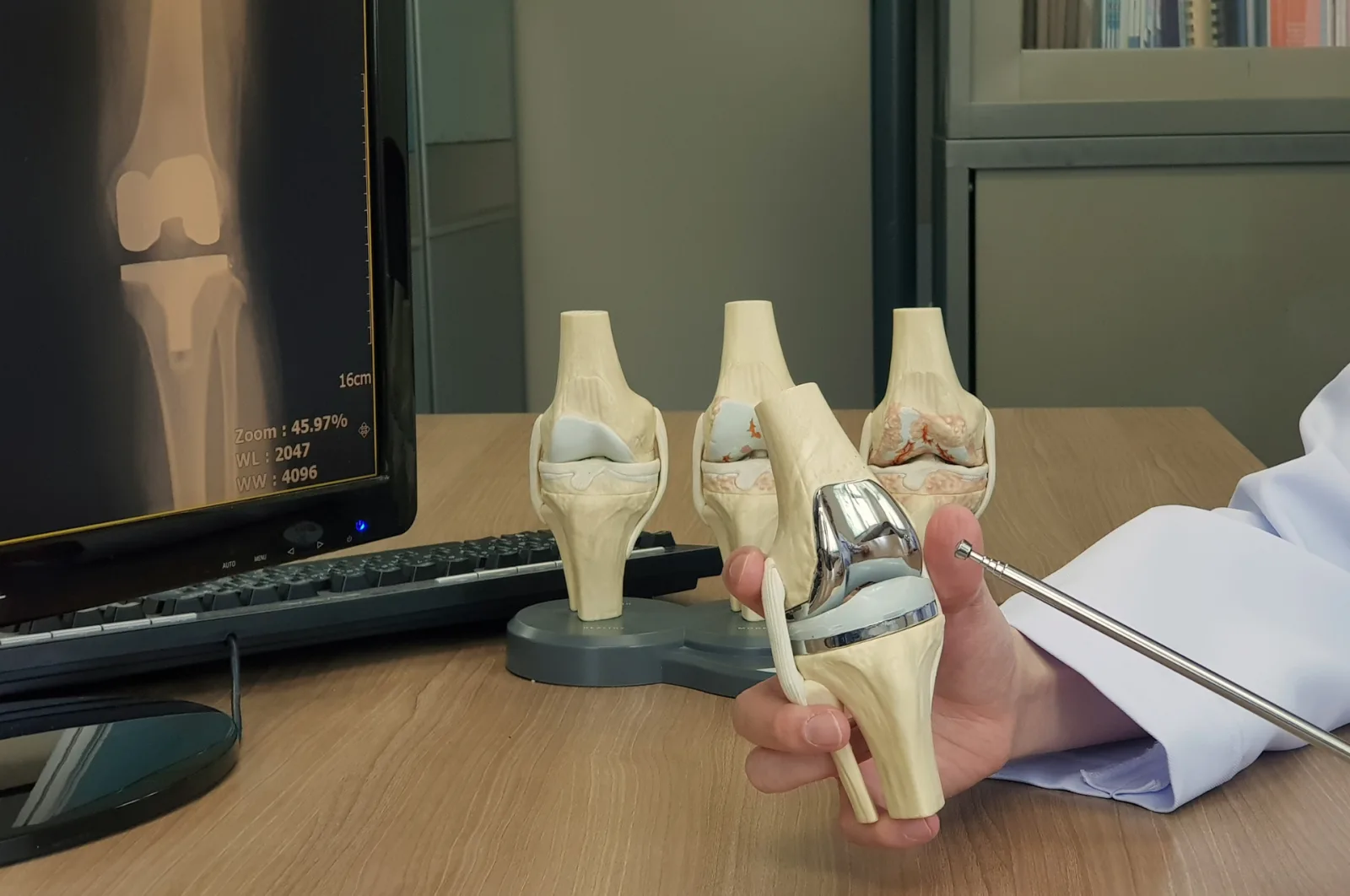
Hip and knee: two different operations, one philosophy
Dr. Morton replaces hips and knees — and treats them as the different problems they are. Hip replacement is among the most reliable operations in modern medicine. His standard is the direct anterior approach, which works between muscles instead of cutting them, lowers dislocation risk, and usually means no hip precautions after surgery.
A knee replacement demands more finesse, because how the knee feels depends on millimeter-level ligament balance. Dr. Morton uses a quad-sparing subvastus approach that never divides the quadriceps tendon, operates without a tourniquet to reduce thigh pain and swelling, and offers partial knee replacement when only one compartment is worn. In both joints the philosophy is the same: protect the soft tissue, position the implant precisely, and let you move immediately.
The Morton protocol: modern from start to finish
Every joint replacement follows the same modern playbook: personalized planning, tissue-sparing surgery, opioid-sparing pain control, and rapid mobilization. Dr. Morton is certified on four robotic platforms — ROSA®, MAKO, CORI, and VELYS — and performed the first robotic-assisted total hip replacement in Hawai‘i. Robotics do not replace the surgeon; they let an experienced surgeon execute the plan for your anatomy with exceptional precision, whether that is a robotic knee replacement or a robotic hip, which he performs on Mako at Hilo Community Surgery Center.
- Personalized planning matched to your anatomy — robotic 3D planning for knees and Mako hips
- Muscle-sparing approaches for hip and knee by default
- Tourniquet-free knee technique and opioid-sparing pain control
- Cementless implants when bone quality allows
- Same-day walking — many patients home within 24 hours
- Lifetime implant surveillance after surgery

When is it time to consider surgery?
It is time to consider joint replacement when hip or knee arthritis limits your daily life despite reasonable non-surgical care — medications, activity changes, physical therapy, or injections. Common signals: pain that wakes you at night, a shrinking walking distance, stairs you now avoid, and activities you have quietly given up.
Joint replacement is elective surgery, and the decision is always yours. Dr. Morton's job is to give you an honest picture of your joint, exhaust the simpler options when they still make sense, and tell you plainly when surgery is likely to help. That conversation starts with an orthopedic consultation, where your X-rays, exam, and goals all get equal weight.
What results can you expect?
Most patients get significant, lasting pain relief and return to the activities that matter to them — walking, golf, hiking, travel, time on the floor with grandkids. Studies report about 98% of total knee replacements still functioning at 10 years and more than 80% at 20 years, and hip replacement has earned its reputation as one of the most successful operations in medicine.
Honesty matters too: a replaced joint is excellent, but it is not a 20-year-old joint. A small percentage of patients have lingering symptoms, and recovery takes commitment to the rapid-recovery protocol and physical therapy. Dr. Morton will set expectations for your specific joint before you ever schedule surgery.
Medically reviewed by Paul N. Morton, MD, FAAOS, FAAHKS — board-certified orthopedic surgeon, fellowship-trained in adult hip & knee reconstruction and orthopedic trauma.
This page is for education only and isn’t a substitute for an exam and personalized advice — schedule a consultation to discuss your situation.