

Buy less than you think — but have it home before surgery
You need far less equipment than the internet suggests. A handful of inexpensive items covers most recoveries, and the right time to get them is before surgery — with same-day joint replacement now the norm, your home needs to be ready the day you leave the operating room. Set up your recovery station, clear walking paths, and test everything while you are still moving well. One island-specific tip: shipping to Hawai‘i often takes longer than mainland delivery estimates suggest, so order at least two weeks before your surgery date.
Two spending rules. First, ask before you buy a walker or crutches: hospitals and insurance often arrange these, and duplicates waste money. Second, skip the exotic gadgets. Continuous passive motion machines are no longer routinely recommended after knee replacement, and expensive recovery devices rarely beat the basics: ice, elevation, walking, and the home program covered in my guide to a speedy recovery after joint replacement. Your discharge instructions always come first.
Everything below is something patients here actually use. As an Amazon Associate, and through the other programs linked on this page, the practice may earn a commission on qualifying purchases at no extra cost to you — that supports keeping resources like this one available. Nothing is recommended for that reason, and none of it replaces the plan you leave the office with.
Jump to: Durable medical equipment · Therapy equipment · Clothing & compression · Surgical dressings · Over-the-counter medications · Surgical nutrition · Fullscript supplements
Durable medical equipment
The bathroom is the highest-risk room in the house during early recovery — hard surfaces, water, tight turns, and a leg that is still waking up. Night trips are the classic setup: you're groggy, the floor is dark, and the medications that manage your pain can also dull your balance. A few inexpensive items take most of that risk off the table, and they matter for every joint replacement patient in the first weeks.
Think of these as fall insurance rather than convenience items. A fall onto a fresh hip or knee replacement can turn a smooth recovery into a fracture or a return trip to the operating room — the cheapest equipment on this page protects against the most expensive complication. Set it all up and rehearse the routine before surgery day.
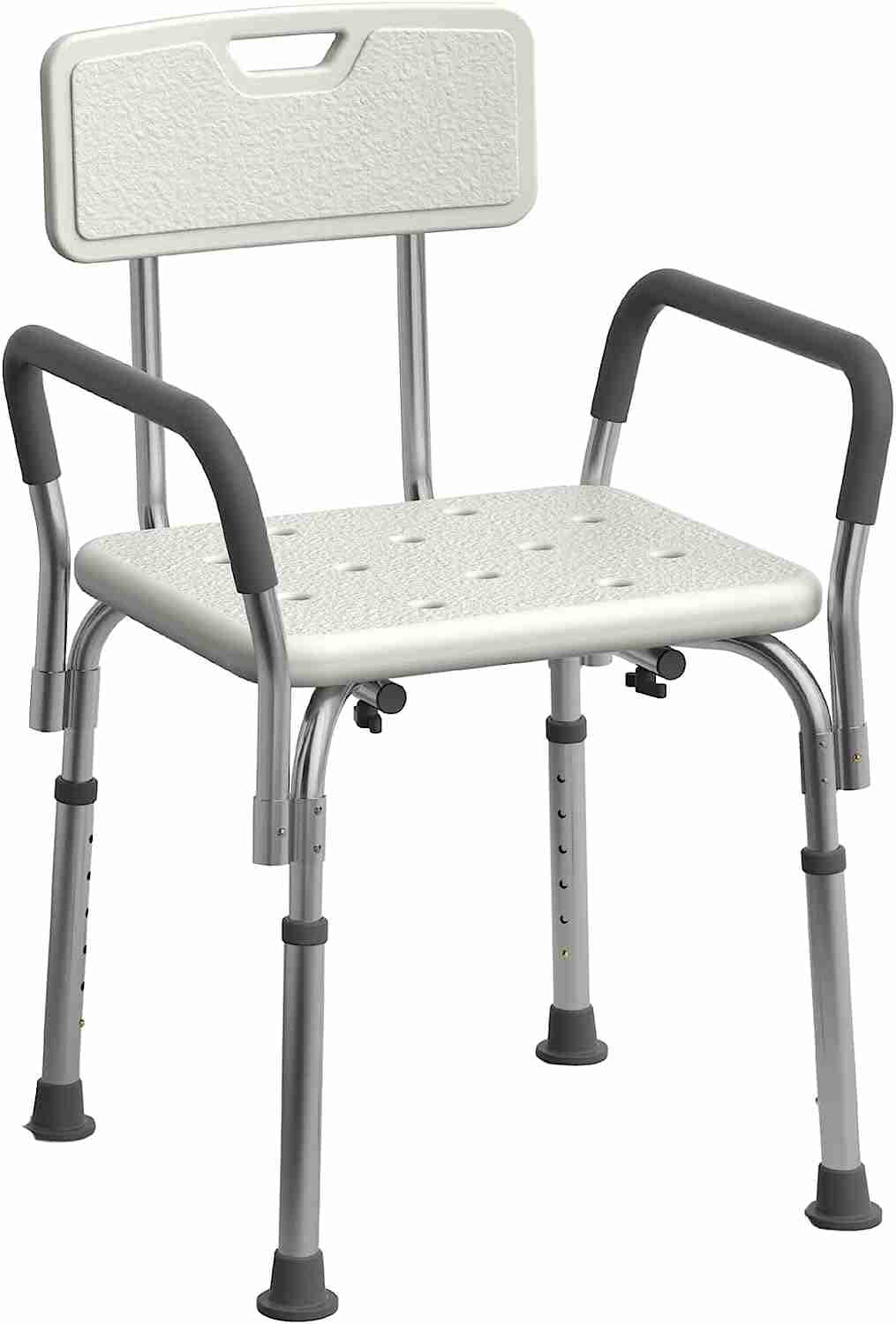
Shower chair
Keeps early showers seated, which is where most bathroom falls are avoided. Steadier, safer, and it makes washing manageable on your own.
Bedside commode
Shortens the night trip to the bathroom, when you are groggy and the floor is dark. Fewer steps means less chance of a fall and less strain on a fresh joint.
Rolling walker
Steadies your walking and shares the load off the operated leg for the first couple of weeks. Ask before you buy: the hospital, the facility where you have surgery, or your insurance often provides one.
Quad cane
The step down from a walker. Four feet on the ground give more balance than a single-point cane while you build confidence. Also available at the office.
Reacher kit
Leg lifter, rotating reacher-grabbers in two lengths, long-handled shoehorn, sock aid, dressing stick and a bath sponge — everything for the jobs below your knees.
Bending to your feet is the hard part early on. A reacher-grabber, a sock aid, a long-handled shoehorn, and a long-handled sponge cover almost everything below your knees, and slip-on shoes or elastic laces remove the fiddliest task of the day. Knee replacement patients tend to use these for a few weeks while deep bending is uncomfortable; most find they retire the gadgets quickly as motion returns.
Hip patients, a nuance worth knowing: with the direct anterior approach Dr. Morton uses, most patients have no formal hip precautions and often need fewer of these aids than older advice suggests. Patients recovering from posterior-approach surgery or revision procedures may be given bending restrictions where these tools become essential. Buy the inexpensive kit if you want the convenience — just do not be surprised if half of it ends up in a drawer by week three.
- Raised toilet seat, ideally with armrests — easier sitting and standing while the joint is sore
- Shower chair or transfer bench, so early showers happen seated
- Handheld shower head — makes seated showering practical and keeps dressings drier
- Non-slip mats inside and outside the shower or tub
- Grab bars where possible — towel racks are not grab bars and will not hold you
- A nightlight for the path from bed to bathroom
Therapy equipment
If you buy one thing, make it good cold therapy. Icing 15–20 minutes at a time, several times a day with a cloth barrier between ice and skin, measurably reduces swelling and pain — which means less medication and easier therapy sessions. It is the closest thing to a free lunch in knee replacement recovery, and it matters for hips too.
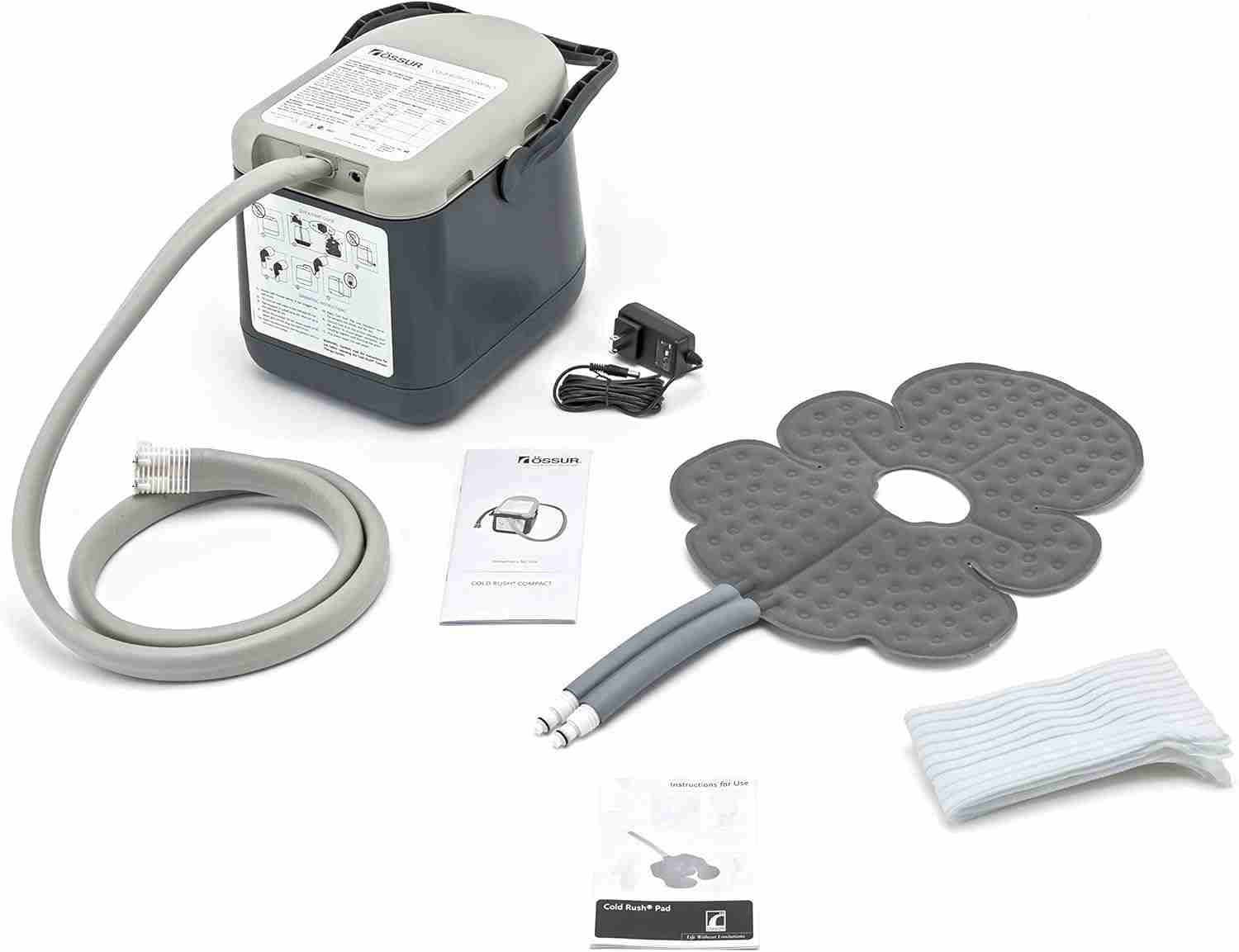
You have two good options. A motorized ice machine (a cold therapy unit) circulates chilled water through a wrap around the joint — convenient, consistent, and easy to use overnight per your surgeon's guidance. Large gel packs do the same job for far less money; buy at least two so one is always in the freezer, and look for packs sized to wrap a knee or lie flat over a hip. Either works. What matters is that you actually use it, on a schedule, like a medication.
Cold therapy system
Circulates chilled water through a wrap around the joint, so icing is consistent and easy to keep up. Straps are available for a hip or a knee.
Reusable ice packs
The affordable way to do the same job. Buy at least two so one is always in the freezer; they keep earning their keep after the first month.
Zero degree knee pillow
A wedge that holds the knee straight with the toes pointing up, letting gravity work on your extension. Ordinary pillows let the leg roll outward and cost you that. Available at the office.
Foam roller
Loosens the muscles around the joint through self-massage and gentle stretching, which makes therapy sessions go better.
Yoga strap
Lets you pull through a controlled stretch without straining, so range of motion comes back steadily.
Swelling drains downhill, so elevation is part of the job description. A firm wedge pillow lets you elevate the whole leg — for knees, the rule is toes above the nose, knee straight. Avoid parking a small pillow just under the knee for hours; keeping the knee bent all night encourages stiffness exactly where you are fighting for extension. Compression socks, if your surgeon prescribes them, help control ankle and calf swelling — wear them as directed rather than by guesswork.
For the walker itself, small accessories earn their keep: a clip-on pouch or tray so you can carry a phone and a water bottle with both hands on the frame, and glide attachments so the walker slides smoothly on the floor rather than catching. Add a sturdy chair with armrests at your recovery station, and you have covered the equipment that does real work in the rapid recovery playbook.
Clothing and compression
Incrediwear sleeves
Semiconductor-embedded fabric that creates cellular vibration to increase blood flow rather than squeezing the leg, so it is more comfortable than traditional compression while helping lymphatic drainage.
Coupon code: PAULMORTON
Thigh-high compression garments
Compression stockings bring down swelling and lower the risk of a blood clot after surgery. Wear them as directed rather than by guesswork.
Tearaway pants
Open down the side so you can dress without twisting a sore leg into position. Small thing, large difference in the first weeks.
Surgical dressings
Your incision leaves the operating room closed under a sterile dressing that stays on and stays dry for at least a week. What follows is for the weeks after that, once the office has told you the wound is ready for it.
Bordered silicone dressing
Sticks gently and comes off without tearing skin, holding the moisture a wound heals best in. Dressing changes hurt far less.
ABD pads
Highly absorbent pads for a larger wound that is still draining, managing fluid without repeated changes.
Ace wraps
Adjustable compression and support over the joint, which keeps swelling down while things settle.
Silicone scar sheets
Once the scabs are gone and nothing is draining, these keep the scar hydrated under a protective barrier and can soften how it finally looks.
Over-the-counter medications — ask first
Some of the most useful recovery items are the ones you should not buy on your own initiative. Lidocaine patches can quiet aching muscles around — never on — a healing incision, but placement and timing matter. Stool softeners are genuinely important, since anesthesia, opioids, and inactivity reliably slow the gut; most patients should start one early, but the choice should match your medication plan. Over-the-counter pain relievers are the foundation of modern pain control, yet acetaminophen has daily limits and anti-inflammatories interact with blood thinners and kidney conditions.
The rule is simple: anything that goes in your body or on your skin gets checked against your discharge plan first. The full home medication playbook — schedules, tapering, and safe disposal — is in medication after surgery. And if surgery is still ahead of you, an orthopedic consultation is where your personal equipment and medication list gets sorted out, item by item.
Acetaminophen (Tylenol)
The well-tolerated backbone of pain control after surgery, taken on a schedule. Mind the daily limit on your discharge plan.
Oral anti-inflammatories (naproxen)
For nonsurgical arthritis care only, not part of your surgery plan. Do not take naproxen while on aspirin after joint replacement. Kidney problems, stomach ulcers, uncontrolled blood pressure or a blood thinner also rule it out. Ask first.
Topical anti-inflammatory
Brings down pain and swelling where you rub it in. Keep it off the incision itself.
Low-dose aspirin
The usual blood-clot prevention after hip and knee replacement. Take what your plan specifies, and do not stop early without asking.
Lidocaine patches
Numb a sore area around the joint. They go near the incision, never on it, and placement is worth confirming with the office.
Docusate
A stool softener, one pill twice a day, started early. Anesthesia, pain medication and sitting still reliably slow the gut.
- Lidocaine patches — for sore muscles near, never on, the incision; confirm placement with your surgeon
- Stool softeners — start early, but match them to your medication plan
- Acetaminophen and anti-inflammatories — follow your discharge schedule and daily limits
- Vitamins and supplements — clear anything new with the office first
- When in doubt, call (808) 439-6201 before you buy
Surgical nutrition
Surgery is a metabolic event, and going into it well fed changes how you come out of it. Two programs cover the weeks on either side; you need one of them, not both. The evidence behind them is on the surgical nutrition page.
ENROUTE™
A surgical nutrition program built for the weeks around an operation. Prepare is a complex-carbohydrate, no-added-sugar formula with electrolytes; Build carries protein, creatine, calcium and vitamin D. Together they protect muscle mass, support wound healing and bone, and help the immune system through surgery.
Mend Joint Replacement
A clinically studied medical food formulated for joint replacement patients, and the alternative to ENROUTE. More on what it does and when to start it on the surgical nutrition page.
Discount code applied at the link: DRMORTON
Clinical CBD softgels
THC-free broad-spectrum hemp in a nanoemulsion softgel, which absorbs better than ordinary oil capsules. Patients use it after surgery for pain and sleep. Clear it with the office first, as with any supplement.
Fullscript: professional-grade supplements, dispensed properly
Amazon covers the hardware of recovery; for supplements, quality control matters more. Dr. Morton dispenses professional-grade supplements through Fullscript, an online dispensary that ships pharmaceutical-grade products from verified manufacturers — so what is on the label is actually in the bottle. Recommendations are individualized at your visit rather than one-size-fits-all, and pair with the whole-food approach on the surgical nutrition page.
Shop Dr. Morton’s Fullscript dispensary (opens in a new tab)
Browse the full dispensary online, or ask at your appointment which products fit your recovery — questions are welcome at (808) 439-6201.
Diosmin
Used to bring down swelling after surgery. It tones the veins and lowers venous pressure, which reduces swelling and inflammation and takes the edge off the discomfort that comes with it.
Wang Q, et al. Efficacy of diosmin in reducing lower-extremity swelling and pain after total knee arthroplasty: a randomized, controlled multicenter trial. JBJS. 2024;106(6):492–500.
Bromelain
A pineapple enzyme with anti-inflammatory and pain-relieving properties. It breaks down the proteins that trap fluid in tissue, so bruising and swelling clear faster.
Vosáhlo J, Salus A, Smolko M, et al. Oral enzyme combination with bromelain, trypsin and the flavonoid rutoside reduces systemic inflammation and pain when used pre- and post-operatively in elective total hip replacement. Ther Adv Musculoskelet Dis. 2023;15.
Ortho multi with 400 mg flax oil
Covers the ground healing depends on: vitamin C for collagen and skin, vitamin D and calcium for bone, and the B vitamins, folate, B12 and iron that keep energy up and help counter the drop in blood count that follows surgery.
Medically reviewed by Paul Norio Morton, MD, FAAOS, FAAHKS. Last reviewed: . This article is for education only and isn’t a substitute for an exam and personalized advice — schedule a consultation to discuss your situation.