
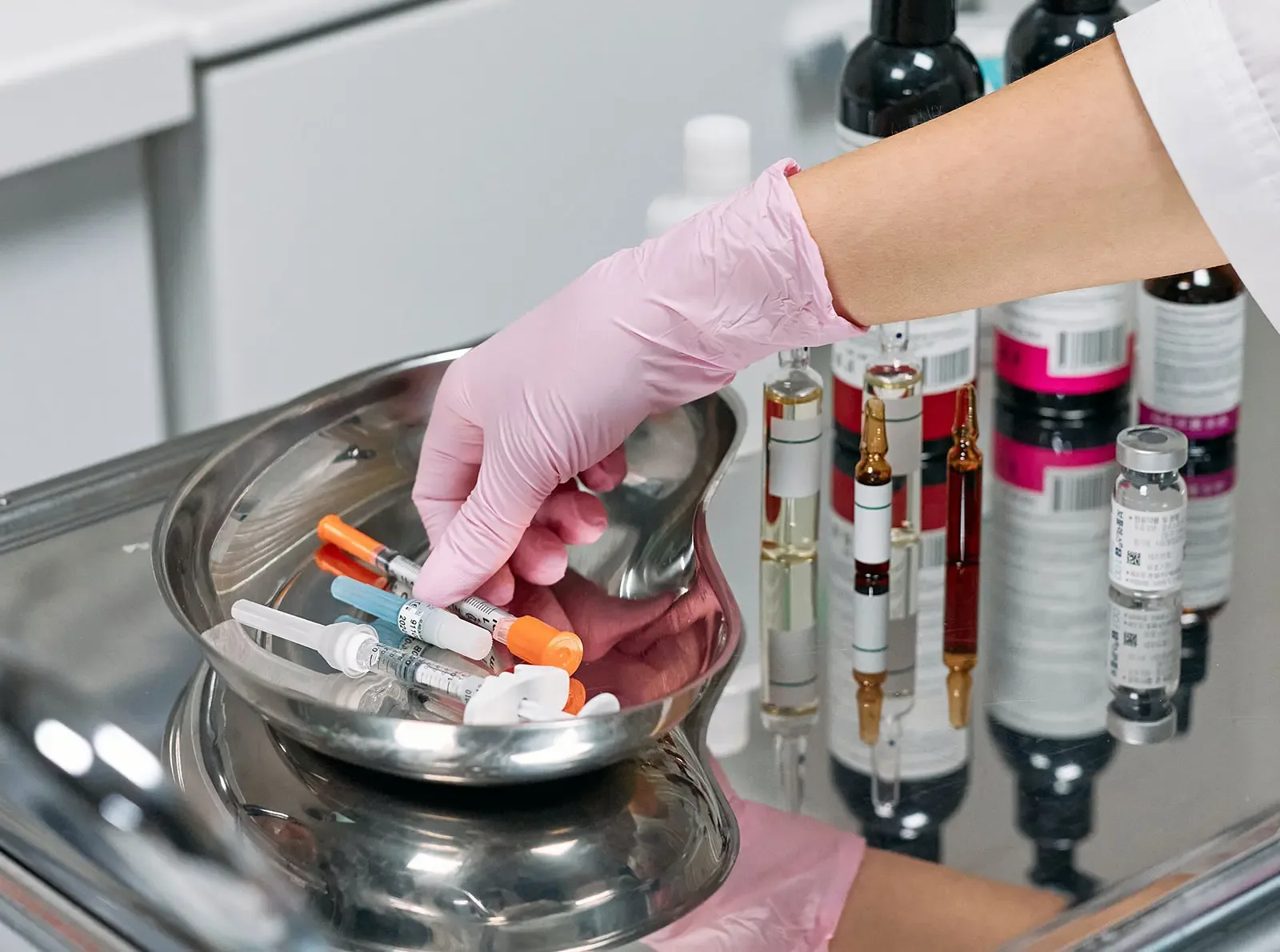
Which joint injection is right for me? — the short answer
It depends on the diagnosis and stage of the joint. Cortisone calms a flare within days and lasts about three months; hyaluronic acid gel lubricates a mild-to-moderate knee over a few weeks and is often covered; PRP works more slowly but often lasts six to nine months in responders; BMAC is reserved for specific jobs. Dr. Morton, a fellowship-trained hip and knee surgeon, diagnoses first and injects under image guidance.
- Minutes, in office — skin prep, local numbing, the injection, a band-aid; most people resume normal activity the same day
- Cortisone — fast relief for a flare; capped at three to four per joint per year to protect cartilage
- Gel — often insurance-covered for knee arthritis; builds over two to three weeks
- Biologics — PRP and BMAC are cash-pay and quoted in writing before you decide
- Where — Pacific Bone & Joint clinics in Honolulu (Ala Moana), West O‘ahu (Kunia), Hilo, and Kona
The injection menu, explained
Joint injections do three different jobs: they diagnose (numbing a specific structure proves whether it's the true pain source), they relieve pain, and they treat the underlying inflammation or lubrication problem. They carry far lower risk than surgery, which is why they sit near the front of nearly every hip and knee arthritis plan. Each option on the menu does a different job:
- Corticosteroid (cortisone) — fast, powerful inflammation control for arthritis flares; relief typically lasts about three months; limited to roughly three to four per joint per year to protect cartilage
- Hyaluronic acid gel — lubricates and cushions arthritic knees; given as a single shot or short series; often insurance-covered
- Toradol (ketorolac) — a steroid-free anti-inflammatory injection; a smart alternative for patients with diabetes because it doesn't raise blood sugar
- PRP — your concentrated platelets and growth factors; relief often lasts six months or longer in the right arthritis and tendon problems
- BMAC — bone marrow concentrate for heavier biologic work
- A2M — enzyme-blocking plasma protein, an emerging cartilage-protection option
- Diagnostic injections — numbing a specific structure (like the SI joint) to prove where pain actually comes from
Cortisone vs gel vs PRP vs BMAC at a glance
The comparison patients ask for most, in one table. The figures are the ones Dr. Morton quotes in clinic; none of these injections regrows cartilage, and the full biologic comparison lives on the orthobiologics hub.
| Injection | What it is | Best for | Onset | Typical duration | Downtime | Usually covered? |
|---|---|---|---|---|---|---|
| Cortisone | Steroid plus a local anesthetic | Calming an arthritis flare quickly; also a diagnostic test | Numbing within minutes; steroid in 2–3 days | About 3 months on average; capped at 3–4 per joint per year | Same-day activity | Usually yes |
| Hyaluronic acid gel | A lubricant the joint makes naturally, given as one shot or a series of 3–5 | Mild–moderate knee arthritis that feels dry and grinding; a steroid-free choice for diabetes | Builds over 2–3 weeks | Several months when it works; evidence is mixed | Easy day; no hard impact for a day or two | Often, for knee arthritis (prior authorization common) |
| Toradol (ketorolac) | A steroid-free anti-inflammatory | Calming a flare when cortisone isn't ideal — e.g. diabetes | Days | Similar role to cortisone for a flare | Same-day activity | Usually yes |
| PRP | Your own platelets and growth factors, concentrated from a blood draw | Mild–moderate knee arthritis, some tendinopathies, select meniscus problems | 2–6 weeks | Often 6–9 months in responders; not everyone responds | Light activity same day; no strenuous exercise for 2–4 weeks | Rarely — cash-pay, quoted before you decide |
| BMAC | Your own bone marrow cells, platelets, and growth factors, concentrated | Early hip AVN with core decompression; selected arthritis when PRP hasn't held | 4–12 weeks | Varies; trials show no advantage over PRP for knee arthritis | Sore harvest site for a few days; light activity within days | Rarely — cash-pay, quoted before you decide |
Cortisone injections: what's actually in the syringe
A steroid injection is really two medicines in one syringe: a local anesthetic — lidocaine, Marcaine, or both — plus the selected corticosteroid. Each half has a job.
The anesthetic works almost immediately and lasts several hours. That window is a built-in diagnostic test: if your pain melts away while the numbing medicine is active, the needle found the true pain generator. The steroid takes two to three days to kick in and provides relief that lasts about three months on average.
How cortisone works
Cortisol is a hormone your body produces naturally under stress — the fight-or-flight response — partly to suppress inflammation. Cortisone is a potent anti-inflammatory that works the same way: it quiets the inflammatory system, and with it the pain signals that inflammation produces.
The cartilage question
Does cortisone wear out cartilage? The data conflict. One imaging study found arthritis progression in about 6% of patients after a steroid injection — but studies like this can't separate cause from coincidence, since arthritic joints often worsen with or without injections. Because the question isn't settled, most physicians — Dr. Morton included — take the balanced path: there is no formal limit on steroid injections, but he keeps them to no more than three to four per joint per year.
Timing if surgery is on the horizon
If joint replacement is coming, the last cortisone shot needs to be timed. Dr. Morton avoids steroid in the joint for about three months before surgery: guidance from the American Academy of Orthopaedic Surgeons and the American Association of Hip and Knee Surgeons associates an intra-articular corticosteroid injection within roughly three months of hip or knee replacement with a higher risk of infection around the new implant. A flare in that window is managed differently — tell the office if surgery is being planned.
Hyaluronic acid (gel) injections
Hyaluronic acid injections — the "gel shots" — act as a lubricant and shock absorber inside the joint, reducing swelling and friction and, with them, pain. The original formulations were derived from rooster comb; synthetic versions now exist for patients with allergies to animal products, and many manufacturers offer them.
Two honest caveats: gel injections are FDA-approved for knee arthritis specifically, and the evidence on how well they work is mixed — some patients get months of meaningful relief, others little. Dr. Morton will tell you which camp your knee is likely to fall in before you commit to a series.
Toradol (ketorolac): the steroid-free alternative
Toradol is an injectable anti-inflammatory that works along a similar pathway to cortisone but contains no steroid. Its biggest advantage: it won't raise blood glucose, which makes it a genuinely good option for patients with diabetes who need an arthritis flare calmed. Research supports its use in knee osteoarthritis and shoulder bursitis, though it remains a less common choice and hasn't been studied in patients who tolerate oral NSAIDs poorly or who have kidney problems.
This isn't secondhand knowledge for Dr. Morton — he co-authored a randomized, double-blind study directly comparing intra-articular corticosteroid with intra-articular ketorolac knee injections, presented at the American Academy of Orthopaedic Surgeons annual meeting in 2019.
PRP, BMAC & A2M — and a straight answer on "stem cells"
Platelet-rich plasma (PRP) concentrates your own platelets and growth factors. Multiple studies show it helps arthritis, with pain improvements that often last six months or longer — and it can also be an alternative for certain tendinopathies. It costs more than cortisone and insurance rarely covers it; Dr. Morton's office performs PRP injections in the clinic and quotes the cost up front. Bone marrow concentrate (BMAC) has its best evidence in early hip avascular necrosis with core decompression; for arthritis, trials show results similar to PRP, so it's used selectively. A2M is an emerging option. Together they round out the orthobiologics tier.
About those "stem cell" ads
You'll see plenty of advertising for stem cell injections as an arthritis cure. Dr. Morton's read of the evidence is blunt: for osteoarthritis, these injections remain experimental. Many studies have been done, most show minimal improvement, and none has demonstrated that stem cells reliably fix orthopedic problems — yet the price tags are often enormous. When Dr. Morton offers a biologic, it comes with honest expectations, not marketing promises.
Where injections work
Knees take most of them. Around the knee, targets include the joint itself, the iliotibial (IT) band, and the pes anserine bursa; cortisone, gel, and Toradol are the usual agents. An arthritic knee joint is commonly injected up to four times a year — once every three months — with minimal risk, for as long as the injections keep earning their keep.
Hips are deeper and unforgiving of blind needles. Targets include the hip joint, the greater trochanteric bursa, and the iliopsoas tendon — and joint or iliopsoas injections require ultrasound or fluoroscopy to confirm accuracy. Guided hip injections also settle the diagnostic question when hip pain could be joint, tendon, or spine. The same quarterly cadence applies.
The SI joint is diagnosed and treated almost entirely with image-guided injections.
Beyond hips and knees: steroid injections are also used for shoulder bursitis, trigger finger, de Quervain's tenosynovitis, carpal tunnel, and small joints of the thumb, foot, and ankle — usually as a one-time shot, because repeated steroid injections around a tendon raise the risk of tendon rupture. Dr. Morton's surgical practice focuses on hips, knees, and the SI joint; for these other areas he'll point you to the right specialist rather than the nearest needle.
How the medicine gets where it belongs
Think of injection delivery as a ladder — each rung adds technology to buy accuracy:
| Method | How it works | When it's the right tool |
|---|---|---|
| Landmark-based | Anatomy guides the needle — at the knee, the kneecap, femur, and tibia map the target | Cortisone into a large, encapsulated joint like the knee, where the drug diffuses throughout the space |
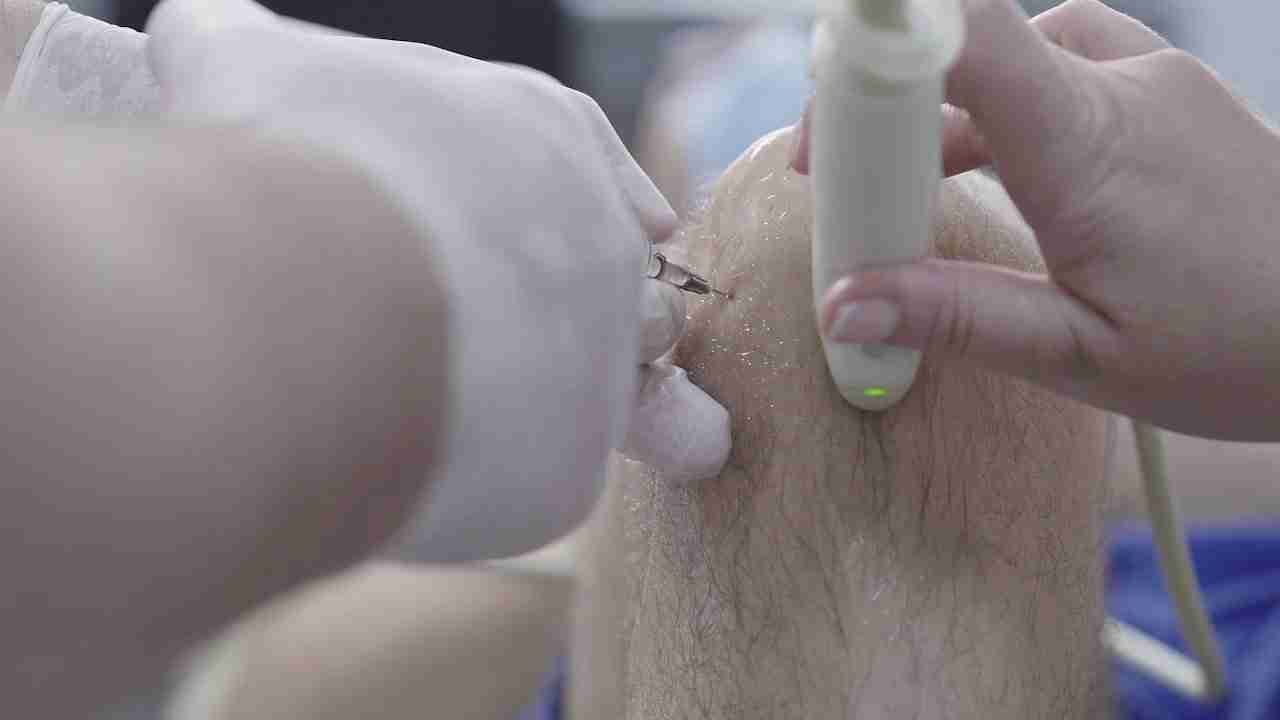
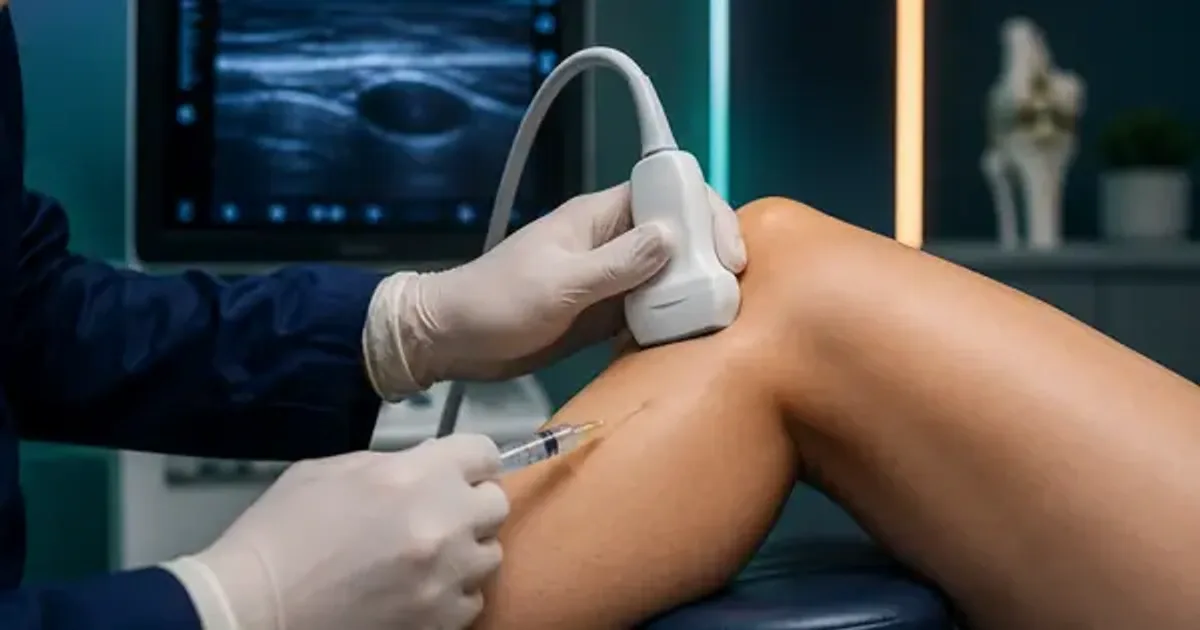
| Ultrasound-guided | Live imaging shows the needle entering the exact structure | Gel, PRP, and other biologics — which can't diffuse through the joint capsule and demand essentially 100% intracapsular accuracy — plus tendon and bursa targets |
| Fluoroscopic (X-ray) | X-ray confirms needle position when soft tissue blocks the view | Hip joint injections, especially in larger patients, and the SI joint |
| CT-guided | 3-D imaging for the rare target nothing else can verify | Select deep or complex injections |
The key distinction: steroid can drift through a big joint space, so a well-placed landmark injection works at the knee. Gel and biologics cannot — if they land outside the capsule, they're wasted. That's why Dr. Morton performs in-office ultrasound-guided injections rather than hoping a blind needle found its mark.
Why placement and judgment beat the drug
Studies consistently show blind injections miss deep targets a meaningful share of the time. Dr. Morton uses image guidance whenever the target demands it, and — more importantly — starts with the diagnosis. An injection is also information: how your joint responds tells us what's really driving pain and shapes everything that follows, from biologic escalation to the honest conversation about whether replacement is approaching. Injections at a surgeon's office aren't a dead end — they're part of one continuous plan that runs from non-surgical care to the operating room.
Aspiration: when a swollen knee needs draining first
For a very swollen knee, the first step may be an aspiration — removing the excess fluid. The process is simple: the knee is numbed, the fluid is withdrawn, and the medication is then placed into the decompressed joint. Much of the relief comes from the decompression itself — a joint under pressure hurts.
The fluid can also answer questions. If gout is suspected, it's examined under a microscope for crystals, which confirm the diagnosis. If infection is a concern, the lab analyzes it for white blood cells — and in that case no injection is given, because steroid in an infected joint makes things worse.
Risks and side effects, plainly stated
Overall, joint injections are considered very safe, with few problems — which is exactly why they sit near the front of most arthritis plans. The risks worth knowing are listed below. Two habits keep them rare: sterile technique with image guidance for deep targets, and an honest count of how many steroid injections a joint has had, because the cumulative dose matters more than any single shot. Prescription blood thinners are not a reason to skip an injection, but tell the office — they are never stopped on your own.
- Infection — extremely rare but potentially serious. Spreading redness and severe, worsening pain after an injection means seek emergency care
- Steroid flare — some patients hurt more the day after a cortisone shot; it typically settles within about 24 hours
- Blood sugar rise — patients with diabetes should monitor glucose and expect elevated readings for roughly three days after cortisone
- Gel reaction — the added fluid volume from a hyaluronic acid injection occasionally causes significant pain in the knee
- Allergic reaction — possible with any agent; synthetic gel formulations avoid the animal-product allergens of older versions
- Tendon weakening — repeated steroid injections into tendon sheaths risk rupture, which is why those are usually one-time shots
Are injections the right rung for you?
Injections are one rung on a ladder that starts with activity modification, strengthening, and weight management, and ends — for some joints — with surgery.
You may be a good candidate if…
- You have hip or knee arthritis with a flare that therapy and oral medication haven't settled
- The diagnosis is uncertain and a numbing injection would prove where the pain actually comes from
- You want to postpone or avoid surgery, or you're not a surgical candidate right now
- You have a bursa or tendon problem — IT band, pes anserine, trochanteric bursitis — that would respond to a targeted shot
It may not be the answer if…
- The joint is bone-on-bone and relief windows keep shrinking — that's the joint telling you it has progressed
- There are signs of infection in the joint; steroid makes an infected joint worse, which is why fluid is tested first
- Joint replacement is scheduled within about three months — cortisone in the joint waits
- A mechanical problem — a locked meniscus tear, instability — needs its own fix
What to expect at your visit
Most injections take minutes. Cortisone may flare briefly before it calms; gel and biologics build over days to weeks. We schedule follow-up to measure the response — because the response is the point.
- Step 1
Diagnosis
Exam and imaging decide which injection, which structure, and whether a joint needs draining first.
- Step 2
Prep and numbing
Skin prep and local anesthetic; ultrasound or X-ray guidance is set up when the target demands it.
- Step 3
The injection
Seconds. Pressure more than pain; a band-aid afterward.
- Step 4
Walk out
Normal activity the same day for most injections, with a short list of do's and don'ts by injection type.
- Step 5
Follow-up
We measure how much it helped and for how long — that answer shapes the next step.
What happens next
Call (808) 439-6201 or book an injection consultation online — cortisone and gel are usually covered; biologics are quoted in writing before you decide. Dr. Morton performs in-office, ultrasound-guided injections at Pacific Bone & Joint in Honolulu (Ala Moana), West O‘ahu (Kunia), Hilo, and Kona, and most new patients are seen within one to two weeks.
What to bring: a photo ID, your insurance card, a list of current medications (including any blood thinner), and any prior X-rays or MRI — if your imaging was taken in Hawai‘i, the office can usually retrieve it electronically, and new standing X-rays can be taken in clinic the same day. Managed-care and Medicaid/Quest plans may need a referral from your primary care physician; the office checks before your visit. When an in-person first visit isn't practical — a neighbor island without a nearby clinic — a telehealth consultation can start the conversation, with the injection itself done in clinic.
Medically reviewed by Paul N. Morton, MD, FAAOS, FAAHKS — board-certified orthopedic surgeon, fellowship-trained in adult hip & knee reconstruction and orthopedic trauma. Last reviewed: .
This page is for education only and isn’t a substitute for an exam and personalized advice — schedule a consultation to discuss your situation.