

Total knee replacement in Honolulu — the short answer
A total knee replacement resurfaces the worn knee joint with a metal-and-polyethylene implant. It is for bone-on-bone arthritis that limits daily life after trying therapy, medication, and injections. Dr. Morton performs every knee with robotic 3D planning, a quad-sparing subvastus approach, no tourniquet, and opioid-sparing anesthesia. Most patients walk the day of surgery, many go home within 24 hours, and most walk comfortably by about three months. Individual results vary.
- Walking: the day of surgery, with a physical therapist
- Going home: same day to one night for most patients
- Driving: about 2–6 weeks on average, only once completely off narcotic pain medication (sooner for a left knee with an automatic)
- Implant lifespan: commonly 20 years or more
- Where: The Queen's Medical Center, Adventist Health Castle, or Hilo Community Surgery Center
Is it time to consider knee replacement?
Knee replacement is worth considering when arthritis pain limits your daily life despite a genuine effort at nonsurgical care — activity changes, anti-inflammatory medication, physical therapy, and injections. The signs are familiar: pain that wakes you at night, stairs you quietly avoid, a knee that swells after every outing, and hikes, rounds of golf, and beach walks you have given up without quite admitting it. When standing X-rays show the cartilage worn away — the "bone-on-bone" arthritis where nonsurgical treatment tends to stop working — and your life is organized around your knee, replacement deserves a serious conversation.
Surgery is never the first step. Dr. Morton walks every patient through the alternatives to knee replacement first, and X-rays are taken in the clinic at the same visit, so you leave with a diagnosis rather than another appointment. But once the joint surface is truly worn out, waiting rarely makes the operation easier or the result better. Stiffness and muscle loss accumulate, and they are avoidable — there is no prize for holding out until you can barely walk. Age by itself settles nothing in either direction: candidacy is decided on health and goals, not birthdays, and implants now last long enough that younger patients are treated far more confidently than a generation ago.
Not arthritis? Pain from a torn ACL, a meniscus tear, or a focal cartilage defect in an otherwise healthy knee is treated very differently — with repair, reconstruction, or cartilage restoration, not replacement. Younger, active patients with knee pain should start with a diagnosis, not an assumption; the joint preservation side of the practice exists for exactly that knee.
“Dr. Morton gave me my life back. I love the attention to detail and overall care I received from Dr. Morton and his team!” — Verified patient
- You may be a candidate if standing X-rays show bone-on-bone arthritis and you have genuinely tried nonsurgical care
- You may be a candidate if pain limits daily activities, work, sleep, or the people and pastimes you care about
- You may be a candidate if your medical conditions are well controlled — age alone settles nothing
- It may be too soon if your arthritis is mild on X-ray, or you have not yet tried therapy, medication, or injections
- It may be the wrong operation if the pain is coming from a ligament, meniscus, or cartilage injury rather than worn-out joint surface
What a total knee replacement actually replaces
A total knee replacement resurfaces the worn joint rather than removing it. The damaged cartilage and a thin layer of bone are removed from the end of the thigh bone (femur) and the top of the shin bone (tibia), and precisely shaped metal components are fixed to each. Between them sits a highly engineered polyethylene bearing — the smooth, durable cushion your worn cartilage used to provide. The underside of the kneecap is usually resurfaced with a small polyethylene button. Your own ligaments, tendons, and muscles keep doing their jobs around the new surfaces; the grinding is gone because the ground-down surfaces are gone.
The knee has three compartments — the inner (medial), the outer (lateral), and the patellofemoral compartment behind the kneecap — and arthritis can wear out one of them or all of them. That anatomy drives the first big decision in knee replacement, covered next: whether your knee needs the whole joint resurfaced, or only the part that is actually worn.
One operation, a deliberately stacked protocol
Ask Dr. Morton which techniques he recommends and the answer is the same for nearly every knee: the ones he uses every week, together. Most surgeons adopt one or two modern advances. Dr. Morton stacks them deliberately, because each one removes a different source of pain, blood loss, or delayed recovery — and the effects compound. The robot makes the plan precise, the subvastus approach spares the muscle that powers your recovery, skipping the tourniquet spares the thigh, the anesthesia protocol keeps opioids in a supporting role, and the rapid-recovery program turns all of it into a same-day walk and, for many patients, their own bed that night.
The sections below tell the story choice by choice, with a deep-dive page on each if you want the full case.
- Robotic 3D planning and verification on every knee — certified on ROSA®, Mako, CORI, and VELYS
- Personalized alignment — the implant fitted to your anatomy, not a textbook average
- Subvastus approach — the quadriceps tendon is never divided
- Tourniquet-free technique — no thigh cuff, less swelling and thigh pain
- Opioid-sparing multimodal anesthesia, including iovera° cryoneurolysis before surgery
- Cementless fixation where bone quality allows
- Rapid-recovery protocol with same-day discharge for eligible patients
Partial or total: matching the operation to the wear
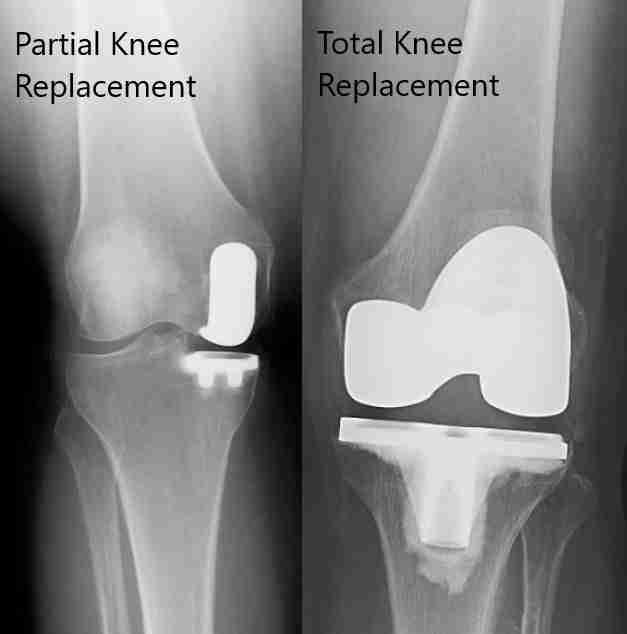
Before any technique question comes the operation question. When arthritis is confined to a single compartment, a partial knee replacement resurfaces only the worn side and preserves everything else — both cruciate ligaments, the healthy cartilage, the bone. It recovers faster and tends to feel more natural, at the cost of a somewhat higher chance of needing another operation someday if arthritis spreads. A total knee replacement resurfaces the whole joint: a bigger operation with a decades-long track record, and one that cannot be outflanked by arthritis in a compartment that was left behind.
Which one is right is not a matter of preference — it is a matter of anatomy. A good partial candidate has wear limited to one compartment, an intact ACL, a knee that still straightens well, and a mild, correctable deformity. Standing X-rays, and sometimes an MRI, map exactly where the cartilage is gone. Dr. Morton performs both operations, so the recommendation follows your knee rather than the limits of a surgeon's repertoire — and he will show you your images and explain which your anatomy favors.
Deep dive: partial vs. total knee replacement — a straight comparison →
Why robotic: precision measured in fractions of a degree
Knee replacement is one of the most successful operations in medicine, yet about 20% of patients remain dissatisfied with some aspect of a traditionally performed knee — and in a published review of 788 consecutive total knees performed in Honolulu with conventional instruments (Andrews et al., The Journal of Arthroplasty, 2019), a neutral mechanical axis was achieved in 86% of patients — roughly one in seven fell outside the ±3° target even in experienced hands. Across the wider literature, a meta-analysis of 29 studies (Mason et al., The Journal of Arthroplasty, 2007) found mechanical-axis malalignment of more than 3° in about 32% of conventional knee replacements versus 9% with computer assistance. Those are the numbers robotic assistance exists to fix, and they are why Dr. Morton uses it on every knee — not just the difficult ones. Patients nicknamed him The Robot Doc; he was the first surgeon in Hawai‘i fellowship-trained in robotic joint replacement and is certified on all four major platforms — ROSA®, Mako, CORI, and VELYS. He operates primarily with ROSA at The Queen's Medical Center and with CORI at Adventist Health Castle on O‘ahu, and with Mako at Hilo Community Surgery Center.
How the robot works in the operating room
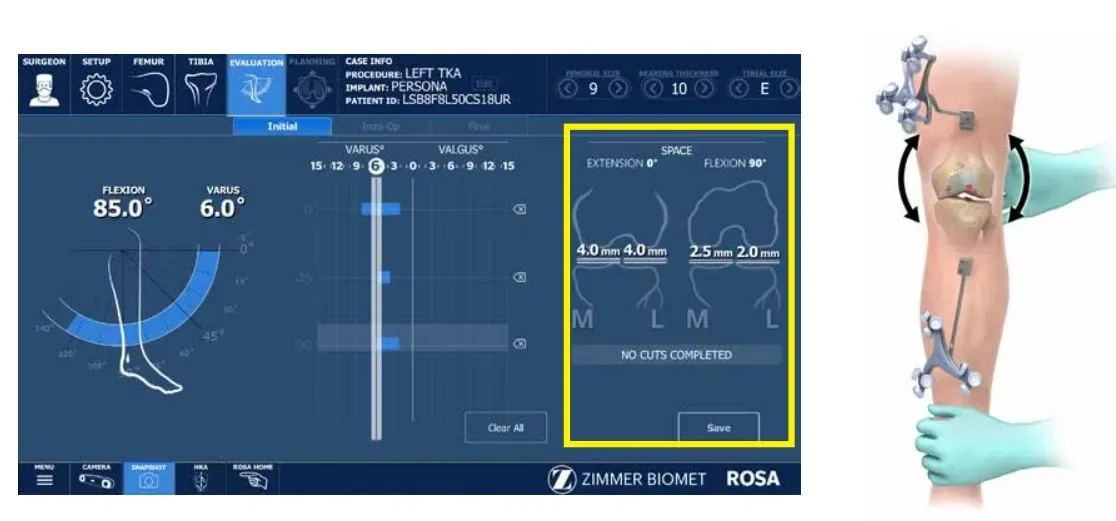
The robot never cuts on its own; Dr. Morton performs every step. At The Queen's Medical Center he operates primarily with ROSA®, which builds a personalized 3D model of your knee from standard X-rays taken with calibration markers — no CT scan, no extra radiation — so implant size, position, and alignment are planned before the first incision. At Adventist Health Castle he uses CORI, which maps your knee and builds the plan in the operating room; at Hilo Community Surgery Center, Mako, which plans from a CT scan taken before surgery. Whichever robot is used, the plan is set before any bone is cut. In the operating room the robot tracks your bones in real time, keeps each cut on the plan within fractions of a degree, and measures something the human eye cannot: how your ligaments tension and balance through the full range of motion. That lets him fine-tune the implant to your ligaments instead of stretching your knee to fit a one-size-fits-all jig. The precision has a visible payoff too — a 4–6 inch incision instead of the traditional 10–12, with far fewer soft-tissue releases along the way.
Deep dive: robotic, minimally invasive knee replacement — a smaller incision and a smarter plan →
Personalized alignment: fitted to your knee, not a textbook average
For decades, every knee replacement was aligned to the same standardized mechanical target, regardless of the leg it went into. It worked — but no two legs are aligned identically, and forcing every knee to one neutral target can leave a joint that looks perfect on X-ray yet never quite feels like the patient's own. Personalized alignment turns that around: using the 3D model built before surgery, the implant is positioned to respect your natural leg alignment, your ligament balance, and your soft-tissue envelope.
The benefits compound with everything else in the protocol. An implant aligned to your anatomy spreads load more evenly — a meaningful factor in long-term wear — moves through a more natural range of motion, and puts less strain on the ligaments the robot just finished measuring. This is exactly the kind of surgery that depends on the tools and the surgeon's fluency with them, which is why it pairs with robotic execution on every case rather than being reserved as an upgrade.
Deep dive: personalized alignment in knee replacement — what it is and why it matters →
Why subvastus: the quad is never cut
The road into the joint decides how the recovery starts. In a standard (medial parapatellar) knee replacement, the surgeon splits the quadriceps tendon to reach the joint — and that incision through the extensor mechanism is one of the main reasons early recovery hurts and quad strength takes months to return. The subvastus approach reaches the same joint by lifting the vastus medialis muscle and sliding underneath it. The quadriceps tendon is never divided. Your knee still gets a complete, precisely aligned replacement — but the engine that straightens it is working from day one.
The difference shows up exactly where momentum matters most: subvastus patients typically demonstrate earlier straight-leg raises, need less pain medication, and regain independent walking sooner than with quad-splitting approaches. It is also what makes same-day discharge realistic rather than aspirational — you can stand safely within hours because the muscle you stand with was never cut. Very muscular or very stiff knees, significant deformity, or prior surgery occasionally make another exposure the safer choice; when that is true, Dr. Morton says so, because the approach is a means to an end — a knee that works, for decades.
Deep dive: the subvastus approach — knee replacement that spares your quad →

Why no tourniquet: sparing the thigh you recover with
Most knee replacements are still performed with a pressurized cuff squeezing the upper thigh for the entire operation — often an hour or more. It gives the surgeon a bloodless field, but it does its job by compressing the muscle, nerves, and vessels beneath it, and the muscle taking the worst of it is the quadriceps — the exact muscle your recovery depends on. Patients feel the cost afterward as deep thigh soreness, extra swelling, and a quad that is slow to fire.
Dr. Morton performs knee replacement tourniquet-free as his standard technique, not as a special request. Bleeding is controlled at every step instead of postponed: regional anesthesia keeps blood pressure low and steady, vessels are sealed as the surgery proceeds, and tranexamic acid — now standard in modern joint replacement — keeps total blood loss low. Studies report overall blood loss is similar with or without the cuff, and transfusion is rare either way. What changes is the recovery: a thigh that is sore from surgery rather than bruised from compression, a quadriceps that activates sooner, and early milestones — the straight-leg raise, confident walker steps, weaning to a cane — that tend to arrive sooner too. For patients with peripheral vascular disease, prior stents or bypass, or a history of blood clots, skipping the cuff is not just more comfortable; it may be the safer plan.
Deep dive: knee replacement without a tourniquet — less pain where you least expect it →
The pain plan: opioid-sparing by design — including freezing nerves before surgery
The best way to fight surgical pain is to create less of it. Everything above — the smaller quad-sparing exposure, the absent tourniquet, the precise robotic cuts that spare soft tissue — is pain control with a scalpel. What remains is managed with layers instead of a bottle of narcotics: regional anesthesia for the operation itself, targeted nerve blocks, long-acting local anesthetic infiltrated around the joint, and scheduled non-opioid medication — acetaminophen and anti-inflammatories on the clock, not as afterthoughts. A small opioid supply exists as rescue, not backbone; many patients barely open it.
For knee replacement, Dr. Morton adds a step most practices skip: iovera° cryoneurolysis before surgery. A handheld device precisely freezes the sensory nerves around the knee — the ones that carry pain but not movement signals — pausing their ability to transmit pain while they safely regenerate over the following months. Patients arrive at surgery with the pain pathway already quieted, and studies suggest they need less opioid medication through recovery. No drugs, no permanent nerve damage; manufacturer trial data show relief lasting up to about 90 days, and some patients report longer. Patients who fear opioids — or must avoid them — should ask about this specifically.
Deep dives: opioid-sparing surgery — the layered protocol → and iovera° — pressing pause on knee pain →
The implant: cementless where bone allows
Fixation is personalized, not standardized. A cemented knee bonds the implant with acrylic bone cement — the long-established gold standard, with decades of registry data behind it. A cementless knee is press-fit with porous titanium surfaces that mimic natural bone, and over the following weeks your own bone grows directly into the implant — a living bond that remodels and renews itself for as long as you own the knee, with no cement mantle to crack or debond over time. Cementless fixation demands good bone, so Dr. Morton assesses yours on X-ray beforehand and makes the final check in the operating room: if the bone is not strong enough for a rock-solid press-fit, he cements the implant instead. You consent to both, and your knee gets whichever fixation your bone actually needs — and precise robotic bone cuts matter even more without cement to fill gaps, which is one more reason the robot is on every case. Cementless components are stable for full weight-bearing immediately.
A sensor-equipped smart knee implant is also available for select patients who want their recovery measured rather than guessed. Dr. Morton offers it only when he is using Zimmer Biomet implants, and he will tell you whether it fits your case.
Deep dive: cementless knee replacement — the pros, the cons, and who it fits →
Recovery: walking in hours, home in a day, and a timeline you can plan around
All of the choices above converge on the first afternoon: most patients stand and walk with a physical therapist within hours of surgery — not as a stunt, but as medicine. Early walking pumps out swelling, is one of the best defenses against blood clots, and tells your nervous system the joint is safe to use. Healthy, motivated patients with support at home often qualify for the same-day knee replacement program and are home — safely, against defined milestones, not a timer — within 24 hours through his outpatient joint replacement pathway; others stay a single night. The rapid-recovery protocol actually starts weeks earlier, with prehab strengthening, medical optimization, and education, so the day-of-surgery walk is a plan you have rehearsed rather than a surprise.
From there the arc is predictable, and it is worth knowing before surgery so week two does not surprise you. The steps below are a typical course — a guide, not a limit — and yours depends on your health, your knee, and your rehab.
- Day 0
Stand and walk
Within hours of surgery a physical therapist has most patients standing, then walking with a walker.
- Within 24 hours
Home
Eligible patients go home the same day, discharged against safety milestones rather than a timer; others stay one night.
- Weeks 1–2
Swelling and straightening
Ice, elevation, short frequent walks, and full knee extension every day; most trade the walker for a cane in this window.
- Weeks 2–6
Cane, stairs, driving
Driving returns at about two to six weeks on average once completely off narcotic pain medication (sooner for a left knee with an automatic); sedentary work around six weeks.
- 3 months
Walking comfortably
Back to low-impact activities — walking, cycling, swimming, golf — as strength returns.
- 1 year
Full recovery
Strength, endurance, and trust in the knee keep improving well past a year.
Milestones, red flags, and clot prevention
| Milestone | Typical timing |
|---|---|
| First walk with a physical therapist | Day of surgery |
| Home | Same day to one night for most |
| Physical therapy begins | Day 1–2, at home or in clinic |
| Walker to cane | 1–2 weeks |
| Driving (completely off narcotics, strong brake) | About 2–6 weeks on average; sooner for a left knee with an automatic |
| Sedentary work | About 6 weeks |
| Pool and ocean (incision healed and cleared) | Week 6 |
| Walking comfortably, low-impact activity | About 3 months |
| Strength, endurance, and trust | 12 months and beyond |
Two things surprise patients most: swelling, which comes and goes for months and is managed with elevation, ice, and pacing rather than alarm; and fatigue in the early weeks, because the body is healing a major operation even on days the knee feels good. Both are normal, and both pass. Blood-clot prevention starts on day one — early walking, ankle pumps, and for most patients a daily aspirin for the first month; the plan is individualized, and some higher-risk patients go home on a prescription blood thinner instead. Physical therapy does the heavy lifting — available through PB&J Physical Therapy, which Dr. Morton founded, at his Honolulu and Kunia locations — and the full playbook lives in the knee replacement recovery guide.
Being a few weeks ahead of or behind this timeline means little; the trend is what matters. Call the office at (808) 439-6201 the same day if you notice any of the following:
- Fever, or spreading redness, warmth with drainage, or an incision that opens
- New calf pain or swelling that does not settle with elevation
- Sudden shortness of breath or chest pain — call 911 first
- Pain that worsens instead of improving week over week, or a knee that will not straighten
- A fall onto the new knee, or a sudden change in how it feels or moves
How long will your new knee last — and what will it let you do?
Modern knee replacements commonly last 20 years or more. Long-term studies report that about 98% of total knees are still functioning at 10 years and more than 80% at 20 years. The named numbers behind claims like these are reassuring: a population study of more than 54,000 knee replacements (Bayliss et al., The Lancet, 2017) found about 96% still in place at 10 years and roughly 90% at 20 years, and a meta-analysis pooling national joint registries (Evans et al., The Lancet, 2019) found roughly 82% of total knee replacements still going at 25 years — which is why age alone rarely rules surgery in or out. Longevity depends on alignment, fixation, bearing wear, and follow-through: the first three are exactly the variables robotic planning, personalized alignment, and bone-matched fixation control, and the fourth is why every patient enters Dr. Morton's implant surveillance program — periodic check-ins and X-rays that confirm the implant stays solid for decades and catch the rare problem while it is still small and simple to fix.
A well-done knee replacement also tolerates real life. Walking, swimming, cycling, golf, doubles tennis, and hiking are all realistic goals — most patients return to the low-impact activities they care about as strength comes back. Running, jogging, jumping, and other high-impact sports get an individualized conversation, because pounding accelerates wear on the polyethylene bearing: walk far, golf often, ride, swim, dance — just don't pound. The numbers behind all of this live in the implant durability guide and the knee replacement success rate page.
The risks, stated plainly
Total knee replacement has a high success rate — most patients experience a dramatic reduction in pain and a significant improvement in everyday function. It is still major surgery, and informed patients make better decisions. The possible complications include:
- Blood clots — deep vein thrombosis or pulmonary embolism; early walking is a primary defense
- Infection — one of the more severe complications; can require further surgery
- Blood loss — occasionally enough to require a transfusion, made rare by tourniquet-free hemostasis and tranexamic acid
- Stiffness — a knee that fights to regain its bend; early motion and therapy are the countermeasures
- Implant loosening or wear — sometimes requiring revision surgery years later
- Fracture — the implant changes how stress distributes across the bone
- Lingering dissatisfaction — studies report up to 20% of patients remain unhappy with some aspect of a traditionally performed knee; imbalance and malalignment are the usual suspects, and they are precisely what robotic balance data targets
- Nerve or blood-vessel injury — rare, but potentially serious
Much of Dr. Morton's protocol exists specifically to shrink this list: robotic guidance makes cuts safer and more accurate, the tourniquet-free technique reduces vessel and muscle trauma, the smaller quad-sparing exposure lowers soft-tissue injury, and day-of-surgery walking defends against clots. Bring your questions about any of these risks to your consultation — that conversation is part of the operation, not an afterthought.
Where it happens — and how to start
Dr. Morton — founder of Pacific Bone & Joint and one of the few fellowship-trained hip and knee reconstruction surgeons in Hawai‘i — performs knee replacement at The Queen's Medical Center — which holds Advanced Certification for total hip and knee replacement from The Joint Commission — at Adventist Health Castle, and at Hilo Community Surgery Center, which brings Mako robotics to the Big Island. The venue is matched to your health and your insurance; at Queen's Dr. Morton operates primarily with ROSA, at Castle with CORI, and in Hilo with Mako.
The next step is an orthopedic consultation at any of Dr. Morton's four Pacific Bone & Joint clinics — Honolulu (Ala Moana), West O‘ahu (Kunia), Hilo, or Kona — or call (808) 439-6201. Most new patients are seen within one to two weeks. Bring a photo ID, your insurance card, a list of current medications, and any prior imaging or operative reports; if your X-rays were taken in Hawai‘i, the office can usually retrieve them electronically, and new standing X-rays are taken in the clinic at the same visit. Managed-care and Medicaid/Quest plans may need a referral from your primary care physician — the office checks before your visit. When an in-person visit isn't practical — a neighbor island without a nearby clinic, or a patient traveling from across the Pacific — a telehealth visit with existing X-rays can start the process. You will leave with a diagnosis, honest options, and a plan, whether or not that plan includes surgery — and the destination joint replacement program plans surgery, therapy and follow-up around one trip for fly-in patients, with travel and lodging coordination available if you would like it arranged. Still deciding? Read what his patients say in their reviews.
Medically reviewed by Paul N. Morton, MD, FAAOS, FAAHKS — board-certified orthopedic surgeon, fellowship-trained in adult hip & knee reconstruction and orthopedic trauma. Last reviewed: .
This page is for education only and isn’t a substitute for an exam and personalized advice — schedule a consultation to discuss your situation.