
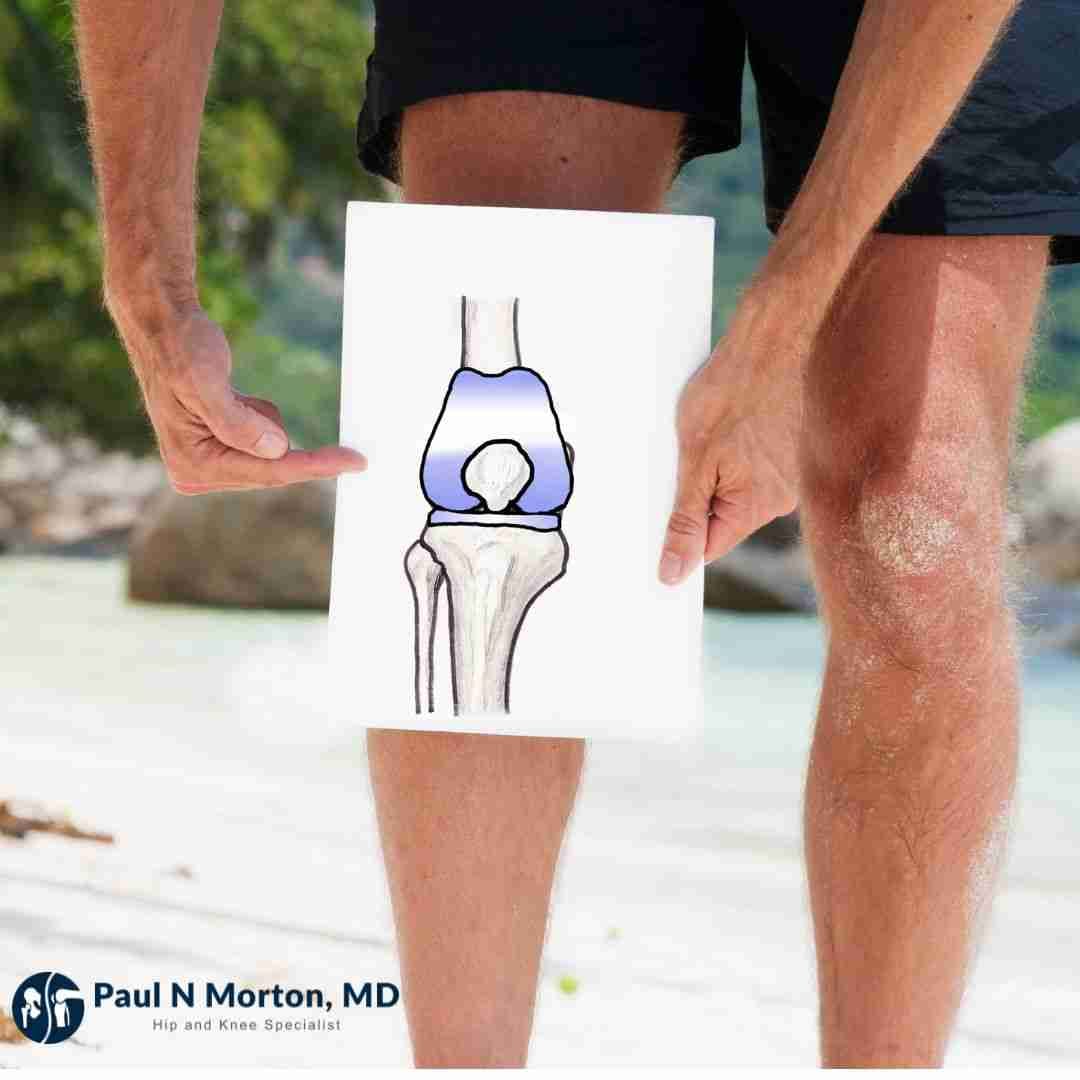
The short answer: age matters, but it isn't the whole answer
No single age rules knee replacement in or out. Age matters because a younger patient will put more years and more miles on the implant — but the severity of the arthritis, your overall health, and the life you want to lead weigh just as heavily. Knee replacements in younger patients are rising every year, and for the right knee, less radical options such as a partial or patellofemoral replacement can preserve your future. Dr. Morton answers the question in Honolulu with an exam and standing X-rays, not a birthday.
- Age is a factor, not a cutoff: candidacy is decided on the joint, your health, and your goals
- The real risk of going young: outliving the implant and needing a revision
- The options: partial, patellofemoral, or total knee replacement — matched to where the wear is
- What changed: robotic positioning and more wear-resistant polyethylene
- Before any of it: a genuine try at nonsurgical care
Not all knee replacements are the same
One reason the age question has no single answer is that "knee replacement" is really three different operations, and the distinction matters most for younger patients.
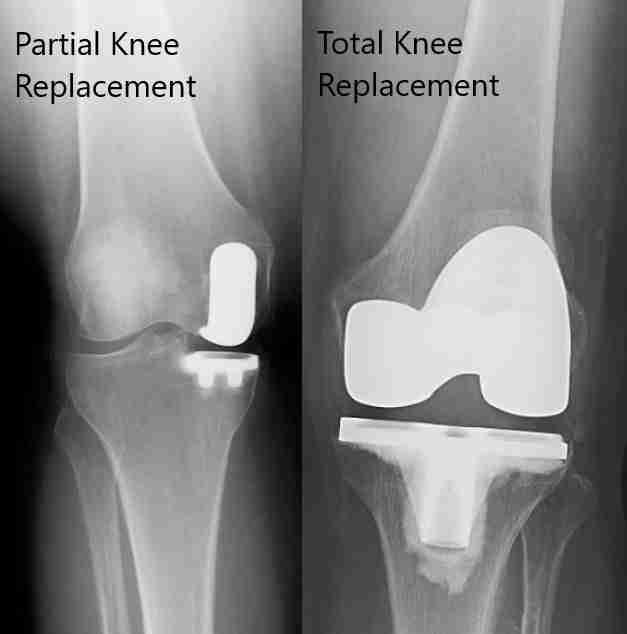
- Partial knee replacement (PKR). Only one compartment of the knee is resurfaced, leaving the rest of the joint untouched. It is a less radical procedure with a faster recovery — and it preserves your future: when a partial eventually wears out years later, you still retain the option of a total knee replacement. Outcomes are extremely positive across all age groups, especially when a specialist who performs them regularly does your PKR.
- Patellofemoral replacement. Only the under-surface of the kneecap and the groove at the front of the thigh bone are resurfaced. It is less invasive than a total knee replacement and is often well suited to younger patients whose arthritis is confined to the kneecap compartment.
- Total knee replacement (TKR). All compartments of the knee are resurfaced. It is the definitive answer for a knee that is worn throughout — but it comes with an honest asymmetry: the older you are, the happier you are likely to be with your new knee, while the younger you are, the more you will ask of the implant, which can mean faster wear.
For a deeper comparison of the first and third options, see partial versus total knee replacement.
The real risk of going too young: outliving the implant
The primary risk of a knee replacement at a young age is simple arithmetic: the implant may wear out while you still have decades of living to do. No implant is indestructible, and the more active you are, the faster it is likely to wear.
When a total knee wears out, the answer is revision surgery — a major overhaul of the joint. Revision is a well-established operation, but the results may not be as good as the original implant's. That is exactly why the least radical operation that solves the problem deserves serious consideration in a younger knee, and why Dr. Morton keeps every implant he places under periodic X-ray surveillance — so wear is caught while it is still a conversation, not a crisis.
How long do today's implants actually last?
The longevity of knee implants has improved significantly over the past couple of decades, and a modern implant is likely to last many years. But the honest answer is a range, not a single number. How long your implant lasts depends on several factors:
- Your age at the time of surgery
- Your body weight
- Your activity level
- Your overall health
For a closer look at the evidence behind implant lifespan, see the durability of knee replacement implants.
The technology that changed the math
Two advances in particular have made knee replacement a more realistic option for younger patients than it was a generation ago.
Robotic-assisted implant positioning. The accuracy of implant positioning is one of the most critical factors in both the success of the surgery and the longevity of the implant. Robotic technology has been a genuine game-changer here: it enhances precision, reduces the risk of human error, and early data on robotic-assisted partial (unicompartmental) knee replacement show fewer short-term revisions than conventional technique. Accurate positioning is the main thing a partial knee needs in order to last, and that is what the robot delivers today — the decades-long survivorship numbers for robotic partials are still being collected, because the implants have not been in place that long. Dr. Morton is certified on all four major surgical robots — ROSA, Mako, CORI, and VELYS — and robotic joint replacement is available across his surgery venues: ROSA, primarily, at The Queen's Medical Center and CORI at Adventist Health Castle on O‘ahu, and the Mako robot at Hilo Community Surgery Center on the Big Island.
Highly cross-linked polyethylene (HXLPE). The plastic spacer that sits between the metal components of a knee implant used to be its weak point. HXLPE is far more durable and wear-resistant than conventional polyethylene, and its use has been associated with lower rates of osteolysis — bone loss triggered by wear debris — and a reduced need for revision surgery due to implant wear. Those benefits are best established in hip replacement; in knees the evidence is still accumulating, but the wear mechanisms are the same ones that once made surgeons hesitate to operate on younger, more active patients. Fixation can be personalized too: when bone quality allows, a cementless knee lets your own bone grow into the implant rather than relying on cement that can only degrade over time.

Plan for the possibility of a revision
The most useful mindset for a younger patient is not "this implant will last forever" but "this implant will probably last a very long time, and I have a plan if it doesn't." The numbers make the point. In a population study of more than 54,000 knee replacements (Bayliss et al., The Lancet, 2017), about 96% were still in place at 10 years and roughly 90% at 20 years. But the lifetime risk of needing a revision depended heavily on age at surgery: about 5% for patients over 70, rising to as high as 35% for men in their early 50s (and roughly 15 percentage points lower for women of the same age). Younger patients live longer with the implant and ask more of it, and a revision is a bigger operation than the original.
That is why, in a younger knee, Dr. Morton favors the least radical operation that solves the problem, positions it with robotic precision, chooses materials and fixation for the long haul, and enrolls every implant in periodic X-ray surveillance. None of that guarantees a lifetime — it stacks the odds and makes sure a worn implant is caught while the fix is still simple. The evidence on lifespan is laid out in the implant durability guide.
- You may be a candidate even if you are young if standing X-rays show bone-on-bone arthritis, you have genuinely tried nonsurgical care, and pain is limiting work, family life, or activity
- You may qualify for a partial if the wear is confined to one compartment and your ACL is intact
- It may be too soon if the arthritis is mild on X-ray, or you have not yet tried therapy, bracing, and injections
- It may be the wrong operation if the pain is from a meniscus, ligament, or focal cartilage injury — joint preservation comes first
So — are you too young?
The decision to undergo knee replacement surgery is a personal one, made together with your surgeon. Age is a factor to consider, but it is not the only one: your overall health, the severity of your knee problems, and your lifestyle should play just as significant a role.
If knee pain is already shaping your work, your family life, or the activities you love, the most useful next step is an honest assessment of what is actually worn in your knee and which option — from non-surgical care to partial or total replacement — fits both the joint and the decades ahead of you.
Schedule an orthopedic consultation at any of Dr. Morton's four Pacific Bone & Joint clinics — Honolulu (Ala Moana), West O‘ahu (Kunia), Hilo, or Kona — or call (808) 439-6201. Most new patients are seen within one to two weeks. Bring a photo ID, your insurance card, a list of current medications, and any prior imaging or operative reports; if your X-rays were taken in Hawai‘i, the office can usually retrieve them electronically, and new standing X-rays are taken in the clinic at the same visit. Managed-care and Medicaid/Quest plans may need a referral from your primary care physician — the office checks before your visit. When an in-person visit isn't practical — a neighbor island without a nearby clinic, or a patient traveling from across the Pacific — a telehealth visit with existing X-rays can start the process.
Medically reviewed by Paul Norio Morton, MD, FAAOS, FAAHKS. Last reviewed: . This article is for education only and isn’t a substitute for an exam and personalized advice — schedule a consultation to discuss your situation.