
Why knee replacements fail
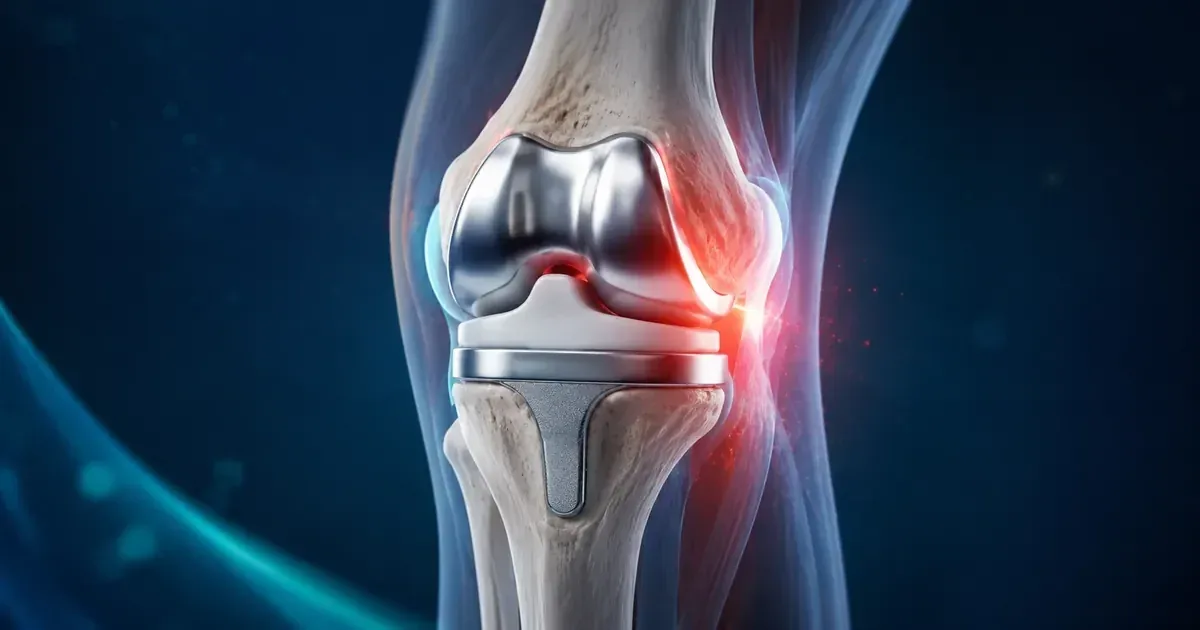
Most people need only one knee replacement in their lifetime. It is one of the most successful operations in medicine, and the great majority of patients go on living an active life on the same implant. But no implant carries a lifetime guarantee. The most common reasons a knee replacement fails are loosening of the components from the bone, instability from stretched or unbalanced ligaments, infection, stiffness (arthrofibrosis), wear of the plastic bearing, fracture of the bone around the implant, and component malposition.
There is also a bigger backdrop. Studies report that up to 20% of patients are not fully satisfied after total knee replacement. Most of those knees do not need revision — but every one of them deserves a real evaluation of their knee pain rather than being told to live with it. When revision is the answer, the goal is simple to state and demanding to deliver: less pain and better function than the knee you have now.
Implant loosening, wear & osteolysis
Loosening is the quiet workhorse of knee-replacement failure, and what sets it off is not always obvious. Orthopedic surgeons believe repetitive high-impact activity, higher body weight, and wear of the plastic liner all speed it up — and patients who receive a knee replacement at a younger age are at higher risk simply because they put more years and more cycles on the implant.
The underlying biology is called osteolysis. As the plastic liner wears, it sheds microscopic particles. The immune system attacks those particles — and in the process destroys the healthy bone around the implant. Once enough bone is gone, the components begin to rock with a windshield-wiper motion: loose, painful, and progressively destructive. This is exactly why Dr. Morton follows every replaced joint with routine implant surveillance — loosening caught on a scheduled X-ray costs far less bone than loosening discovered after years of silent erosion.
Infection: the failure that changes everything
When bacteria reach a replaced knee, they can attach to the surface of the implant itself, where antibiotics and the body's defenses struggle to reach them. The infection can be seeded in the hospital at the time of the original operation or arrive years later through the bloodstream. It complicates roughly 0.5% of primary knee replacements — a small number, but a major complication for the patient it happens to — and the risk runs higher in people with underlying medical conditions such as diabetes, and in patients who smoke.
Because infection rewrites the entire treatment plan, it must be ruled out first in every painful knee replacement. Dr. Morton considers it whenever a replaced knee develops pain, instability, or drainage. Depending on how long the infection has been present and which organism is involved, treatment may mean a surgical washout (debridement) with liner exchange, a staged reconstruction — removing the implant, placing an antibiotic spacer, treating the infection, and re-implanting a new knee once it is cleared — or, for patients who cannot undergo further surgery, long-term antibiotic suppression. Curing an infected knee often takes more than one operation, and Dr. Morton walks patients through that road honestly before it begins.

The workup comes before any re-operation
No one should undergo revision surgery without a clear diagnosis. Revising a painful knee without an identified, correctable cause has poor odds of helping — so Dr. Morton runs a systematic workup first at his Revision Hip & Knee Replacement Clinic: a detailed history and exam, X-rays compared over time, blood work for inflammation markers, and joint aspiration to test the fluid for infection. Advanced imaging fills in the gaps when the picture is still unclear — CT to measure component rotation, and Metal Artifact Reduction MRI that can see around the implant.
Preparation is part of the workup. Bring your previous operative reports, medical records, and prior X-rays or other imaging if you have them — knowing exactly which implants are in your knee, and how they were put in, shapes the entire plan. Only when the cause is found does the conversation turn to surgery. If you have been offered a revision elsewhere, a second opinion on the diagnosis is time well spent.

What revision surgery involves
Revision means removing some or all of the existing components and rebuilding the knee. It is a significantly different operation from a primary knee replacement — usually longer and more complex, planned in far greater detail, with specialized revision implants and instruments ready before the first incision. The failed parts are extracted while preserving as much bone as possible; defects left behind are reconstructed with metal augments, cones, and stemmed implants that anchor deeper in the bone. Dr. Morton then restores the joint line, rebalances the ligaments, and selects the level of implant constraint the knee needs — more constrained designs can substitute for ligaments that no longer do their job.
Infection follows its own playbook, described above: depending on timing and the organism, treatment may mean a washout with liner exchange or a staged reconstruction with an antibiotic spacer before the new knee goes in.
The constraint ladder: matching the implant to your ligaments
Revision knees are built up a ladder of constraint — using exactly as much mechanical stability as your soft tissues can no longer provide, and no more:
- Posterior-stabilized (PS) — the starting point when the primary implant failed but collateral ligaments still work.
- Varus-valgus constrained (VVC/CCK) — a taller, thicker post that substitutes for weakened collateral ligaments; the workhorse of revision knees, almost always on stems that share load with the tibia and femur.
- Rotating-hinge — for knees whose ligaments are gone entirely, massive bone loss, or salvage situations; modern hinges rotate as well as swing, a world away from the rigid hinges of decades past.
More constraint transfers more stress to fixation — the reason constraint is earned by examination, not applied by default.
Bone loss: cones, sleeves & stems
Removing a failed knee implant always costs some bone; loosening and infection cost more. Contained defects are grafted or filled with augments, but the transformative tools of the last decade are porous metal cones and sleeves: they fill the damaged metaphysis with a scaffold your remaining bone grows into, giving revision implants the platform primary knees get for free. Paired with stems that bypass weak bone, they've markedly improved how durable revision knees are. Component rotation — a common, subtle cause of the painful, stiff, or unstable knee — is corrected at the same sitting, planned from CT.
The stiff knee and the unstable knee
Two failure patterns bring more patients to this clinic than any others:
- Instability — the knee that "gives way" on stairs, swells recurrently, and never feels trustworthy. It can be built in at the first operation, when components are positioned or ligaments balanced imperfectly, or develop over time as the ligaments stretch out. Often traced to ligament imbalance, component loosening, or malrotation, this is among the most correctable causes of the unhappy knee — provided the specific pattern (mid-flexion, flexion, or global) is identified before surgery.
- Stiffness (arthrofibrosis) — excessive scar tissue that caps motion no matter how hard you rehab, sometimes badly enough to shut down everyday activities. Caught early, a manipulation under anesthesia can restore range. Severe, established scarring — arthrofibrosis, sometimes with a fixed contracture — may require revision surgery. Dr. Morton has treated many patients with severe knee contractures, yet he approaches revision for stiffness alone cautiously, because it has the least predictable payoff in revision surgery — honest counseling matters more here than anywhere.
Fractures around a knee replacement
A fall — or bone silently weakened by severe osteolysis — can break the femur or tibia around a knee implant, an injury called a periprosthetic fracture. Dr. Morton evaluates three things: how much good bone remains, whether the implant is still fixed or has loosened, and where the break sits relative to the components. Most of these fractures need surgery — fixation if the implant is solid, revision to stemmed components if it is not — though selected stable patterns can be managed with a period of protected weight-bearing instead. As a trauma surgeon at The Queen's Medical Center, Hawai‘i's Level 1 trauma center, Dr. Morton manages these injuries with both the fracture and the reconstruction in view.
Risks of revision surgery, honestly stated
The risks of a revision knee replacement are higher than those of a first-time replacement. The operation is longer, the anatomy is scarred, hospital stays can run longer, and patients are usually carrying more medical conditions than they were at their first surgery. The risks Dr. Morton reviews with every patient include:
- Blood clots
- Blood loss
- Infection
- Implant loosening
- Fracture
- Knee stiffness
- Nerve or blood vessel damage
He does everything in his power to minimize each of these — meticulous planning, modern techniques, and staying current with the latest research — and he wants every one of your questions answered before surgery, not after. If you are concerned about an upcoming revision planned by another surgeon, you are welcome to schedule a second opinion.
The best revision is the one you never need
The surest way to avoid a revision is to get the first knee right. Accurate component positioning and a knee balanced at the time of surgery are the strongest technical defenses against early loosening and instability — and robotic assistance is designed to deliver exactly that. Dr. Morton is certified on all four major surgical robots — ROSA, Mako, CORI, and VELYS — and uses robotic technology to minimize the technical errors that send knees back to the operating room. If you are still planning your first replacement, that choice matters more than any decision you will make afterward.
Recovery after a revision
Most revision patients stand and walk the same day or the next morning, usually with a walker at first. Overall progress tends to be steadier and slower than after a primary replacement — the surgery is bigger, and the soft tissues have been through more. Physical therapy is essential, and pain is managed with the same opioid-sparing multimodal protocol Dr. Morton uses for primary joints. Milestones vary with the reason for revision, so your plan is individualized rather than copied from a standard knee replacement recovery timeline.
When to get a failing knee checked
See a revision specialist if a replaced knee develops new pain after a comfortable stretch, swelling or warmth, a sense of instability or giving way, grinding, drainage from the incision, or fevers with knee symptoms. Early evaluation matters: loosening caught on routine X-rays is a smaller problem than loosening found after bone has eroded, and early infection has treatment options that late infection does not. If any of this sounds familiar, book an orthopedic consultation and bring your operative records if you have them.
Medically reviewed by Paul N. Morton, MD, FAAOS, FAAHKS — board-certified orthopedic surgeon, fellowship-trained in adult hip & knee reconstruction and orthopedic trauma.
This page is for education only and isn’t a substitute for an exam and personalized advice — schedule a consultation to discuss your situation.