
Robotic hip replacement in Hawai‘i — the short answer
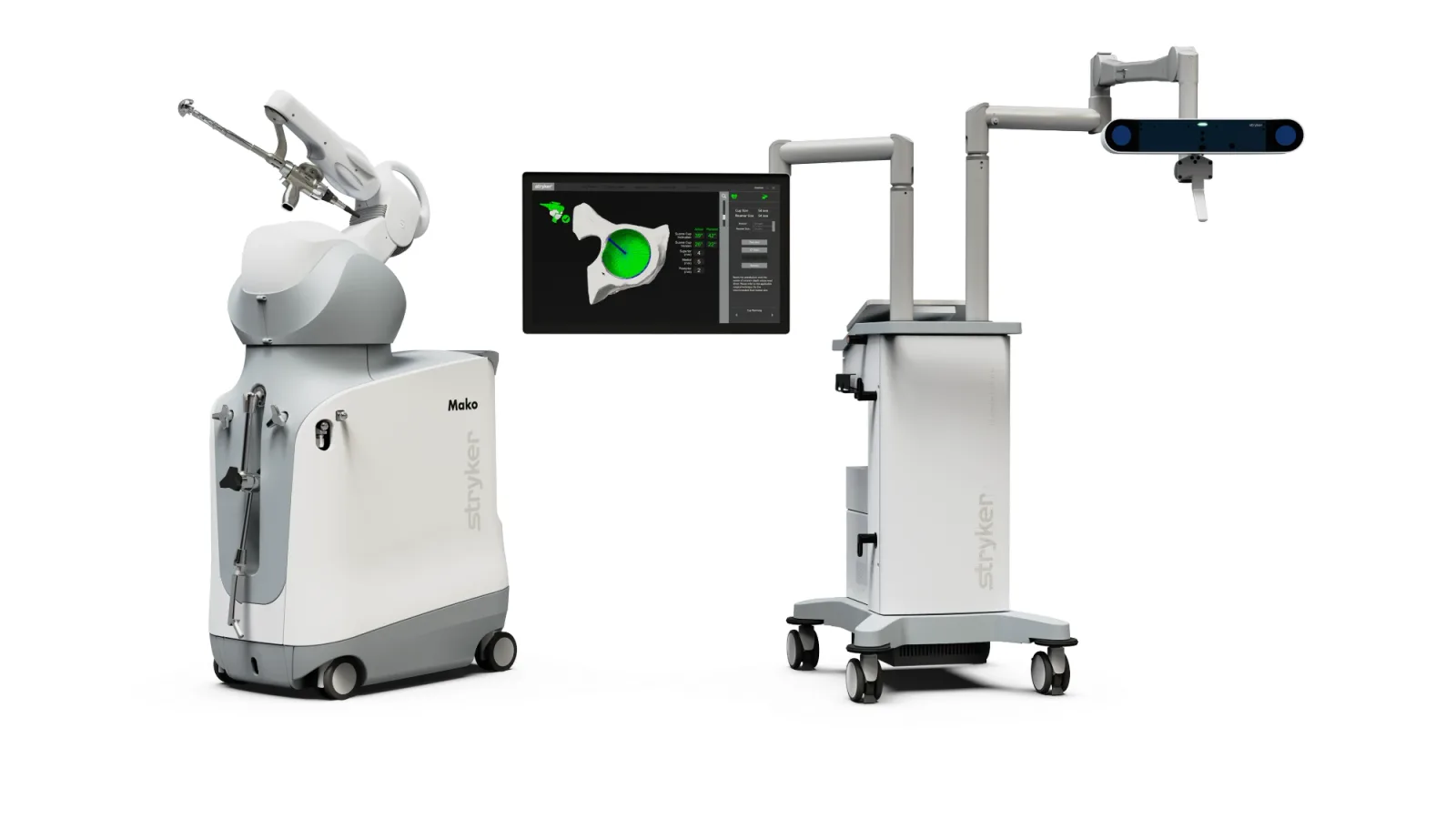
Robotic hip replacement is a total hip replacement planned in three dimensions — on Mako, from a CT scan of your own hip — then carried out with robotic guidance that holds that plan while the surgeon works — confirming cup position, implant sizes, leg length, and offset within millimeters. It suits nearly every first-time hip. In Honolulu, Dr. Paul Norio Morton — who performed Hawai‘i's first robotic hip replacement in 2022 — sees patients at Pacific Bone & Joint and performs hip replacement through the muscle-sparing anterior approach. His robotic hip replacements are done on Mako at Hilo Community Surgery Center on Hawai‘i Island. Most patients walk the day of surgery. Individual results vary.
- What the robot does: carries your 3D plan (on Mako, built from your CT), tracks your anatomy, and holds the surgeon to that plan — it holds no scalpel and makes no decisions
- What that buys you: accurate, reproducible cup position, leg length, and offset, with fewer outliers
- Where: Mako robotic hip replacement at Hilo Community Surgery Center on Hawai‘i Island — close to home for Big Island patients
- Platforms: ROSA®, Mako, CORI, and VELYS — Dr. Morton is certified on all four; his robotic hips are Mako cases in Hilo
- Recovery: same-day walking, usually no hip precautions, often home within 24 hours
How robotic hip replacement works
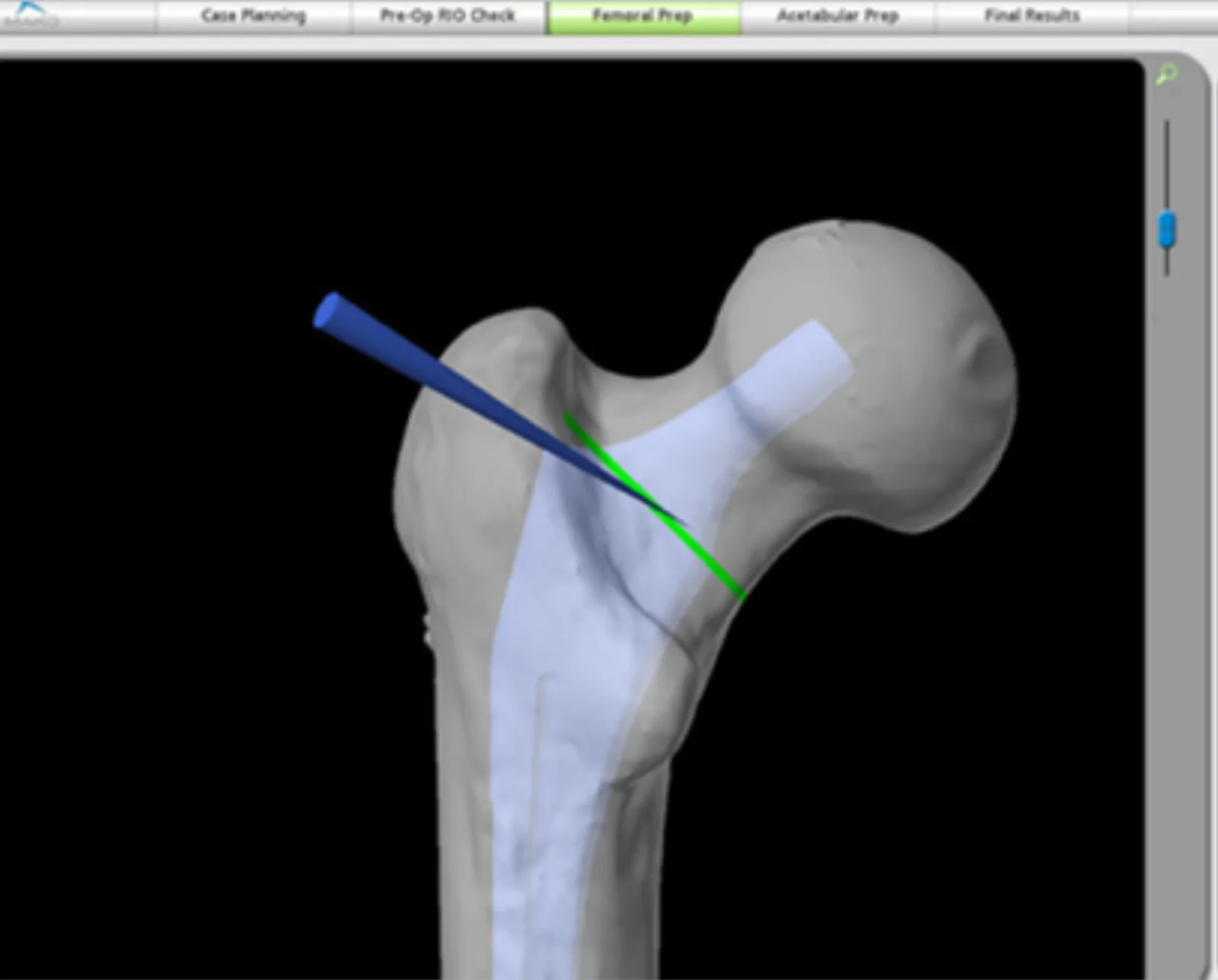
On Mako — the platform at Hilo Community Surgery Center — robotic hip replacement starts weeks before the operating room. A CT scan of your pelvis and hip is converted into a three-dimensional model of your own anatomy, and on that model Dr. Morton plans the operation in advance: cup size and position — inclination and anteversion — stem size, leg length, and offset, set to your bone rather than a population average. On surgery day your anatomy is registered to that plan, and the robotic arm keeps reaming and cup impaction inside it while leg length and offset are displayed live. If your anatomy calls for an adjustment mid-case, the plan changes with it and the arm holds the new one.
One thing the robot does not do is operate. It holds no scalpel and makes no decisions. Think of it as a GPS with guardrails: the surgeon performs every step, and the robot keeps the execution inside the plan — and confirms it before you ever leave the operating room.
In practical terms, robotic assistance adds:
- Patient-specific planning from your own CT — every cup and stem is sized and positioned for your hip before the first incision
- Improved accuracy of component positioning, with fewer outliers than manual instrumentation
- Measured leg length and offset — the two things patients most often notice after a hip replacement, verified on screen rather than estimated
- Haptic guidance — the arm holds the reamer and the cup inside the planned boundary, so the plan and the operation stay the same thing
- Flexibility — the plan can be adjusted during the operation when your anatomy calls for it
- Minimal added trauma — the robot works through the same muscle-sparing exposure, not a bigger one
- Before surgery
CT scan → your hip in 3D
A quick, painless CT of your pelvis and hip — no IV contrast — becomes a 3D model of your own anatomy.
- The plan
Built for your hip
On that model, cup position, stem size, leg length, and offset are planned before the first incision — not to a population average.
- In the OR
Haptic-guided precision
Your anatomy is registered to the plan, and the arm holds reaming and cup impaction inside it. The surgeon operates; the robot holds the plan.
- Same day
Up and walking
Most patients stand and walk the day of surgery, usually with no hip precautions.

A Hawai‘i first
Dr. Morton performed the first robotic-assisted total hip replacement in the state of Hawai‘i in 2022, using the ROSA® platform. Earlier that same year, he performed the first robotic joint replacement on Hawai‘i Island at Kona Community Hospital — a meaningful milestone for a surgeon raised in Kea‘au.
Those firsts weren't about novelty. They were the product of fellowship training in adult hip and knee reconstruction at the University of Chicago — and of bringing that technology home, so patients here don't have to fly five hours to get it. Being first also meant building the protocols, training the operating room teams, and proving the workflow so that robotic assistance could become routine rather than exceptional in his knee replacements. The newest chapter is Mako: CT-planned, haptic-guided robotic hip replacement at Hilo Community Surgery Center, so a Big Island patient can have a robotic hip on the Big Island.

Why millimeters matter in a hip
Precision is not a luxury in hip replacement — it determines how the joint behaves for decades. A hip replacement done freehand by an experienced surgeon is usually positioned well; robotic guidance exists to close the gap between usually and always. Three things depend directly on component position:
- Stability. Cup orientation works together with the surgical approach, soft-tissue tension, and how your spine moves your pelvis — and Dr. Morton plans for all four in every hip. It is worth the effort at the front end: revision surgery for a dislocated hip is among the more disruptive and expensive outcomes to treat. Accurate cup placement, a muscle-sparing anterior approach and spine-aware planning are how that plan gets built.
- Leg length. A hip that leaves one leg noticeably longer is one of the most common sources of dissatisfaction after surgery — especially in Hawai‘i, where people live in slippers or walk barefoot on the beach and feel every millimeter of difference. Robotic tracking measures leg length in real time so it is restored, not guessed.
- Implant wear. Components that articulate at the intended angles distribute load evenly. Malposition concentrates stress and can accelerate wear — precision protects the 20-plus-year lifespan modern implants are capable of.
Traditional instruments estimate these targets by eye and feel, and experienced hands estimate well. Robotic guidance doesn't estimate — it measures. Measurement is what turns a good plan into a reproducible result, hip after hip.
What the research shows
The case for robotic assistance is measurement. Here is what the published record supports:
- More accurate, more reproducible cup position. In a matched-pair laboratory study of a CT-free robotic hip platform (Kamath et al., Journal of Robotic Surgery, 2021 — 33 hips per arm, performed by 14 high-volume surgeons), 100% of robotically placed cups landed within the stricter Callanan target zone versus 73% with manual instruments, with roughly a third of the inclination error.
- Fewer leg-length outliers. The same study, and a propensity-matched clinical series (Clement et al., Bone & Joint Research, 2021), found leg length restored to plan significantly more consistently with robotic guidance.
- Better early hip scores in several studies. A systematic review and meta-analysis of 17 studies (Ng et al., The Bone & Joint Journal, 2021) found more cups in the safe zone and a modestly better Harris Hip Score at short-to-mid-term follow-up; a 2016 cohort (Bukowski et al.) reported higher patient-reported scores at one year, and a Japanese series (Shibanuma et al., 2021) reported faster early walking versus navigated surgery.
- A stable hip is built from several things at once. A Mayo Clinic analysis (Abdel et al., Clin Orthop Relat Res, 2016) is why Dr. Morton personalizes the cup target rather than aiming at the classic safe zone alone. Registry analyses of 78,098 Swedish and 42,379 Finnish hip replacements (Hailer et al., 2012; Kostensalo et al., 2013) show that surgical approach, head size, and patient factors all shape how a hip behaves over the long run — which is why Dr. Morton pairs robotic planning with the anterior approach and spine-aware cup targeting rather than leaning on any single element.
Individual results vary.
Robotic vs conventional hip replacement at a glance
| Conventional (manual instruments) | Robotic-assisted (Mako, Dr. Morton) | |
|---|---|---|
| Planning | Templated on X-rays; targets estimated by eye and feel in the OR | A 3D model built from your own CT scan — cup position, stem size, leg length, and offset planned before the incision |
| Cup accuracy | 73% within the target zone in one matched-pair laboratory study of a CT-free robotic platform | 100% in the same study; fewer outliers across published series |
| Leg length and offset | Estimated; checked by X-ray in anterior cases | Measured and displayed during the operation, with fewer outliers |
| Bone preparation | Freehand reaming and impaction, guided by experience | Haptic guidance keeps reaming and cup impaction inside the planned boundary |
| Cup target | Classic safe-zone angles | Personalized to your standing and sitting spine X-rays, then executed inside the plan |
| Incision | 3–6-inch anterior incision | The same 3–6-inch anterior incision, plus small separate pin sites for the tracking arrays, which come out before you leave the operating room |
| Discharge and recovery | Same rapid-recovery protocol | Same protocol; modestly better early hip scores in some studies — individual results vary |
Key sources: Kamath AF et al., J Robot Surg 2021 (PMID 34709535); Ng N et al., Bone Joint J 2021;103-B(6):1009-1020 (PMID 34058875); Clement ND et al., Bone Joint Res 2021;10(1):22-30 (PMID 33380216); Shibanuma N et al., BMC Musculoskelet Disord 2021;22:314 (PMID 33781263); Bukowski BR et al., Surg Technol Int 2016;29:303-308 (PMID 27728953); Hailer NP et al., Acta Orthop 2012 (PMID 23039167); Kostensalo I et al., Acta Orthop 2013 (PMID 23799348); Abdel MP et al., Clin Orthop Relat Res 2016 (PMID 26150264).
Certified on all four major platforms
Dr. Morton — known to many patients as The Robot Doc — is certified on all four major robotic platforms: ROSA®, Mako, CORI, and VELYS. That breadth matters. Each system takes a different route to the same goal: some build the plan from a CT scan, others from X-rays or direct anatomic mapping, and each pairs with different implant families. Today his robotic hips are Mako cases at Hilo Community Surgery Center on Hawai‘i Island; on O‘ahu he uses ROSA, primarily at The Queen's Medical Center, and CORI at Adventist Health Castle for knee replacement. The technology serves the plan, not the other way around.
Mako is the hip platform. Robotic hip replacements at Hilo Community Surgery Center are Mako cases: the plan is built from a CT scan of your pelvis and hip, giving a fully volumetric, millimeter-accurate map of your anatomy, and the robotic arm then holds the reamer and the cup inside that plan. It is a natural fit for complex anatomy — a shallow socket, a deformed femur, prior surgery — and it means Big Island patients get a CT-planned robotic hip close to home. ROSA® reaches the same destination from standard X-rays and live anatomic mapping; it was the platform for Hawai‘i's first robotic hip in 2022, and today it is his primary platform for knee replacement at The Queen's Medical Center.
Who is a candidate for robotic hip replacement?
Nearly every first-time hip replacement can be done with robotic assistance — at Hilo Community Surgery Center, Dr. Morton's hip replacements are Mako cases, not reserved for select patients. Age is not a limiting factor; if anything, precision matters most in the youngest patients, whose implants have the most miles ahead of them (see am I too young for hip replacement?). Robotic planning earns its keep when anatomy is less forgiving: a dysplastic (shallow) socket, a collapsed femoral head from avascular necrosis, a stiff spine that changes how the pelvis tilts, or prior surgery around the hip. Retained hardware, severe deformity, or major bone loss occasionally change the plan or the platform, and bone quality shapes fixation choices more than the decision to use the robot.
The real question is whether your hip is ready for replacement at all. Not sure where you stand? Book a consultation or call (808) 439-6201 to find out. You may be ready if you recognize yourself here:
- Hip pain that keeps you from sleeping
- Pain or stiffness after a long period of sitting
- Hip pain that limits the activities you love
- Difficulty getting up from a seated position or climbing in and out of a bathtub
What causes the pain in the first place
Hip osteoarthritis is the most common culprit. Cartilage is the smooth protective surface on the ends of your bones that keeps them from rubbing together; osteoarthritis is the wear and tear of that cartilage. Once it wears away, bone grinds on bone — and basic activities like walking, sitting, even lying down can become painful.
Other causes include osteonecrosis (loss of blood supply to the femoral head, causing the bone to die), trauma, and rheumatoid arthritis.
Surgery is not the first step. Dr. Morton encourages patients to explore non-operative treatment strategies first — activity modification, physical therapy, medications, injections. When non-operative treatment has failed and the pain is dictating your life, that is when hip replacement earns its place.
A smaller incision that spares the muscle
Dr. Morton performs robotic hip replacement through the muscle-sparing direct anterior approach: a 3-to-6-inch incision at the front of the hip, directly over the joint, instead of the traditional 8-to-12-inch incision on the side. Because the front of the hip sits closer to the joint itself, the incision can be smaller — and more importantly, the approach follows the natural path between muscles rather than cutting through them or detaching them from bone.
That anatomical detail drives almost every recovery advantage:
- Less pain. With no muscle cut, many patients need little more than Tylenol for pain control after surgery.
- No posterior hip precautions. Traditional posterior approaches require patients to avoid internally rotating the hip or bending it past 90 degrees for weeks — no low chairs, no crossing your legs, careful getting in and out of cars. Anterior patients skip those restrictions entirely, which makes the recovery phase dramatically less limiting.
- Faster, easier recovery. Less pain plus no precautions means patients move confidently sooner — the foundation of Dr. Morton's rapid-recovery protocol.
- Early discharge. Many patients go home the day of surgery.
- Verified leg lengths. The face-up anterior position allows intraoperative X-ray verification, and robotic guidance stacks measurement on top of it.
Preparing for your robotic hip replacement
Preparation starts weeks before surgery with imaging; for a Mako hip, that imaging turns your hip into something Dr. Morton can operate on before he operates on you.
A planning CT scan. For a Mako hip, a CT of your pelvis and hip is the foundation. It is quick and painless and needs no IV contrast, and software converts it into a three-dimensional model of your own anatomy — bone shape, socket depth, the deformity arthritis has left behind. On that model Dr. Morton sets cup size and position (inclination and anteversion), stem size, leg length, and offset before the day of surgery, so the operation begins with the decisions already made and checked.
Standing and sitting spine X-rays. These are taken for a Mako hip too, because they answer a question no CT can: how your pelvis tilts as you move. Arthritis of the spine changes that tilt between sitting and standing, which changes the functional orientation of your hip socket. A cup position that is textbook-perfect for one patient's spine can be wrong for another's. Understanding your specific pelvic-spine mechanics lets Dr. Morton personalize the target — not just hit a generic one.

Inside the operating room, step by step
Here is how a Mako robotic anterior hip replacement actually unfolds:
- The plan, already built. Your CT-based 3D model comes into the room with cup size and position, stem size, leg length, and offset already set for your anatomy — the roadmap for the case.
- Muscle-sparing exposure. The approach mirrors the standard anterior hip: superficially, the dissection passes between the sartorius and tensor fascia lata muscles; deeper, it travels between the rectus femoris and gluteus medius. No muscle is cut — which is why recovery is faster.
- Registration. Tracking arrays, held by small pins, let the system match your actual anatomy to the CT model point by point, so the plan and your hip become the same thing. The pins are placed and removed within the same operation.
- Haptic-guided reaming. Once the arthritic femoral head is removed, the socket is reamed with the robotic arm holding the reamer inside the planned boundary — depth and orientation stay where they were planned.
- Controlled impaction. The cup is impacted while attached to the robotic arm, holding the planned inclination and anteversion — usually within the classic Lewinnek and Callanan target zones, and deliberately adjusted when your standing and sitting spine X-rays call for a different target.
- Stem placement. The femoral stem is broached and sized by hand — surgical judgment and feel still matter, and the robot doesn't replace them.
- Verification before closing. The system then displays two measurements conventional hip replacement can only estimate: leg length and offset. Offset is how far your femur sits from your pelvis — too much can tension the IT band and cause pain on the outside of the hip; too little can leave the hip unstable. Patients after traditional posterior hip replacement have long complained of exactly these two problems — a leg that feels longer and pain on the outside of the hip. Verifying both before the incision is closed is the point of the whole exercise, and it matters even more in revision and deformity surgery, where equal leg lengths are hardest to achieve.
Throughout, the plan is a starting point rather than a straitjacket: if your anatomy calls for a different cup angle, a different offset, or a different stem, Dr. Morton changes the plan and the arm holds the new one. Once the final implant is confirmed in position, you're on the road to recovery — with a hip placed using the most advanced technology and techniques available anywhere, right here in Hawai‘i.

Recovery — and protecting your new hip for decades
Over 90% of people who have a total hip replacement experience a remarkable reduction in pain and a dramatic improvement in function. With normal use and activity, the plastic spacer in a modern hip replacement rarely wears out. But a replaced hip deserves long-term stewardship, and Dr. Morton builds that in:
- Annual surveillance. Dr. Morton follows every joint replacement patient with a yearly X-ray to confirm the implant is functioning at its best — for life. Small problems caught on a routine X-ray are simple; the same problems found late are not.
- Sensible activity. Increased weight or high-impact activity can accelerate wear on the plastic components and may cause the replacement to loosen or become painful. The American Academy of Orthopaedic Surgeons advises patients to avoid running, jogging, jumping, and other high-impact activities with a hip replacement. Nearly everything else — swimming, hiking, golf, cycling, surfing — is back on the table.
Most patients walk the day of surgery and many go home the same day through Dr. Morton's outpatient joint replacement pathway, with physical therapy available at his Honolulu and Kunia locations, or coordinated with a therapist near home for neighbor-island patients, working from Dr. Morton’s protocol. Individual results vary — the first year after hip replacement lays out the milestones.
Consider the risks before surgery
Total hip replacement has a high success rate and is one of the most reliable operations in all of orthopedics. It is still major surgery, and honest counsel includes the risks:
- Blood clots — deep vein thrombosis or pulmonary embolism
- Blood loss that may require a transfusion
- Infection — one of the more serious complications, sometimes requiring multiple operations
- Implant loosening — occasionally requiring revision surgery
- Fracture — the implant changes how stress distributes across the bone, which can predispose to breaks
- Dislocation — when the ball pops out of the socket; addressed with accurate, verified cup placement, the muscle-sparing anterior approach, and spine-aware planning
- Leg-length inequality — minimized by measuring leg length during the operation rather than estimating it
- Heterotopic ossification — a rare complication in which the hip becomes increasingly stiff
- Nerve or blood vessel damage — extremely rare, but potentially serious
Dr. Morton takes great care to minimize every one of these risks and is happy to discuss any questions or concerns at your consultation — that conversation is part of the operation, not an afterthought.
Is robotic hip replacement right for you? Your first visit
Most patients who are candidates for total hip replacement are candidates for robotic assistance; at Hilo Community Surgery Center, Dr. Morton's hip replacements are Mako cases, not reserved for select patients. It pairs naturally with the rest of his rapid-recovery protocol: anterior approach, opioid-sparing pain control, and same-day walking for most patients. Hawai‘i Island patients can have the whole thing at home — planning CT, Mako robotic hip replacement at Hilo Community Surgery Center, and follow-up at the Hilo or Kona clinic or by telehealth. East Hawai‘i, Puna and Ka‘ū patients can have the planning CT at Hawai‘i Radiologic Associates in Hilo or at Hilo Medical Center; Kona-side and Waimea patients at Hawai‘i Radiologic Associates, North Hawai‘i Community Hospital or Kona Community Hospital. HDRS in Honolulu can also do the scan.
What happens next. Schedule an orthopedic consultation online or call (808) 439-6201. Pacific Bone & Joint sees patients in Honolulu (Ala Moana), West O‘ahu (Kunia), Hilo, and Kona. Bring a photo ID, your insurance card, and any prior X-rays or reports; managed-care and Medicaid/Quest plans may require a referral from your primary care physician, and the office can help you check (insurance plans accepted). When an in-person visit isn't practical, neighbor-island and mainland patients can start with a telehealth visit and existing X-rays — the 3D planning conversation travels well.
Medically reviewed by Paul N. Morton, MD, FAAOS, FAAHKS — board-certified orthopedic surgeon, fellowship-trained in adult hip & knee reconstruction and orthopedic trauma. Last reviewed: .
This page is for education only and isn’t a substitute for an exam and personalized advice — schedule a consultation to discuss your situation.