

Am I too young for a hip replacement? The short answer
There is no minimum age for hip replacement. The decision rests on how much the hip hurts, how much of your life it has taken, and what the joint looks like on imaging — not on the year printed on your driver's license. In Honolulu, Dr. Paul Norio Morton — fellowship-trained in adult hip and knee reconstruction — replaces hips in patients in their thirties, forties, and fifties when the diagnosis calls for it, using cementless anterior hip replacement built to be monitored for life. Individual results vary.
The old advice — wait as long as you possibly can — made sense a generation ago, when implants fixed with cement and lined with older plastics wore out quickly in young, active patients. Waiting rationed a part that couldn't be trusted to last, and revision surgery was harder and riskier than it is today. Modern implants changed that trade. Being younger still shapes the conversation, because you will live more years — and put more miles — on the implant than an older patient will. But today that is a planning question, not a disqualification — and for some diagnoses, waiting is the worse plan.
- No minimum age: the decision is driven by pain, function, and imaging
- Common young-hip diagnoses: avascular necrosis, hip dysplasia, post-traumatic arthritis
- What changed: cementless fixation, highly cross-linked polyethylene bearings, and robotic placement
- The honest part: a younger patient should plan for the possibility of a revision someday
- Waiting has costs too: muscle loss, a changed gait, and years of limited living
Why young hips wear out in the first place
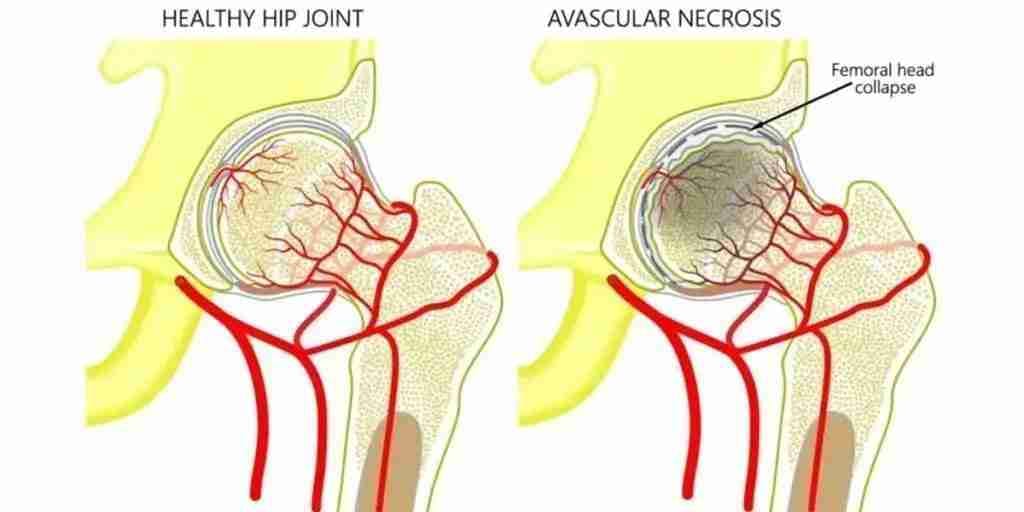
Most hip replacements in younger patients don't come from ordinary wear-and-tear arthritis — they follow a specific diagnosis. Avascular necrosis (AVN) is one of the most common: the blood supply to the femoral head fails — sometimes after steroid treatment or heavy alcohol use, sometimes for no identifiable reason — and the ball of the joint collapses. Hip dysplasia, a socket that formed too shallow in childhood, quietly overloads the cartilage until it wears through, often announcing itself in the thirties or forties. Post-traumatic arthritis after a fracture or dislocation, childhood hip conditions, and inflammatory arthritis fill out the list.
The diagnosis matters because it sets the clock. Dysplasia and AVN don't behave like slow, garden-variety arthritis — a collapsing femoral head can destroy a joint in months. In those hips, waiting as long as you can doesn't preserve anything; it just prolongs the worst stretch of your life with that hip.
What changed the math: fixation, bearings, and robotics
Three advances rewrote the calculus for younger patients. First, cementless fixation. Instead of grouting the implant in place, modern components have porous surfaces your own bone grows into — a living, biologic bond that is particularly well suited to the strong bone of younger patients. It is Dr. Morton's preference whenever bone quality allows.
Second, the bearing surfaces. The plastic lining modern hip sockets — highly cross-linked polyethylene — wears dramatically slower than the older material, and ceramic femoral heads reduce wear further (see hip bearings, explained). That matters because wear debris is what loosened the old implants; slow the wear and you slow the main clock running against a young patient.
Third, precision. Robotic-assisted hip replacement helps place the socket and set leg length exactly as planned. Dr. Morton's robotic hips are done on Mako at Hilo Community Surgery Center; on O‘ahu, your hip is templated on calibrated X-rays before surgery, and X-rays in the operating room check cup position and leg length. A well-positioned implant loads evenly, wears more slowly, and dislocates less — and in a hip that needs to last decades, position is destiny. Add a muscle-sparing anterior approach and a rapid-recovery protocol on top, and the operation itself has become far less disruptive to a working adult's life than the one an earlier generation was told to fear.

The honest part: plan for the possibility of a revision
Here is the part that deserves plain language: if you get a hip replacement at forty, you may need a revision at some point in your lifetime. Modern implants commonly last twenty years or more, and many keep working well beyond that — but no honest surgeon can promise a forty-year-old that the first operation will be the last.
What that plan looks like: revision hip surgery is a well-established operation for a fellowship-trained arthroplasty surgeon, and the earlier a wearing implant is caught, the simpler that surgery is. That's why Dr. Morton builds lifetime implant surveillance into every younger patient's care — periodic X-rays that catch wear or loosening years before it causes symptoms or costs you bone. A monitored implant rarely produces surprises, and a young patient with a surveillance plan can stop worrying about the clock and get on with living.
How likely is a revision for a younger patient? The numbers
The best numbers come from a 2017 study in The Lancet (Bayliss et al.) that followed more than 63,000 hip replacements in the United Kingdom for up to 20 years: 85% of hips were still in place at 20 years, and the lifetime risk of ever needing a revision was about 1 in 20 for patients who had surgery in their seventies — but rose to roughly 1 in 3 for men who had surgery in their early fifties, with women in the same age group about 15 percentage points lower. Those figures come from implants placed between 1991 and 2011, before today's bearings and placement techniques were standard, and your own risk depends on your diagnosis, weight, activity, and bone; individual results vary. The point is not fear — it is that a young patient should go in with eyes open and a plan.
Waiting has costs, too
Delaying surgery is not a neutral choice. Years of limping reshape how you move: the muscles around the hip weaken, the low back and the opposite knee absorb the strain, and overall fitness erodes at exactly the age you can least afford it. Careers, parenting, and sports get planned around the hip. There is a real cost to spending your forties on the sidelines to protect against a hypothetical operation in your seventies.
That doesn't mean rushing to the operating room. When cartilage remains and symptoms are early, joint-preserving options — activity modification, physical therapy, injections, cartilage restoration for focal defects, and BMAC with core decompression for early avascular necrosis before the femoral head collapses — deserve a genuine trial, and Dr. Morton offers them. But once the joint surface is gone or the femoral head has collapsed, no injection rebuilds it. At that point the honest comparison isn't surgery versus a healthy hip; it's surgery versus more years of a bad one.
How we decide together — and your first visit
The right answer comes from an exam, imaging, your specific diagnosis, and an honest conversation about what you want your life to look like — not from a rule of thumb about age. Some patients leave that conversation with a surgery date for a total hip replacement in Honolulu — through the muscle-sparing anterior approach, with a bikini-incision option; others leave with a preservation plan and a follow-up schedule. Both are good outcomes when they fit the hip in front of us. Dr. Morton walks younger patients through the trade-offs in plain terms, including the cases where the better advice really is to wait: it may be too soon if your X-rays still show joint space, the femoral head has not collapsed, and joint-preserving care hasn't had a fair trial.
What happens next. Schedule a consultation online or call (808) 439-6201 — Pacific Bone & Joint sees hip patients in Honolulu (Ala Moana), West O‘ahu (Kunia), Hilo, and Kona. Bring a photo ID, your insurance card, and any prior X-rays or MRI; managed-care and Medicaid/Quest plans may require a referral from your primary care physician (insurance plans accepted). When an in-person visit isn't practical, neighbor-island patients can start by telehealth. If the signs below sound familiar, it's time for that conversation — bring every question you have.
- Hip pain most days despite months of therapy, medication, or injections
- Night pain that interrupts your sleep
- Work, parenting, or exercise planned around the hip
- Imaging showing advanced cartilage loss or a collapsing femoral head
- A diagnosis — AVN, dysplasia, post-traumatic arthritis — that progresses rather than stabilizes
- Big life decisions on hold while you wait for the hip to improve
Medically reviewed by Paul Norio Morton, MD, FAAOS, FAAHKS. Last reviewed: . This article is for education only and isn’t a substitute for an exam and personalized advice — schedule a consultation to discuss your situation.