

Revision hip replacement in Honolulu — the short answer
Revision hip replacement removes and replaces some or all of a failed total hip replacement — most often for loosening, repeated dislocation, infection, bearing wear with bone loss, or a fracture around the implant. It is for anyone whose replaced hip hurts, gives way, drains, or has never felt right. In Honolulu, Dr. Paul Norio Morton, fellowship-trained in adult hip and knee reconstruction, devotes roughly half his practice to revision surgery referred by other surgeons — and never schedules it without a diagnosis first. Recovery ranges from primary-like after a simple bearing exchange to a protected, slower course after major bone reconstruction. Individual results vary.
- Diagnosis first: comparison X-rays, inflammatory labs, joint aspiration, MARS MRI, and metal-ion levels as needed
- Where: The Queen's Medical Center and Adventist Health Castle — and, for very carefully selected cases, Hilo Community Surgery Center — planned from the dedicated Revision Hip & Knee Clinic
- Tools: porous augments, cup-cage constructs, modular revision stems, dual-mobility bearings, staged treatment for infection
- Recovery: same- or next-day walking after a component exchange; protected weight-bearing when bone must heal
- Off-island? Start with a telehealth review of your imaging and operative reports when an in-person visit isn't practical
Why hip replacements fail — and when yours deserves a workup
Total hip replacement is one of the most successful operations in all of medicine — The Lancet famously named it the “operation of the century.” The overwhelming majority of hip replacements restore an active life and keep working for decades. But on occasion, even a well-done hip replacement fails.
The most common reasons are loosening of the implant from bone, instability or repeated dislocation, infection, wear of the bearing surfaces with bone loss (osteolysis), fracture of the bone around the implant, and reactions to metal debris from certain designs. Rarely, excess bone formation around the joint (heterotopic ossification) stiffens the hip enough to need surgery.
Each problem produces its own pattern. New groin or thigh pain after years of a quiet hip, a sensation of slipping or giving way, start-up pain when you rise from a chair, warmth or drainage near the scar, or a hip that has never felt right since the original surgery — these all point in different diagnostic directions. If your replaced hip hurts and no one has explained why, start with a structured evaluation. The guide to a painful hip replacement walks through the possibilities, and certain recalled implants deserve specific screening even without symptoms.
Your replaced hip deserves an evaluation if:
- New or worsening groin or thigh pain after years of a quiet hip
- Start-up pain when you rise from a chair, or a sense of slipping or giving way
- One or more dislocations
- Warmth, swelling, redness, or drainage near the scar — at any point, even years later
- A metal-on-metal bearing or a recalled implant that has never been checked
- A hip that has never felt right since the original surgery
Wear, loosening & osteolysis: how a quiet hip goes bad
Why an implant loosens is not always clear, but several contributors are well established: repetitive high-impact activity, higher body weight, and — above all — slow wear of the plastic liner between the ball and the metal cup. Patients who receive a hip replacement at a young age carry a higher lifetime risk of loosening, simply because they put more miles on the bearing.
The wear particles themselves do the real damage. As the liner wears, microscopic plastic debris accumulates in the joint and the immune system attacks it — and in the process attacks the healthy bone around the implant. The result is osteolysis: progressive bone loss that silently loosens the implant. A loose implant is a painful implant, and the longer osteolysis goes unrecognized, the more bone is lost and the larger the eventual reconstruction becomes.
This is exactly why every joint replacement deserves scheduled surveillance X-rays: osteolysis shows up on films years before it causes symptoms, when fixing it is still simple.
Infection: the hardest failure to treat
If bacteria find their way to a hip replacement, an infection can take hold at any point — during the initial hospital stay, in the weeks after returning home, or years later when bacteria travel through the bloodstream from elsewhere in the body. Underlying medical conditions and exposures that seed bacteria into the blood raise the risk.
What makes implant infections uniquely stubborn is biofilm — a protective layer bacteria build on the implant surfaces that insulates them from antibiotics. Once biofilm is established, antibiotics alone almost never cure the infection, no matter how long they are taken. An infected hip causes pain, swelling, drainage, and sometimes instability, and there are no easy options — curing it usually takes surgery, and often more than one operation.
Dr. Morton walks each patient through the realistic choices:
- Debridement with liner exchange — for select early infections, a thorough surgical washout and exchange of the plastic liner can clear the infection while keeping the well-fixed metal components.
- Staged revision — the standard for chronic infection: the implant is removed, a temporary antibiotic spacer is placed, targeted antibiotics clear the infection, and the definitive new hip goes in at a second operation.
- Antibiotic suppression — for patients who cannot safely undergo revision surgery, long-term antibiotics can sometimes keep an infection quiet without curing it.
Fracture around the implant & heterotopic ossification
A periprosthetic fracture — a broken bone around the implant, usually after a fall or other trauma — is one of the most urgent reasons for revision surgery, and most of these fractures require an operation. The plan depends on three questions Dr. Morton answers on imaging: how much good bone remains around the implant, whether the implant is still solidly fixed, and exactly where the break runs. A well-fixed stem may be repaired around the implant; a loose stem usually means revision to a longer stem that bypasses the fracture. He will review the findings with you and lay out the options before anything is scheduled.
Heterotopic ossification is extra bone that forms in the soft tissues around a hip replacement. It shows up as calcification on X-rays and is surprisingly common — for most people it is of no consequence. Rarely, it grows enough to make the hip very stiff and rob it of motion. When that happens, surgery to remove the excess bone can restore movement; these excisions are planned carefully, often with advanced imaging, to confirm that nerves and arteries are not involved in the abnormal bone.
The workup comes first — never surgery without a diagnosis
Revision surgery should not be scheduled until the cause of failure is identified. Operating on an undiagnosed painful hip is how patients end up with two failed surgeries instead of one.
Dr. Morton's workup follows a consistent sequence: a detailed history and exam; new X-rays compared side by side with your earlier films to catch subtle loosening or implant movement; blood tests for inflammatory markers that screen for infection; and, when infection is a possibility, an aspiration — fluid drawn from the joint and sent for cultures and cell counts. For soft-tissue problems and metal reactions, a Metal Artifact Reduction (MARS) MRI shows the tissues around a metal implant that a standard MRI cannot. Blood metal-ion levels are added when a metal-on-metal bearing is in place, and a CT scan maps bone loss in three dimensions when a major reconstruction is being planned.
Your records matter as much as your images. Bring prior operative reports and medical charts if you can — knowing the exact make and model of the implants in your hip lets Dr. Morton order matching or compatible parts before the day of surgery. This is exactly what the dedicated Revision Hip & Knee Replacement Clinic was built for — on-site X-ray, access to MARS MRI, and one surgeon reviewing everything in a single visit.

Off-island or on the mainland? Start with a records review
Off-island or on the mainland? When an in-person visit isn't practical and you're in Hawai‘i, start with a telehealth review of your X-rays and operative reports, or a formal second opinion: Dr. Morton can usually tell you from those records whether a revision is likely, what workup still needs to happen, and how to fold the exam, aspiration, and advanced imaging into a single planned trip. From the mainland, start with a pre-travel video call that reviews your records and imaging to plan that trip; because Dr. Morton is licensed in Hawai‘i, his evaluation happens in person in Hawai‘i.
How revision hip replacement works
“Revision” covers an enormous range of surgery. At the simple end, it can mean exchanging only the plastic liner and ball while leaving well-fixed components alone — a procedure with a recovery much like a first-time replacement. At the complex end, it is a salvage operation: removing a loose stem or cup, rebuilding missing bone with grafts or metal augments, and fixing new components designed to gain purchase in compromised bone. Salvage cases are longer and more technically demanding, and part of an honest consultation is setting realistic expectations for what the rebuilt hip can do.
That range is why planning time matters. Complex revisions may call for specialized equipment, implant components ordered specifically to fit the system already in your hip, or even custom 3D-printed implants built for your anatomy. The goal is simple: the full range of revision implants, grafts, and augments in the room before the case starts. Dr. Morton performs revision hip surgery at The Queen's Medical Center in Honolulu and at Adventist Health Castle — and a very carefully selected few at Hilo Community Surgery Center — with each case planned in detail beforehand; a CT scan is often used to plan a complex revision.
Rebuilding bone that isn't there: augments, cones & cup-cage constructs
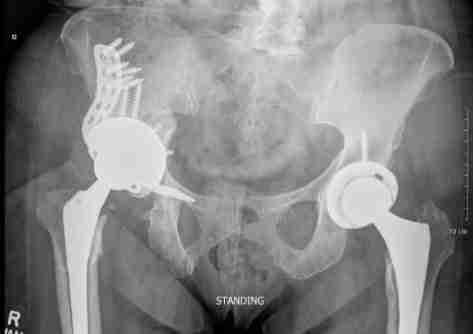
The defining problem of revision hip surgery is acetabular bone loss — a loose or worn cup erodes the socket that has to hold its replacement. Modern reconstruction meets each grade of loss with a specific tool:
- Cavitary defects — a larger hemispherical cup with screws, often enough on its own.
- Segmental defects — porous tantalum/titanium augments bolted to the pelvis rebuild the missing rim, functioning as structural bone substitute that your bone grows into.
- Massive or discontinuous defects — cup-cage constructs or custom triflange implants bridge the pelvis itself; this is referral-center surgery, planned from CT.
On the femoral side, modular tapered revision stems bypass damaged bone to gain fixation in solid diaphysis — and when a fracture accompanies a loose stem (periprosthetic fracture), Dr. Morton's AO trauma fellowship is precisely the training that case demands.
Instability, metal reactions & corroded tapers
Three revision indications deserve their own detail:
- Recurrent dislocation — the most common single reason hips get revised. The hip is a ball-and-socket joint, and an artificial ball escapes its socket far more easily than a native hip; trauma or certain positions can lever it out, and each dislocation is intensely painful and usually means an emergency-room visit. Treatment targets the cause found on workup: a malpositioned cup gets repositioned, deficient soft tissue gets a dual-mobility bearing or, in salvage settings, a constrained liner — a specially designed implant that mechanically captures the ball.
- Adverse local tissue reaction (ALTR) — with long-term use, metal implant surfaces can break down and release debris that triggers inflammatory reactions in the surrounding soft tissue, classically from metal-on-metal bearings. It is diagnosed with metal-ion levels and MARS MRI, and when bone and soft tissue are being damaged, revision exchanges the bearing to ceramic-on-polyethylene and debrides the reaction. Timing matters, because ALTR quietly destroys the abductor muscles that keep you from limping.
- Trunnionosis — corrosion where head meets stem, producing pain and ion elevation years after an otherwise good hip. Often solved with a bearing exchange — ceramic head with a titanium sleeve on the cleaned taper — rather than removing well-fixed components.
Why fellowship training matters for revision surgery
Revision hip surgery is the deep end of hip surgery. It demands comfort with bone loss, retained hardware, scar tissue, and fractures around implants — situations that don't come up often in a general orthopedic practice.
Roughly half of Dr. Morton's practice is revision joint replacement: complicated problems referred to him by other orthopedic surgeons across Hawai'i. He completed a fellowship in adult reconstruction of the hip and knee at the University of Chicago, where complex revisions are a core part of training, plus an AO Trauma fellowship at Charité in Berlin focused on difficult fracture care — directly relevant when bone breaks around an implant, and he cares for complex trauma at The Queen's Medical Center, Hawai'i's Level 1 trauma center. He performs revision knee replacements as well.
If you're weighing where to have a revision done, read why fellowship training changes outcomes. A revision is your best chance to get it right; the goal is to make it the last hip operation you ever need.
Risks of revision hip replacement
The risks of revision surgery fall into the same categories as a first-time hip replacement, but several run higher — because of scar tissue, longer operating time, bone loss, or medical problems that have developed since the original operation. They include:
- Implant loosening
- Blood clots
- Blood loss
- Infection
- Fracture
- Dislocation
- Leg-length inequality
- Heterotopic ossification
- Nerve or blood-vessel injury
Knowing the risks is not a reason to avoid a needed operation — a loose, unstable, or infected hip carries serious risks of its own. It is a reason to have the surgery planned meticulously and performed by a surgeon who does this work routinely.
The best revision is the one you never need
Caring for failed hip replacements shapes how Dr. Morton performs first-time ones. Having seen every way a hip can fail, he is committed to doing the original operation to the highest standard so a revision is never needed — using the anterior approach where appropriate and careful planning for precise component positioning — the failure factor most within a surgeon's control — with Mako robotic guidance for hips at Hilo Community Surgery Center. He is certified on all four major surgical robot platforms — ROSA, Mako, CORI, and VELYS — and stays current with the research behind them.
Recovery after revision hip replacement
Recovery depends on why your hip was revised. After a straightforward component exchange, it can look much like recovery from a primary hip replacement — most patients are up walking the same or next day with support. After major bone reconstruction or staged infection treatment, weight-bearing may be protected for a period while bone heals, and progress is slower by design. Expect swelling and fatigue to linger a little longer than they did after your first hip.
Throughout, Dr. Morton uses the same rapid-recovery playbook as his primary joint replacements: opioid-sparing multimodal pain control, early mobilization, and structured therapy milestones. Every revision patient then enters lifetime implant surveillance, so small problems are caught on scheduled X-rays long before they become big ones.
- Step 1
Workup
History, comparison X-rays, inflammatory labs, aspiration when infection is possible, MARS MRI or CT as needed.
- Step 2
Plan and parts
Implant records identify what is in your hip; matching or compatible components, augments, and grafts are ordered before surgery.
- Step 3
Surgery
From a liner-and-ball exchange to full reconstruction — or a staged plan with an antibiotic spacer for infection.
- First weeks
Walking, as directed
Same or next day after a component exchange; protected weight-bearing and sometimes temporary precautions after major reconstruction.
- For life
Surveillance
Scheduled X-rays catch wear or loosening years before symptoms.
Temporary precautions — and when to call right away
Most anterior primary hips need no hip precautions, but revision is different. When the soft tissues around the hip were deficient or repaired, when a constrained or dual-mobility bearing was placed for instability, or when the hip was approached from the back through the prior scar, Dr. Morton may ask you to follow temporary precautions — avoiding deep bending, crossing the legs, or specific rotations — for a defined number of weeks while the tissues heal. He will tell you exactly which rules apply to you and when they end.
Call (808) 439-6201 right away if you notice:
- A sudden inability to bear weight, a leg that suddenly looks shorter or turned, or a sensation of the hip popping out — possible dislocation
- Spreading redness, drainage, or an opening at the incision, or a wound that is still draining after the first days
- Fever or chills
- New calf pain or swelling
- Chest pain or shortness of breath — call 911 first
- Pain that worsens instead of easing
Ready for answers? Your first visit
Schedule a consultation online or call (808) 439-6201. Revision patients are seen at Pacific Bone & Joint in Honolulu (Ala Moana), West O‘ahu (Kunia), Hilo, and Kona, with complex cases routed through the Revision Hip & Knee Replacement Clinic. Bring a photo ID, your insurance card, your prior operative reports and implant stickers if you have them, and every X-ray, MRI, or CT of the hip. Some managed-care and Medicaid/Quest plans require a referral from your primary care physician; the office will check your plan (insurance plans accepted). Off-island patients for whom an in-person visit isn't practical can start by telehealth.
Medically reviewed by Paul N. Morton, MD, FAAOS, FAAHKS — board-certified orthopedic surgeon, fellowship-trained in adult hip & knee reconstruction and orthopedic trauma. Last reviewed: .
This page is for education only and isn’t a substitute for an exam and personalized advice — schedule a consultation to discuss your situation.