
First, what's normal — and what isn't
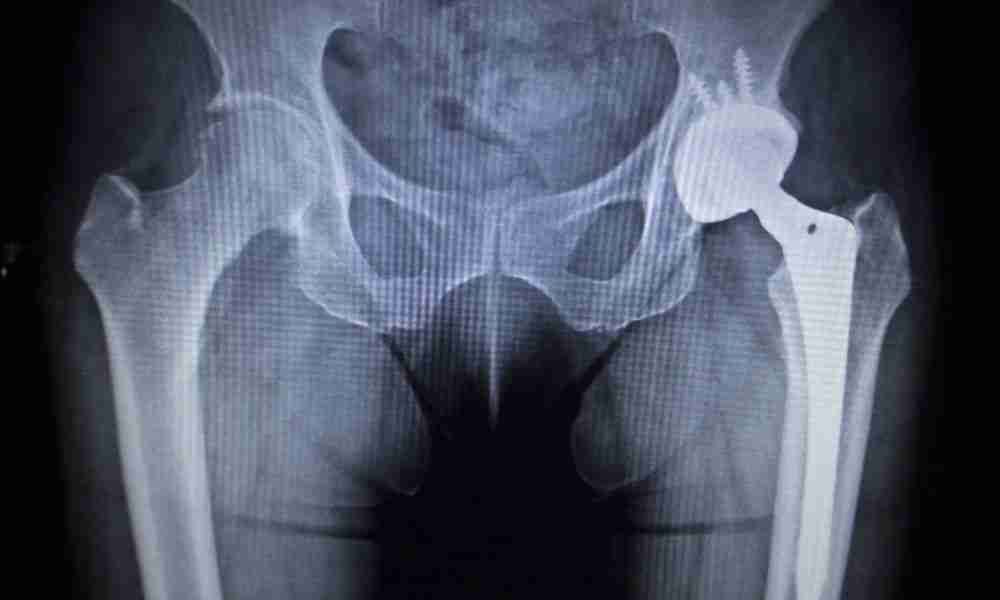
Total hip replacement is one of the most common and most successful operations of our time. Nearly 96% of patients report being satisfied with their new hip — even 16 years after surgery. But a smaller group, ranging from 12% to 18% depending on the study, has some degree of continued pain — most often traced to the femoral component, the stem seated in the upper thigh bone.
A hip replacement should become a quiet part of your life. Soreness, swelling, and muscle fatigue are expected in the first weeks and can take a few months to fully settle. What is not normal: pain that persists well beyond the early recovery months, pain that worsens instead of improves, or a new pain that appears after a comfortable stretch. Each of those patterns has a cause, and a modern workup finds it far more often than not. "Give it more time" is reasonable advice at three weeks; it is not a diagnosis at a year.
Surgeons sort the causes into two groups. Intrinsic causes come from inside the joint — problems with the implant itself. Extrinsic causes come from the tissues around an implant that is perfectly fixed and positioned — and they can often be treated with conservative measures, no operating room required. The distinction matters, which is why the workup is built around making it. Below are the ten causes Dr. Morton looks for, roughly from the implant outward.
Causes 1–5: problems with the implant itself
These five intrinsic causes are ruled out first, because each can cost you bone, function, or both if it is missed while everyone waits.
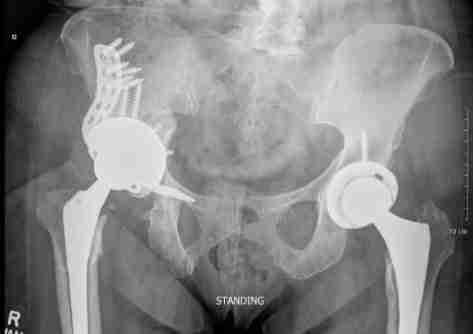
- Loosening. The bond between implant and bone fails over time, often from wear debris dissolving surrounding bone — sometimes shortly after surgery, sometimes years later. Where it hurts points to which component: a loose socket (the cup) tends to cause groin and buttock pain, while a loose stem produces thigh pain and sometimes groin pain. The classic pattern is pain with the first steps after sitting that worsens with activity. Many factors play a role — component fit and sizing, how much weight-bearing activity you demand of the hip, and your age. Whether cemented or uncemented implants loosen more often is still an open research question. Comparison imaging plus a detailed history of your activity and pain usually settles the diagnosis, and the fix is typically revision surgery.
- Infection. Any surgery carries infection risk, ranging from a superficial infection of the incision (cellulitis) to a deep infection around the implant itself — a periprosthetic joint infection. Deep infection is uncommon, affecting fewer than 1% of hip replacements, but it never resolves on its own and can loosen an otherwise solid implant. It can be dramatic — warmth, swelling, drainage, fever — or smolder quietly for months with nothing but a dull, constant ache, including at rest and at night. Risk is higher with obesity, uncontrolled diabetes, rheumatoid arthritis, cardiovascular disease, chronic kidney disease, smoking, heavy alcohol use, and depression. Every painful hip replacement is screened for infection, no exceptions.
- Instability. Components positioned outside the safe zone, or weakened soft tissues, can let the ball sublux or dislocate. Patients describe slipping, clunking, or a hip they no longer trust. Contributors include implant position, spine problems that change how the pelvis moves, other medical conditions — and, after a posterior-approach replacement, not following the early movement precautions. Strengthening the core and hip muscles improves stability in milder cases; recurrent instability often requires revision to correct.
- Fracture. A periprosthetic fracture — a break in the bone around the implant — usually follows a fall and causes sudden new pain that needs prompt attention. But fractures can also appear with no injury at all: insufficiency fractures are small stress fractures that develop when a newly active patient asks more of the bone than it can yet handle. Because a new hip changes how load travels through the pelvis, these can occur away from the implant entirely — in the pubic ramus or elsewhere in the pelvis — producing unexplained hip, thigh, or pelvic pain. Imaging finds them; many heal with rest and protected weight-bearing, while some require fixation surgery.
- Metal reaction. Metal-on-metal bearings — a discontinued design once expected to last longer, which instead failed early — and corrosion where the head joins the stem can shed metal debris that inflames the surrounding tissue, causing pain and fluid collections. Blood tests measure metal ion levels, and specialized imaging gauges the thickness and volume of the inflamed joint lining — seeing the reaction long before an ordinary X-ray shows anything. The treatment is revision to components the body tolerates. Patients who suspect a metal sensitivity deserve this workup, not reassurance.

Causes 6–10: pain around a well-fixed implant
Just as often, the implant is fine — and something around it is not. These extrinsic diagnoses are missed precisely because the X-ray looks perfect, which reassures everyone except the patient. The good news: most respond to conservative treatment.
- Impingement and iliopsoas tendinitis. The hip flexor tendon can rub against the front edge of the socket, causing groin pain when actively lifting the leg — climbing stairs, getting out of a car. Component sizing plays a role in soft-tissue irritation more broadly: implants sized too large can overstretch and irritate the tendons, while undersized components leave the soft tissues under-tensioned and raise the risk of dislocation. Pain can involve the groin, the front of the hip, and even the thigh or buttock. Physical therapy to stretch and strengthen the surrounding muscles resolves most cases; occasionally revision is needed to restore a pain-free range of motion. This is one of the most commonly missed diagnoses after hip replacement.
- Trochanteric pain syndrome. The trochanter is the bony prominence you can feel on the outside of your hip, and many tendons and bursae live around it. Tight buttock muscles keep constant pressure on the area, so walking, sitting, and lying on that side all aggravate it — and the trauma and inflammation of the surgery itself can irritate the region, making nearly every daily activity hurt. Therapy plus a steroid injection settles most cases. If outer-hip weakness persists despite therapy, the hip should be evaluated for a gluteus medius tear: this buttock muscle is essential to normal walking, and a partial tear is painful while a complete tear causes a limp.
- Leg-length difference. A real or perceived difference after surgery can strain the back and pelvis, causing aching and a sense of imbalance. Many cases settle as muscles adapt; persistent ones deserve measurement, not reassurance.
- Referred pain from the spine or SI joint. Lumbar arthritis and stenosis routinely masquerade as hip pain — nerves that travel down to the hip become pinched or inflamed, typically causing buttock and posterior thigh pain, sometimes with numbness or tingling. The sacroiliac joint can refer pain to the hip as well when it isn't moving properly. And years of limping on an arthritic hip can leave the spine and pelvis with problems of their own that only surface once the hip is fixed — which is why Dr. Morton evaluates the whole person, not just the joint.
- Nerve irritation or injury. Burning, numbness, or weakness in a specific nerve's territory points away from the joint and toward a nerve — around the incision, deeper in the pelvis, or from the spine. The most common example: the lateral femoral cutaneous nerve travels near the incision of an anterior hip replacement and can be stretched during surgery, leaving a numb patch on the thigh. Numbness alone is usually harmless, but a cut nerve can occasionally form a painful neuroma. Some surgeons routinely sacrifice this nerve during more extensive exposures; Dr. Morton's minimally invasive technique is designed to protect it. A focused physical examination sorts out which nerve is involved.
The systematic workup: how the cause gets found
Finding the answer is a process of elimination done in a deliberate order — not a shrug and a follow-up in six months. It starts with your story: when the pain began, where it lives, and what provokes it. Pain present since the day of surgery points to a different list than pain that appeared five comfortable years later; groin pain points differently than pain over the outside of the hip. A hands-on exam narrows the list further before a single test is ordered.
Then the tests confirm or exclude each remaining suspect, starting with infection — the one diagnosis that must never be missed. Dr. Morton's Revision Hip & Knee Replacement Clinic is built around exactly this evaluation, with on-site X-ray and access to Metal Artifact Reduction MRI, so most of the workup happens in one place.
- Comparison X-rays — today's images against your earliest post-op films, looking for migration or lucent lines
- Blood tests — ESR and CRP, the standard screening tests for infection
- Hip aspiration — joint fluid drawn for cell counts and culture when infection is suspected
- Blood metal ion levels — when a metal reaction or metal-on-metal bearing is in question
- Metal Artifact Reduction (MARS) MRI — sees soft tissue around metal implants that ordinary MRI cannot, including the thickened joint lining of a metal reaction
- Targeted diagnostic injections — numbing one structure, like the iliopsoas tendon, to confirm it is the source
- Spine and SI joint evaluation — when the pattern points above the hip rather than at it
When every test comes back normal
A small group of patients — between 6% and 27% in published studies — experience persistent post-surgical pain with no identifiable structural cause. That is a real finding, not a failure of the workup: it means the implant is sound, infection has been excluded, and nothing around the hip is broken or torn. In that situation, the pain itself becomes the condition to treat, and referral to a pain management specialist is the right next step. Pain management physicians are genuinely helpful with pain that is not coming from the hip replacement — and a thorough negative workup is exactly what lets them treat it with confidence.
Treatment matched to the cause — often without surgery
The treatment follows the diagnosis, and for several of the ten causes it never involves an operating room. Trochanteric pain and iliopsoas tendinitis usually respond to therapy and targeted injections. Spine-referred pain gets spine care, not hip surgery. Insufficiency fractures often heal with rest and protected weight-bearing. Small leg-length perceptions often resolve with time and strengthening or a simple shoe adjustment. Getting one of these diagnoses is genuinely good news — it means the implant is sound and the fix is measured in weeks, not another operation.
When the implant itself is the problem — loosening, infection, instability, fracture, or metal reaction — revision hip replacement by a fellowship-trained arthroplasty surgeon is a well-established solution. Outcomes are consistently better when the cause is found early: less bone is lost to a loosening implant, an infection is easier to clear, and the surgery itself stays smaller. Watching a painful hip for years is not a conservative choice — it usually just makes the eventual fix bigger. If you've been told nothing is wrong but the pain says otherwise, a structured second opinion is reasonable and routine — bring your operative notes and implant records if you have them. Wherever you had your original surgery, schedule a consultation and get the workup your hip deserves.
Medically reviewed by Paul Norio Morton, MD, FAAOS, FAAHKS. Last reviewed: . This article is for education only and isn’t a substitute for an exam and personalized advice — schedule a consultation to discuss your situation.