
Do gel injections work for knee arthritis? The short answer
For some knees, yes — modestly, for months; for others, little. Hyaluronic acid (gel) injections replace lost lubrication in a mild-to-moderate knee, are given as one shot or a short weekly series, and are often insurance-covered. They do not regrow cartilage. Dr. Paul Morton, a fellowship-trained knee surgeon in Honolulu, matches the product to the knee and coverage, places it under ultrasound, and says plainly when another option fits better.
- Best for — a mild-to-moderate arthritic knee that feels dry and grinding rather than hot and swollen
- Onset and duration — relief builds over two to three weeks; when it works, it commonly lasts several months
- Evidence — mixed on average; the AAOS guideline does not recommend routine use, but cross-linked single-injection products have done well in head-to-head trials
- Coverage — often covered for knee arthritis, usually with prior authorization; the office handles the paperwork
- Steroid-free — won't raise blood sugar, which matters for patients with diabetes
What hyaluronic acid injections actually do
Hyaluronic acid is a natural component of the fluid inside your joints — a glycosaminoglycan that helps make healthy joint fluid thick, slippery, and shock-absorbing. In an arthritic knee that fluid thins and turns watery, so it loses its cushion and the bones grind against each other with more friction. A hyaluronic acid injection — often called viscosupplementation, a “gel shot,” or even a “rooster shot” (the earliest versions were purified from rooster combs) — replaces some of that lost lubrication directly inside the joint.
Think of it as topping up the oil in a hard-working joint rather than rebuilding the parts. It does not regrow cartilage or reverse arthritis, and it isn't an anti-inflammatory in the way cortisone is. What it can do for the right knee is help the joint glide more comfortably for months at a stretch. There's also reason to think it works beyond pure mechanics: laboratory and clinical evidence suggests hyaluronic acid can calm overactive inflammatory cells, coat and desensitize the nerve endings inside the joint, and even nudge the joint lining toward making better fluid of its own. It sits alongside cortisone and biologics on the broader menu of joint injections a surgeon can offer.
Single shot or a series?
There's no single right answer, because different gel products are formulated differently. Some are designed as a single injection, while others are given as a short series of weekly shots — commonly three to five, depending on the specific product. All are delivered in the office, and image guidance is used when it improves accuracy, especially in a knee that's hard to enter cleanly.
The practical differences come down to convenience, cost, and what your insurance will cover. A single-injection product means one visit; a series means a few. Neither is automatically better — what matters is choosing a product that suits your knee and your coverage, and placing it accurately into the joint. A gel shot that lands in the soft tissue instead of the joint space does nothing, which is one more reason placement matters as much as the product. But the products themselves are not interchangeable, and understanding why is worth a moment.
Not all gels are the same: molecular weight and cross-linking
Hyaluronic acid products differ in two ways that affect how long they last inside the joint: molecular weight and whether the strands are cross-linked.
Molecular weight describes the length of the hyaluronic acid chain. A higher-molecular-weight product has longer chains, which in theory linger in the joint longer before the body breaks them down. Cross-linking goes a step further — it chemically ties the strands together into a more stable, resilient gel that resists breakdown. Durolane, for example, packs a high concentration of cross-linked hyaluronic acid into a single 3 mL injection, while Synvisc and Gel-One are also cross-linked formulations. Lower-molecular-weight, non–cross-linked products tend to be given as a series because each dose clears more quickly.
| Feature | What it means | Why it matters |
|---|---|---|
| Molecular weight | The length of the hyaluronic acid chain | Longer chains (higher weight) tend to stay in the joint longer |
| Cross-linking | Strands chemically tied into a more stable gel | Resists breakdown, which can extend the effect — e.g. Durolane, Synvisc, Gel-One |
| Single vs. series | One 3 mL injection vs. three to five weekly shots | Convenience and cost differ; coverage often drives the choice |
None of this makes one brand universally “best.” It simply explains why Dr. Morton matches the product to the knee and the coverage in front of him rather than defaulting to whatever a sales rep is promoting — the injection you're offered here is chosen on evidence, not on marketing.
What the evidence honestly shows
This is where you deserve candor. The research on hyaluronic acid is genuinely mixed. Across large studies the average benefit is modest, and major guidelines have gone back and forth on whether to recommend it. The current position of the AAOS clinical practice guideline on non-arthroplasty management of knee osteoarthritis (3rd edition, 2021) is that hyaluronic acid injections are not recommended for routine use (a moderate-strength recommendation) — which is a large part of why coverage rules and expert opinions differ. That's the part clinics selling gel don't always mention, and you should hear it plainly before you decide.
Part of the reason the averages look muddy is that studies lump very different products together — high- and low-molecular-weight, cross-linked and not, single-shot and multi-dose — as if they were one treatment. When you separate them, some formulations hold up better than others (more on that below). And averages always hide the individual: a meaningful number of patients get real, months-long relief from gel and are glad they tried, while others notice little. Because gel is low-risk and often covered, a carefully chosen trial is reasonable for the right knee — as long as you go in understanding it may or may not help you specifically. If your knee has more active inflammation than mechanical dryness, PRP (who responds and who doesn't) or a cortisone shot may be the better fit; matching the tool to the problem beats defaulting to any one injection.
What the head-to-head studies show
When researchers compare specific products against each other, instead of pooling them all together, the picture sharpens. The cross-linked, single-injection formulations have generally performed well:
- Gel versus steroid. In a randomized, double-blind trial of 442 patients (Leighton et al., Osteoarthritis and Cartilage, 2014), a single injection of a cross-linked hyaluronic acid (NASHA) was compared with a methylprednisolone steroid injection. At 12 weeks the two performed about the same — roughly 45% of patients in each group met the pain-responder threshold. The difference showed up afterward: the gel's benefit was maintained through 26 weeks while the steroid's declined.
- Gel versus PRP. In head-to-head trials for knee arthritis, PRP has on average outperformed hyaluronic acid at six to twelve months — but PRP is cash-pay and gel is often covered, so a well-chosen gel trial is a reasonable first step for many knees.
These numbers describe averages from selected studies, not a promise for any one knee. They're most useful as a reminder that which gel is chosen — and how accurately it's placed — genuinely matters.
A good option when cortisone isn't
Gel earns a particular place on the treatment ladder for two groups of patients. First, when a cortisone shot has stopped working, or its relief has become too short-lived, gel offers a completely different mechanism to try before moving on to surgery. Second, because hyaluronic acid contains no steroid, it won't raise blood sugar — which makes it a genuinely useful option for patients with diabetes, for whom repeated cortisone injections can be a real problem.
Are you a candidate for gel injections?
Unlike PRP, hyaluronic acid gel is often covered by insurance for knee arthritis, though many plans require prior authorization and proof that simpler measures were tried first. Our office verifies your coverage and handles the paperwork before you commit to anything.
You may be a candidate if…
- Your knee has mild-to-moderate arthritis, especially when it feels dry and grinding rather than hot and swollen
- You want to postpone surgery and prefer an insurance-covered treatment
- You have diabetes and need a steroid-free option that won't disturb blood sugar
- A cortisone shot has stopped working or its relief has become too short-lived
- Less useful if the knee is end-stage, bone-on-bone, where relief tends to be limited
- Not a fix for a mechanical problem like a locking meniscus tear — that needs its own diagnosis (is my knee clicking a meniscus tear?)
- Often combined over time with strengthening, weight management, and other rungs of the treatment ladder
What the visit is like
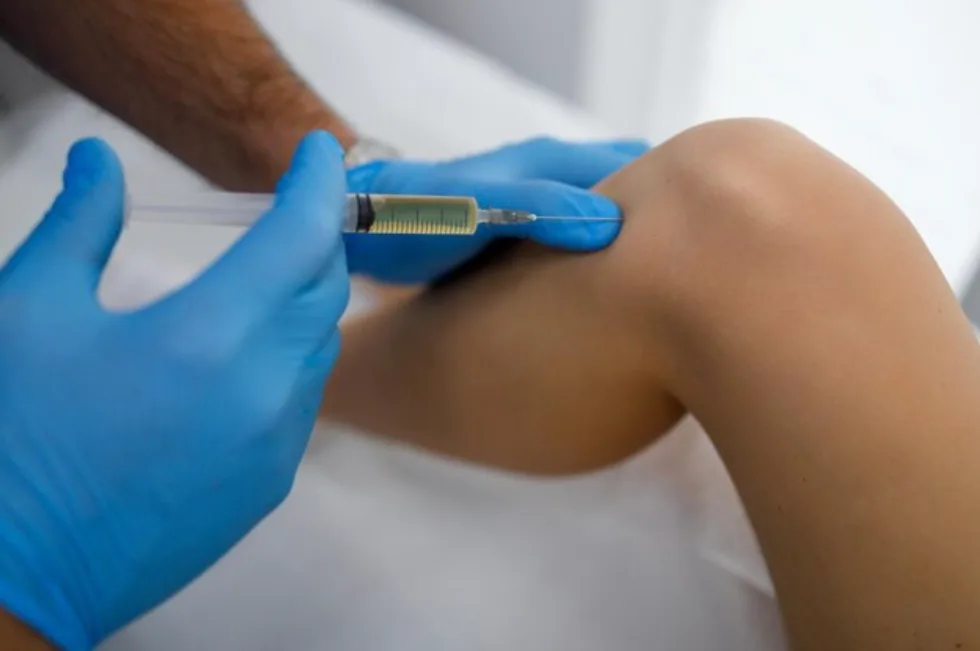
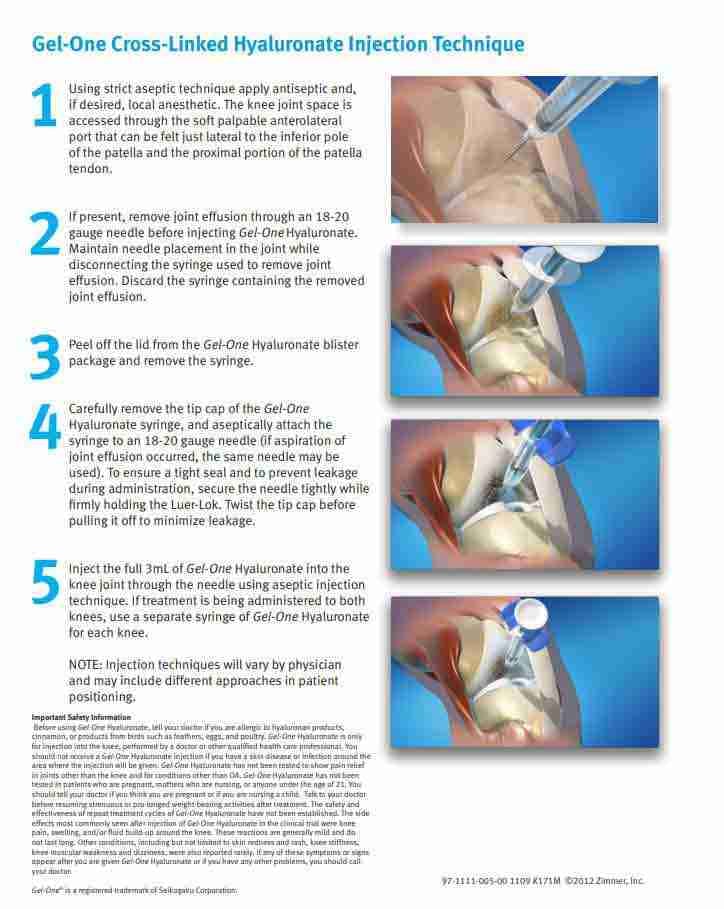
A gel injection is a quick office procedure that takes only a few minutes, with no anesthesia beyond local numbing. The skin is cleaned and numbed, and the injection is placed into the joint — under ultrasound guidance when the target calls for it, because gel has to land inside the joint capsule to do anything at all.
If the knee is holding excess fluid, Dr. Morton may first draw off a small amount of that effusion through the same needle to relieve pressure before delivering the gel; when both knees are being treated, a separate syringe is used for each. You'll leave with a small bandage and can drive yourself home.
- Step 1
Diagnosis and authorization
Exam and X-rays confirm the knee fits; the office secures prior authorization when your plan needs it.
- Step 2
Numb and, if needed, drain
Skin is cleaned and numbed; excess fluid may be drawn off first to relieve pressure.
- Step 3
Ultrasound-guided injection
The gel is placed inside the joint capsule — it does nothing if it lands in soft tissue.
- Step 4
Home the same day
A small bandage; drive yourself home; easy day, no hard impact for a day or two.
- Step 5
Weeks 2–3
Relief builds gradually; many notice a meaningful difference by about three weeks.
- Step 6
Follow-up
Measure whether it earned its place; a series is repeated only if it helped.

Recovery and when relief arrives
Afterward, take it easy for the rest of the day and avoid hard-impact activity for a day or two. It's sensible to skip swimming pools, hot tubs, and anything that could introduce bacteria through the tiny needle track while it seals — usually within about 24 hours. Some patients feel mild soreness or a sense of fullness in the knee, which typically settles quickly with ice and an over-the-counter pain reliever.
Unlike PRP, gel isn't meant to provoke a healing flare, so significant swelling or increasing pain is worth a phone call rather than something to push through. Relief, when it comes, tends to build over a couple of weeks rather than arriving overnight — some patients notice a meaningful difference within about three weeks. Give the treatment a fair window before judging it, and keep your follow-up so Dr. Morton can measure whether it earned its place in your plan. If a gel series helped last year and the effect has faded, repeating it is reasonable; if two honest trials did little, that's a signal to move to a different rung of the ladder rather than keep chasing the same shot.
Side effects and safety
Hyaluronic acid has a strong safety record, and most side effects come from the injection itself rather than the gel. In the day or two afterward you may notice temporary pain, swelling, warmth, or a sense of fullness at the joint, along with some redness, itching, or bruising around the injection site. These usually fade on their own. A few points deserve genuine caution:
- Allergic reactions are rare, but anyone with a history of severe hypersensitivity or anaphylaxis should tell Dr. Morton before treatment; stable, cross-linked formulations tend to carry the lowest risk.
- Pseudosepsis is an uncommon reaction that mimics an infected joint — fever, severe pain, and difficulty bearing weight. It isn't a true infection, but call the office right away so the symptoms can be evaluated properly.
- Pregnancy and breastfeeding: the safety of hyaluronic acid injections hasn't been established during these times, so they're generally avoided.
How to decide
The smartest way to approach gel injections is to treat them as one option among several, not a default. A knee that's dry and mechanically stiff may do well with gel; a knee flaring with inflammation may respond better to cortisone; a knee with cartilage worth protecting may be a candidate for biologics — the injections page compares all of them in one table. And a knee that's truly worn out may be ready for a frank talk about knee replacement.
That decision should follow a real diagnosis — an exam and X-rays — not a guess. As a fellowship-trained hip and knee surgeon, Dr. Morton can offer every rung of the ladder, which means the recommendation you get is the one your knee actually needs, not the one a single-product clinic happens to sell.
What happens next. Start with an orthopedic consultation or call (808) 439-6201. Gel injections are given at Pacific Bone & Joint in Honolulu (Ala Moana), West O‘ahu (Kunia), Hilo, and Kona. Bring a photo ID, your insurance card, a medication list, and any prior X-rays; managed-care and Medicaid/Quest plans may need a referral from your primary care physician, which the office checks before your visit. If travel isn't practical, a telehealth consultation can review your imaging first, with the injection done in clinic.
Medically reviewed by Paul Norio Morton, MD, FAAOS, FAAHKS. Last reviewed: . This article is for education only and isn’t a substitute for an exam and personalized advice — schedule a consultation to discuss your situation.