
Partial knee replacement in Honolulu — the short answer
A partial (unicompartmental) knee replacement resurfaces only the one worn compartment of an arthritic knee and leaves the ligaments, healthy cartilage, and bone alone. It is for patients whose arthritis is confined to a single compartment with an intact ACL. Dr. Morton plans every partial in 3D and performs it with robotic assistance, through a smaller incision, without a tourniquet. Most patients walk the day of surgery and go home the same day; many walk normally within two to three weeks. Individual results vary.
- What is kept: ACL, PCL, and every healthy compartment
- Going home: same day for most patients
- Walking normally: 2–3 weeks for many; driving about 2–6 weeks on average, only once completely off narcotic pain medication (sooner for a left knee with an automatic)
- The trade-off: partial knees are revised somewhat more often than total knees over a lifetime
- Where: The Queen's Medical Center, Adventist Health Castle, or Hilo Community Surgery Center
What is a partial knee replacement?
A partial (unicompartmental) knee replacement resurfaces only the arthritic compartment of your knee and leaves the rest of the joint alone. Your knee has three compartments: the medial (inner side), the lateral (outer side), and the patellofemoral (behind the kneecap). Arthritis often wears out one compartment while the other two stay healthy.
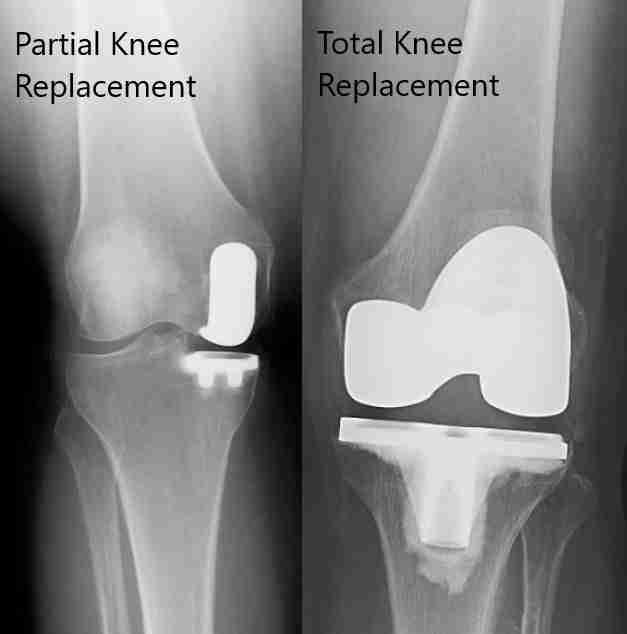
The distinction from a total knee replacement is bigger than it sounds. In a total knee, all three compartments are resurfaced and the anterior cruciate ligament (ACL) is removed — often the posterior cruciate ligament (PCL) as well. In a partial knee, only the worn surfaces are capped with metal and a smooth plastic bearing; your ACL, PCL, and every bit of healthy cartilage remain exactly where they belong. That is why partial knees are best understood as a resurfacing of the damaged area rather than a replacement of the whole joint — and why patients with a partial knee tend to recover faster and are more likely to end up with a knee that feels like their own.
The types of partial knee replacement
Each compartment of the knee can be resurfaced independently, so "partial knee replacement" is really a family of operations. Dr. Morton performs all of them, matching the implant to the exact pattern of your arthritis:
| Type | What it resurfaces | Notes |
|---|---|---|
| Medial unicompartmental | The inner side of the knee | By far the most common pattern of single-compartment arthritis |
| Lateral unicompartmental | The outer side of the knee | Less common; demands especially precise balancing |
| Patellofemoral arthroplasty | Behind the kneecap | For kneecap-only arthritis |
| Bicompartmental | Two compartments | Occasionally two worn compartments are resurfaced while the ligaments are still preserved |
Standing X-rays — and sometimes an MRI — map which compartments are worn and which are worth keeping, so the operation is tailored to your knee rather than the other way around.
The benefits: why a partial knee often feels more natural
Because your ligaments and healthy cartilage stay in place, a partial knee tends to feel more like your own knee than a total replacement does. The intact ACL preserves the joint's normal motion and position sense, and far less bone is removed.
The surgery itself is smaller too: a shorter incision, less blood loss, and less tissue disruption mean an easier early recovery. Most patients walk the day of surgery, and same-day discharge is common through the outpatient joint replacement program.
- ACL and PCL preserved — more natural motion and stability
- Smaller incision and less blood loss than a total knee
- Less pain in the early recovery
- More of your own bone and cartilage kept
- Same-day discharge is common for healthy patients
- Typically a faster return to daily life
Why robotic precision matters most in partial knees
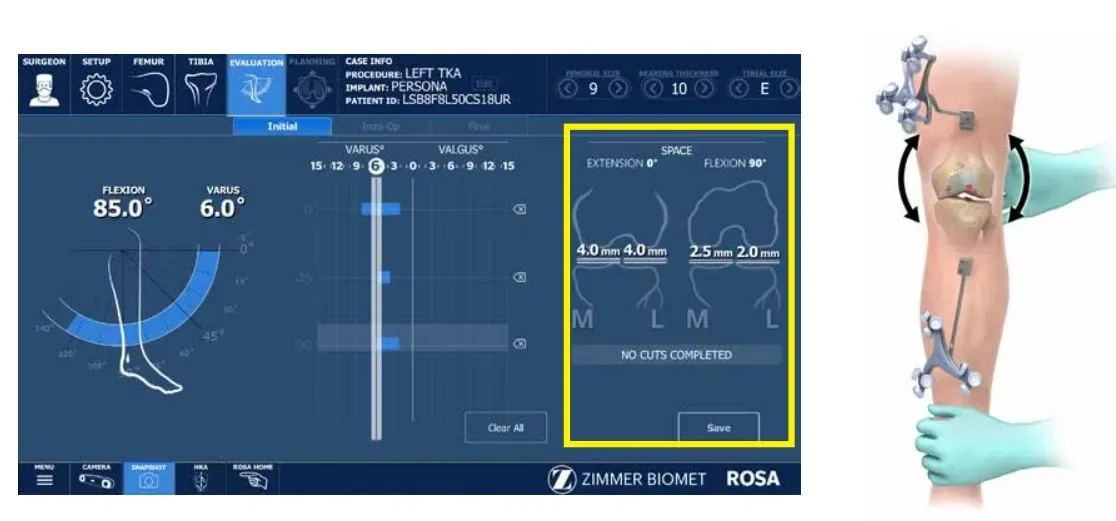
A partial knee leaves less room for error than a total knee. The new component has to match the height, slope, and tension of the compartments you keep — small positioning errors are a leading reason partial knees fail early.
That is why Dr. Morton, known as "The Robot Doc," plans every partial knee in 3D and executes it with robotic assistance. He is certified on four robotic platforms — ROSA®, MAKO, CORI, and VELYS — and uses the technology to fine-tune component position and ligament balance to the millimeter, protecting the healthy part of your knee while the worn part is resurfaced. Robotics helps in any knee replacement; in a partial, it is where the technology earns its keep.
The honest trade-off: partials are revised more often
Partial knees have one well-documented downside: over a lifetime, they are more likely to need a second operation than total knees. Joint registries around the world consistently report higher revision rates for partial knees, for two main reasons.
First, a partial resurfaces only part of the knee, and in some patients that shifts extra pressure onto the compartments that were left alone. Over years, that added load can accelerate degenerative wear in the un-resurfaced cartilage — arthritis progressing in the very areas the operation preserved. Second, component positioning is simply less forgiving in a partial knee. The best defense against both problems is accurate implant placement, which is exactly what robotic assistance delivers.
The reassuring part is that converting a partial knee to a total knee is generally simpler than revising a failed total knee. It is still a revision, though: results are usually not quite as good as a first-time total knee, and augments or stems are sometimes needed to make up for bone loss. Dr. Morton runs a dedicated revision clinic for exactly these knees. If you want the full comparison, read partial versus total knee replacement. Dr. Morton will walk you through both sides of the ledger before you decide anything.
Is a partial knee replacement right for you?
A partial knee is a good option if you have severe knee pain that has not improved with conservative treatment, and your arthritis is confined to a single compartment with an intact ACL and only mild, correctable deformity. If arthritis involves more than one compartment, a partial knee is likely to fail early and lead to revision surgery — which is why the imaging work-up matters so much.
Surgery is worth considering when knee pain starts taking over specific areas of your life:
- Activities of daily living — household chores or grocery shopping have become a struggle
- Activities you enjoy — long walks, golf, riding a bike, or gardening are off the table
- Work — you can no longer perform the functions of your job
- Family life — pain gets in the way of playing with your grandchildren or doing things with your spouse
When Dr. Morton will steer you toward a total knee instead
Some knees should not get a partial. If you have severe deformity, loss of ACL function, inflammatory arthritis such as rheumatoid arthritis, severe ligament damage, or advanced arthritis across multiple compartments, a partial knee carries a high chance of failure and a likely future revision knee replacement. In those knees, a total knee replacement is the more reliable operation — and Dr. Morton will tell you so plainly, and explain exactly why.
The goal is not to do the smallest surgery possible — it is to do the one operation most likely to give you a knee that works for decades. Schedule a consultation or call (808) 439-6201 to find out where your knee stands.
- You may be a candidate if standing X-rays show arthritis in one compartment and the others are healthy
- You may be a candidate if your ACL is intact, your knee still straightens well, and any deformity is mild and correctable
- You may be a candidate if pain persists despite therapy, medication, and injections
- It is probably not the right operation if two or three compartments are worn, the ACL is gone, or you have inflammatory arthritis such as rheumatoid arthritis
- It may be too soon if your arthritis is mild or you have not yet tried nonsurgical care
Recovery after partial knee replacement
You will begin walking the day of surgery, as soon as the anesthesia wears off, with a physical therapist at your side. Most healthy patients go home the same day — Dr. Morton performs partial knees at The Queen's Medical Center, Adventist Health Castle, and Hilo Community Surgery Center on the Big Island.
Pain control starts in the operating room and is deliberately layered: nerve blocks, intra-operative injections, and a low-narcotic, multimodal medication plan so you can move early without being fogged by opioids. Expect some pain while you heal — recovery is real work, and rebuilding muscle strength takes effort. A walker or cane helps in the early going; most patients shed them quickly, but use whatever keeps you steady for as long as you need it.
| Milestone | Typical timeline |
|---|---|
| Stand and walk with physical therapy | Day of surgery |
| Home | Same day for most patients |
| Walking normally | 2–3 weeks for many |
| Back to many activities | Around 6 weeks |
| Continued gains in strength and stamina | Over the first year |
| Full benefit of the new knee | Sometimes up to 2 years |
Because your ligaments and quadriceps mechanism are untouched, therapy starts from a stronger baseline than after a total knee, focusing on quadriceps strength and confidence rather than protecting a healing repair. Physical therapy is available at Dr. Morton's Kunia and Honolulu locations. Individual timelines vary with your age, health, and the knee you started with.
- Day 0
Stand and walk
As soon as the anesthesia wears off, a physical therapist has you up and walking; most healthy patients go home the same day.
- Weeks 1–2
Walker to cane
Layered, low-narcotic pain control; short frequent walks; most patients shed the walker quickly.
- Weeks 2–4
Walking normally, driving
Many walk normally by 2–3 weeks; driving returns at about 2–6 weeks on average once completely off narcotic pain medication (sooner for a left knee with an automatic).
- Week 6
Back to many activities
Low-impact activity for many patients; therapy focuses on quadriceps strength and confidence.
- Year 1
Continued gains
Strength and stamina keep improving; the full benefit can take up to two years.
Goals — and realistic expectations
The goal of a partial knee replacement is to give you the best opportunity at a normal-feeling knee that lets you return to the activities you enjoy — long walks, dancing, golfing, gardening, and biking. It is an operation with a long track record: decades of results showing reduced pain, restored independence, and improved quality of life.
Honesty matters here too. A knee replacement may not solve every problem your knee has — but more than 90% of patients who undergo a partial knee replacement have a dramatic improvement in their knee pain and get back to a normal lifestyle.
One thing to protect for the long haul: the plastic bearing in your new knee can wear over time, and excess body weight or high-impact activity speeds that wear up. The American Association of Hip and Knee Surgeons advises patients with any knee replacement to avoid running, jogging, jumping, and other high-impact activities. Trade the pavement pounding for the pool, the bike, or the golf course, and your partial knee will thank you for years.
Risks of partial knee replacement
Despite every technological and medical advance, partial knee replacement is still surgery, and it carries real risks. Dr. Morton believes you deserve the full list before you consent to anything — and he will go through each one at your consultation, along with how his protocol addresses it.
Two risks are specific to partials. First, arthritis can progress in the compartments that were left alone — the most common reason a partial is eventually converted to a total knee. Second, in mobile-bearing designs the polyethylene insert can, rarely, dislocate and require reoperation; fixed-bearing designs avoid that particular problem. Both are reasons accurate positioning matters so much, and why Dr. Morton is selective about who gets a partial. If a partial ever does fail, the conversion is a revision — generally simpler than revising a failed total knee, but still a bigger operation than the original, and one the partial knee revision guide covers honestly.
- Infection
- Blood loss
- Blood clots
- Wear or arthritis progression in the compartments that were not resurfaced
- Bearing dislocation (mobile-bearing designs — rare)
- Fracture
- Implant loosening
- Knee stiffness
- Nerve or blood vessel damage
- Need for conversion to a total knee replacement years later
How to find out if you are a partial-knee candidate
The answer is on your standing X-rays, so the fastest route is to get them in front of Dr. Morton.
Schedule an orthopedic consultation at any of Dr. Morton's four Pacific Bone & Joint clinics — Honolulu (Ala Moana), West O‘ahu (Kunia), Hilo, or Kona — or call (808) 439-6201. Most new patients are seen within one to two weeks. Bring a photo ID, your insurance card, a list of current medications, and any prior imaging or operative reports; if your X-rays were taken in Hawai‘i, the office can usually retrieve them electronically, and new standing X-rays are taken in the clinic at the same visit. Managed-care and Medicaid/Quest plans may need a referral from your primary care physician — the office checks before your visit. When an in-person visit isn't practical — a neighbor island without a nearby clinic, or a patient traveling from across the Pacific — a telehealth visit with existing X-rays can start the process. You will leave knowing which compartments are worn, which are worth keeping, and whether a partial, a total, or no surgery at all is the right call.
Medically reviewed by Paul N. Morton, MD, FAAOS, FAAHKS — board-certified orthopedic surgeon, fellowship-trained in adult hip & knee reconstruction and orthopedic trauma. Last reviewed: .
This page is for education only and isn’t a substitute for an exam and personalized advice — schedule a consultation to discuss your situation.