
Most partial knees do well — so why does yours hurt?
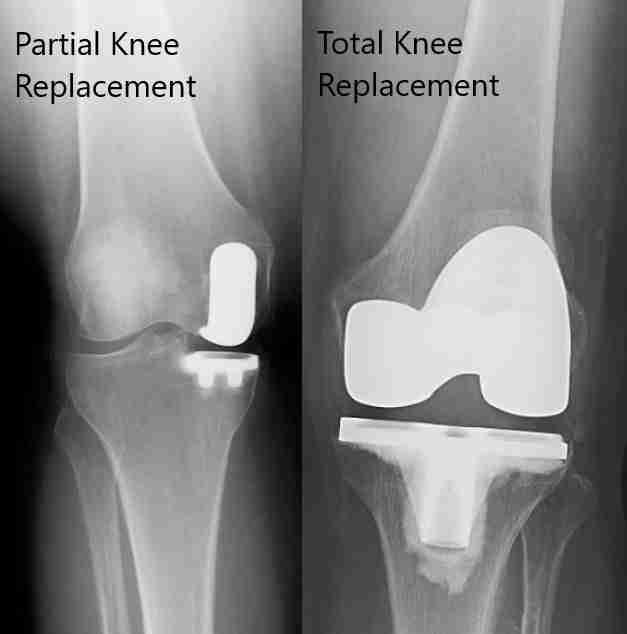
A painful partial knee replacement almost always has an identifiable cause — and finding it is the whole game. In a partial (unicompartmental) knee replacement, only the arthritic compartment is resurfaced; the rest of your knee keeps its own cartilage and ligaments. When the right knee gets a partial, the result feels remarkably natural. But joint registries consistently show that partial knees are revised more often than total knees, and the reasons cluster into a short list: arthritis progressing elsewhere in the joint, a loosening or poorly fitting component, or a knee that was never a great candidate for a partial in the first place. Pinning down which one applies to you takes a methodical workup — never guesswork, and never surgery for pain nobody can explain.
Cause one: arthritis progressing in the rest of the knee
The most common long-term reason a partial knee starts hurting is that arthritis advances in the compartments that were left alone. The implant itself may be perfect — but the cartilage next door was living tissue, and living tissue can wear. Patients usually notice this as a new pain in a new place: an ache on the opposite side of the knee, or pain behind the kneecap on stairs and hills, often years after a stretch of excellent function. X-rays typically tell the story by showing joint-space narrowing in a previously healthy compartment. Progression is not a failure of the surgery or anything you did wrong; it is the known trade-off of preserving most of your natural knee, and it is one of the core topics in choosing between a partial and a total knee up front. The good news: when progression is the diagnosis, the solution is well defined. Converting to a total knee addresses every compartment at once, and because the diagnosis is clear, the results of that conversion are far more predictable than surgery done for pain no one can explain.
Cause two: loosening, wear, and component problems
The second cluster of causes lives at the implant itself. Aseptic loosening — the bond between component and bone gradually failing, most often on the tibial side — produces a deep, load-related ache that eases with rest. Polyethylene wear can thin the plastic bearing over many years. And component overhang, where an edge of the implant extends a few millimeters past the bone, can irritate the soft tissues and tendons along the inner knee, causing a sharp, well-localized pain that starts early and never quite settles. These problems announce themselves differently: loosening tends to appear on serial X-rays as a lucent line creeping along the implant, while overhang is often visible on the very first film if someone looks for it. This is exactly why routine implant surveillance matters — comparison X-rays over time catch a loosening partial long before it becomes a reconstruction problem.
Cause three: the wrong knee for a partial in the first place
Some painful partials were set up to struggle from the start. A partial knee depends on the rest of the joint being healthy: intact ligaments — especially the ACL — good cartilage in the other compartments, and arthritis genuinely confined to one area. When a partial is placed into a knee with inflammatory arthritis, an ACL-deficient knee, or arthritis that was already more widespread than it appeared, the remaining joint keeps degenerating and the implant gets blamed for pain it didn't cause. Careful patient selection is the single biggest driver of partial knee success, which is why a fellowship-trained arthroplasty surgeon will sometimes talk a patient out of a partial even when the X-ray looks tempting. The pattern to watch for here is pain that never really improved after surgery, or a knee that aches diffusely rather than in one spot. If that describes your knee, the question isn't whether the implant failed — it's whether the whole joint needed treating from the beginning.
Before anyone talks revision: the workup
Revising a knee for unexplained pain has poor results — that is one of the most consistent findings in revision surgery. So the diagnosis comes first. At Dr. Morton's Revision Hip & Knee Replacement Clinic, the workup is systematic: infection is excluded with blood work and, when needed, joint aspiration, because even a low-grade infection changes everything. Weight-bearing and serial X-rays are compared, on site, against your prior films. Metal Artifact Reduction MRI can see the cartilage and soft tissues around the implant that ordinary MRI cannot. And pain referred from the hip or spine is actively ruled out — a surprising number of "knee" problems don't start in the knee. Only when the workup produces a clear diagnosis does the conversation turn to treatment, and not every diagnosis leads to an operation; some knees simply need time, therapy, or treatment of a problem elsewhere.
- Blood work — and joint aspiration when indicated — to exclude infection
- Weight-bearing X-rays compared against your earlier films
- Metal Artifact Reduction MRI to assess cartilage and soft tissue around the implant
- Evaluation of component position, fit, and any overhang
- Exam of the hip and spine to rule out referred pain
Converting a partial to a total knee: what to expect
When the cause is progression, loosening, or a failing bearing, the usual answer is conversion to a total knee replacement. Here is the encouraging part: because a partial removes so little bone, conversion is generally a more contained operation than revising a failed total knee — in many cases it behaves much like a primary total knee replacement, with a similar recovery. Sometimes bone loss under the old component requires small augments or a stemmed implant, which is routine work for a revision-trained surgeon. Most conversion patients are up and walking the same day, and the rapid-recovery protocol Dr. Morton uses for primary knees — multimodal pain control, early mobilization, and structured therapy — applies here too. Outcomes after conversion are generally good, though studies suggest they can fall slightly short of a first-time total knee — one more reason the underlying diagnosis has to be right before anyone operates. If your partial knee still hurts, start with answers: schedule a consultation and bring your operative report and prior X-rays if you have them.

Medically reviewed by Paul Norio Morton, MD, FAAOS, FAAHKS. Last reviewed: . This article is for education only and isn’t a substitute for an exam and personalized advice — schedule a consultation to discuss your situation.