
The short answer
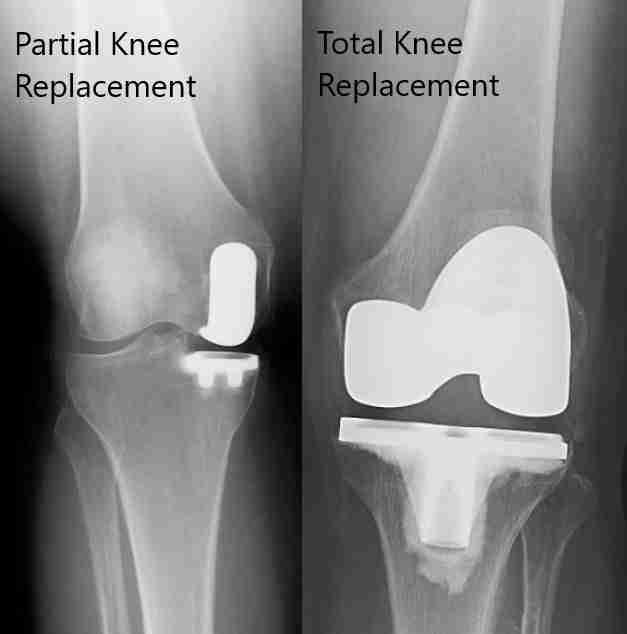
A partial knee replacement resurfaces one worn compartment and preserves everything else — ligaments, healthy cartilage, bone. It recovers faster and feels more natural, but carries a somewhat higher chance of needing another operation someday. A total knee replacement resurfaces the whole joint. It treats arthritis anywhere in the knee, has a decades-long track record, and is revised less often — but it is a bigger operation, and the knee feels more "replaced."
Which one is right is not a matter of preference. It is a matter of anatomy: where your arthritis actually is and what your ligaments look like. That is what an exam and standing X-rays decide. Neither operation is a compromise — a partial is not an incomplete total, and a total is not overkill. Each is the correct operation for a different pattern of arthritis.
- Partial: one compartment resurfaced; ACL and PCL kept; faster early recovery; revised somewhat more often over a lifetime
- Total: whole joint resurfaced; ACL removed; handles any pattern of arthritis; decades-long track record
- What decides: where the wear is and whether the ACL is intact — anatomy, not preference
- Both: planned in 3D and performed with robotic assistance by Dr. Morton in Honolulu
What each operation actually replaces
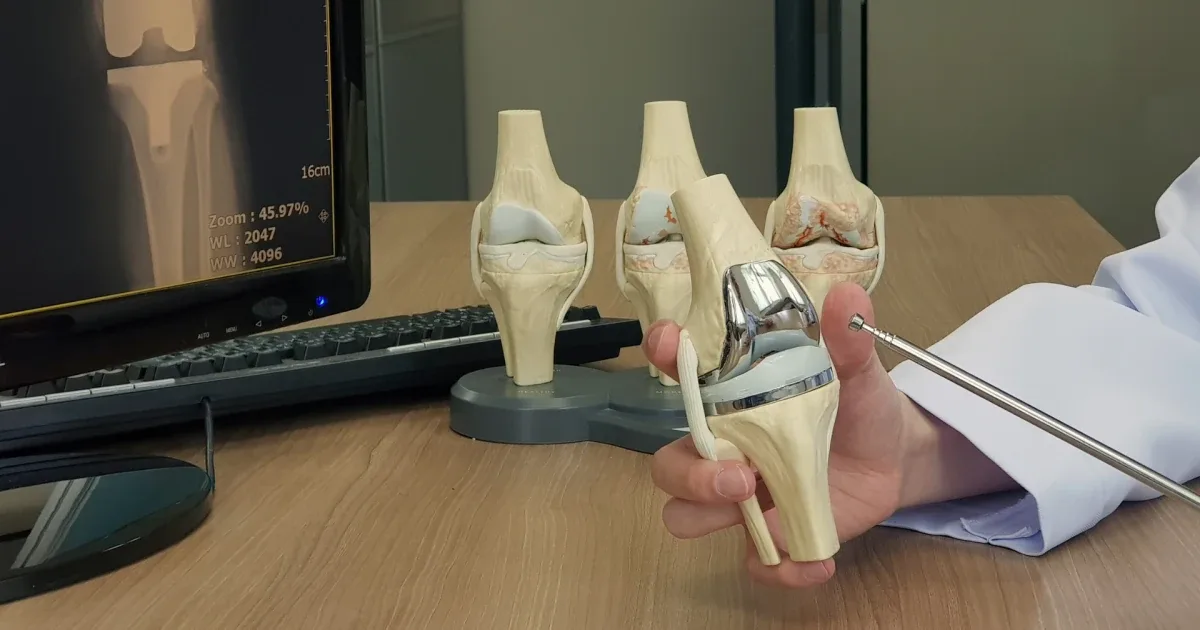
Your knee has three compartments: the medial (inner) side, the lateral (outer) side, and the patellofemoral compartment behind the kneecap. Arthritis can wear out one compartment or all three, and the operation should match the wear.
A partial replacement resurfaces only the diseased compartment. Medial partials are the most common; lateral partials and patellofemoral arthroplasty — the kneecap-only version — cover the other two patterns. Both cruciate ligaments stay in place.
A total knee replacement resurfaces the ends of the femur and tibia across all compartments, and usually the underside of the kneecap as well. The ACL is removed, and the implant's shape takes over its stabilizing job. That design is what lets a total knee handle widespread arthritis, deformity, and ligament damage that would disqualify a partial.
Side-by-side comparison
The partial's advantages all flow from one fact: most of your knee is left alone. The total's flow from its completeness: it treats the whole joint, so arthritis cannot spread into a compartment that was left behind.
| Partial knee replacement | Total knee replacement | |
|---|---|---|
| What is resurfaced | One compartment (medial, lateral, or patellofemoral) | All compartments, usually including the kneecap |
| Ligaments | ACL and PCL preserved | ACL removed; the implant's shape takes over its job |
| How it feels | Closer to a natural knee — both cruciates keep working | Reliable, but feels more "replaced" |
| Incision and blood loss | Smaller incision, less bone removed, less blood loss | Larger operation; 4–6 inch incision with Dr. Morton's robotic technique |
| Early recovery | Faster; same-day discharge common; walking normally in 2–3 weeks for many | Walk the same day; home within a day; sedentary work around 6 weeks |
| Medical complications | Lower rates reported in large comparative studies | Higher — it is a bigger operation |
| Durability | Lasts many years when well selected; revised somewhat more often in registries | About 98% functioning at 10 years, more than 80% at 20; lower lifetime revision rate |
| If revision is needed | Conversion to a total knee — generally simpler than revising a failed total, but still a revision | Revision total knee — a bigger, more complex operation |
| Who qualifies | Single-compartment wear, intact ACL, mild correctable deformity, no inflammatory arthritis | Any pattern — including ACL deficiency, deformity, or inflammatory arthritis |
| Satisfaction | Many report a more natural knee | Studies report up to 20% have some lingering dissatisfaction even with a technically perfect implant |
Every number here is a typical figure across many patients; individual results vary with the knee you start with and the rehab you put in.
Recovery: the first weeks, compared
The recovery difference is most visible in the first six weeks. Partial knee patients typically go home the same day, shed the walker quickly, and are often driving and running errands within a few weeks. Pain medication needs are lower, swelling is less, and the knee tends to bend well early because so little was disturbed.
Total knee patients hit the same milestones on a longer arc. Most walk the day of surgery and go home within a day; therapy is more demanding because more tissue is healing, and regaining full bend takes deliberate work. By a few months out, the two groups look far more alike than different — both operations reliably relieve arthritis pain. The gap is in how the early weeks feel, not in where you end up.
Who actually qualifies for a partial
Roughly, a good partial knee candidate has arthritis confined to a single compartment, an intact ACL, a knee that still straightens well, and a deformity that is mild and correctable. Inflammatory arthritis, significant stiffness, or wear in multiple compartments push the answer toward a total knee.
Selection is everything — most failed partials were the wrong operation for that knee, not a bad operation. Standing X-rays and sometimes an MRI map exactly where the cartilage is gone. Execution matters too: a partial implant must match the height, slope, and ligament tension of the compartments you keep, which is why Dr. Morton plans them in 3D and performs them with robotic assistance. The margin for error in a partial is smaller than in a total, and robotics is where that margin gets protected.
Age by itself is not the deciding factor. Younger, active patients are sometimes steered toward partials to preserve bone for the decades ahead, while older patients often do beautifully with either — the anatomy decides, not the birthday.
- Partial is on the table if arthritis is confined to one compartment on standing X-rays
- Partial is on the table if your ACL is intact, the knee straightens well, and any deformity is mild and correctable
- Total is the reliable answer if two or three compartments are worn, the ACL is gone, or you have inflammatory arthritis
- Either way, it may be too soon if your arthritis is mild or you have not tried nonsurgical care first
A simple decision framework
Three questions settle most cases. First, where is your arthritis? If it lives in one compartment, a partial is on the table; if it involves two or three, a total is the reliable answer. Second, what do your ligaments look like? An intact ACL is a prerequisite for most partials. Third, how do you weigh the trade-off? A partial trades a somewhat higher lifetime revision chance for a more natural-feeling knee and easier recovery; a total trades a bigger operation for maximum durability — knowing that studies report up to 20% of total knee patients have some lingering dissatisfaction even when the implant is technically perfect.
One reassurance tips the scale for some patients: if a partial does eventually need conversion to a total, that operation is generally simpler than revising a failed total knee. It is still a revision, though — results are usually not quite as good as a first-time total knee, and augments or stems are sometimes needed to make up for bone loss. If you have been told you need a total and wonder whether one compartment could be treated instead, a second opinion with your X-rays answers it quickly — or start fresh with an orthopedic consultation.
Get a real answer: bring your X-rays
To get a real answer rather than a general one, bring your existing standing X-rays or have them sent — if they were taken in Hawai‘i the office can usually retrieve them electronically — and if you have none, they are taken at the visit. Call (808) 439-6201 or book online; clinics are in Honolulu (Ala Moana), West O‘ahu (Kunia), Hilo, or Kona. Most new patients are seen within one to two weeks, and managed-care or Medicaid/Quest plans may need a PCP referral. When an in-person visit isn't practical — a neighbor island without a nearby clinic — a telehealth review of your local imaging can start the process. Individual results vary — the X-rays tell you which operation fits, not how any one knee will turn out.
Medically reviewed by Paul Norio Morton, MD, FAAOS, FAAHKS. Last reviewed: . This article is for education only and isn’t a substitute for an exam and personalized advice — schedule a consultation to discuss your situation.