

Knee replacement recovery — the short answer
Recovery from a total knee replacement takes about a year, but most of normal life comes back within six to twelve weeks. Dr. Morton's Honolulu patients walk with a therapist the day of surgery, most go home within 24 hours, trade the walker for a cane in two to three weeks, drive at about two to six weeks on average once completely off opioids (sooner for a left knee with an automatic transmission), and are back in the pool and ocean at week six. Strength and endurance keep improving past twelve months. Individual timelines vary.
- Day 0: first walk with a walker; home the same day for many
- Weeks 1–2: the sorest stretch — swelling control and full straightening set the pace
- Weeks 2–6: cane, stairs, driving once completely off opioids; water at week six
- Months 2–3: full days on your feet, most daily activities
- Months 3–12: hikes, golf, and trust in the knee return; warmth can persist up to a year
A long journey with a short first step
Total knee replacement used to be a very invasive operation followed by several days in a hospital bed. With modern minimally invasive, robotic-assisted technique — Dr. Morton is certified on all four major platforms, ROSA, Mako, CORI, and VELYS — most patients now go home the same or next day and recover faster than the generation before them.
Faster does not mean instant. Real healing continues throughout the entire first year: the incision closes, mobility and strength return, the walker goes back in the closet, and eventually you get back to doing what you love. It is a long but genuinely exciting journey, and it goes better when you hold on to three principles from day one:
- Stay ahead of the pain — take medication as prescribed and ice frequently, rather than chasing pain after it flares
- Physical therapy will hurt at times, and it is exactly what restores your function — do it anyway
- You will reach your goals. It takes work and patience, but the outcome is more than worth it
Surgery day: yes, you will walk
Most patients stand and take their first steps within hours of knee replacement surgery — the same day, on the new knee. You will likely wake from anesthesia in less pain than you feared, because the local anesthetic placed during surgery is still working. From there the sequence is simple: sit up, transfer to standing, and walk with a walker and a therapist alongside. That first short walk is the foundation everything else builds on — it controls swelling, protects against blood clots, and proves to your brain that the knee holds.
Early walking is possible because of how the operation is done. Dr. Morton uses a quad-sparing subvastus approach that leaves the quadriceps tendon intact, operates without a tourniquet, and controls pain with opioid-sparing multimodal anesthesia. If pain is well controlled, most healthy patients go home within 24 hours through the same-day knee replacement program. If you stay a night, a physical therapist works with you in your room that day — practicing transfers, walking, and the best resting positions for the knee.
Plan for someone to drive you home, and ideally to stay with you for the first two weeks. Getting into the car as a passenger is often the hardest bend of the day, because the knee has to flex further than it has in a while: bring the most spacious car available, slide the seat all the way back, and take the transfer slowly. Once home, the first assignment is identical for everyone: short, frequent walks around the house, ankle pumps whenever you are resting, and ice in between.
Pain control and clot prevention, from hour one
You start a modern multimodal pain protocol immediately — several medications and modalities working together so no single one has to do all the work. That means IV or oral analgesics at the surgery center or hospital, then oral medications at home: acetaminophen and anti-inflammatories on a schedule, with opioids for breakthrough pain in the early days. The non-drug half of the protocol matters just as much: cryotherapy (ice), elevation, and compression, repeated throughout the day. The full home schedule is laid out in medication after surgery.
Blood-clot prevention begins on day one as well. Your clot-prevention plan is individualized: for most patients that means daily aspirin for the first month, while some higher-risk patients — a prior clot, certain medical conditions — go home on a prescription blood thinner instead. Sequential compression devices (SCDs) are worn on both legs early on to control swelling and keep blood moving; your team will tell you whether they continue at home, and they are phased out over the first weeks as walking takes over that job. Do not stop the aspirin or blood thinner early without checking with the office.
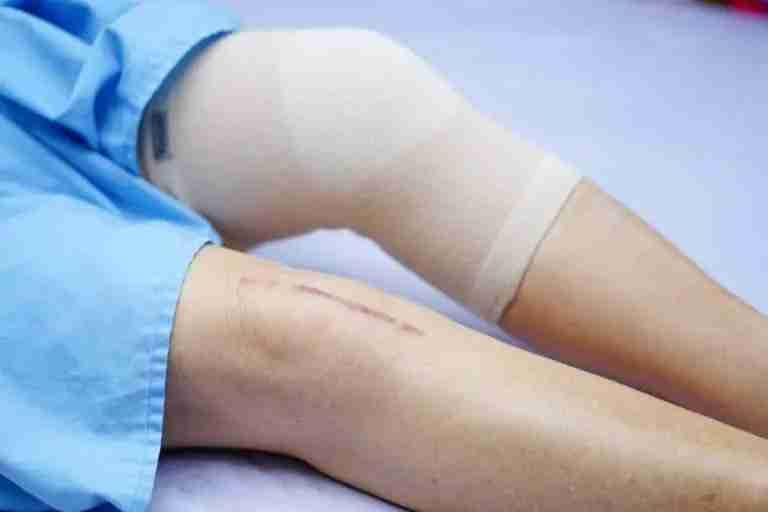
You will not see your incision at first: it is fully closed beneath a sterile dressing and bandage, which stays in place for at least a week and needs to stay dry.
Weeks 1–2: swelling sets the pace
Expect the first few days home to be the sorest stretch of the whole recovery. Pain often ticks up once the surgical anesthetic fully wears off, and swelling and bruising bloom down the leg — all normal, and all exactly what the medication schedule, ice, elevation, and compression are for. Staying consistent with them is not just about comfort; it is what makes physical therapy doable.
Therapy starts on the first or second day home, either at home or in a clinic, with three jobs that matter more than anything else right now: waking up the quadriceps muscle, straightening the knee completely, and bending it. Full extension is the milestone that matters most — it is what makes normal walking possible later — so work on straightening the knee every single day. Ice 15–20 minutes at a time, several times a day, and elevate with the ankle above the level of your heart: toes above the nose. Walk short and often rather than long and rarely; a lap around the house every hour or two while awake is the sweet spot.
Sleep is the hardest part of these weeks, and it helps to know that going in. Do not prop a pillow under the bent knee for hours — it feels good and quietly costs you extension. Use a pillow or wedge under the ankle instead, so the leg is elevated and the knee rests straight. And time your evening medications so they cover bedtime. Around the one-week mark you will have your first follow-up — in the office or by telehealth — to check the incision and confirm healing is on track.
- Keep walking with the walker — short, frequent laps, not marathons
- Avoid any twisting forces through the new knee
- Elevate with a pillow or wedge under the ankle — never parked under the bent knee
- Keep the bandage dry: bathe carefully, no soaking, no swimming
- Stay ahead of the pain so you can actually do your therapy
Weeks 2–6: driving, stairs, and the return of routine
This month is about weaning — off the walker, off the narcotics, off the compression devices — while the knee gets stronger every week. By two to three weeks most patients trade the walker for a cane, and by six weeks many are walking unassisted indoors. Opioids stop first; acetaminophen, anti-inflammatories, and the daily aspirin continue as prescribed. By the end of the first month you should be bending the knee to 90 degrees or more, and walking will feel noticeably stronger.
Two habits deserve attention now. First, do not let a limp become permanent — it is easy to keep favoring the surgical leg long after it can carry its share, so make yourself load both legs evenly. Second, expect odd sensations: some areas of the leg feel extra sensitive, others numb, and these sensations shift throughout the first year. That is a normal part of nerves healing, not a problem with the knee.
Weeks 2–6: stairs, driving, work, and the water rule
Stairs progress from one step at a time — up with the stronger leg, down leading with the operated leg — to foot-over-foot as quadriceps strength returns. Driving comes back when two things are true: you are completely off opioid pain medication, and you can stomp the brake hard without hesitating. On average that lands between two and six weeks, often by the end of the first month, and later for a right knee than a left with an automatic transmission. Test yourself in a parked car first. Desk workers often return to work in this window; jobs on your feet take longer.
One rule stings more in Hawai'i than anywhere else: the incision cannot get wet in a pool or the ocean until week six. Physical therapy is doing its heaviest lifting now — take it seriously even when it hurts, because this is when range of motion and strength are won. The structured progression is described in Dr. Morton's rehabilitation protocols, and doing the home program daily matters more than anything that happens in the clinic.
Months 2–3: most of your life comes back
By week six the bruising has resolved, the swelling is way down, and the incision is fully healed — the replaced knee is beginning to look a lot like your other knee. Best of all for island life: once cleared at follow-up, you are back in the water. Swimming, the pool, the ocean — week six is the gate.
Between two and three months, most patients are back to the bulk of normal life: full days on their feet, shopping, stairs without thinking about them, walking the neighborhood or a beach path. The bend approaches what your other knee can do, and therapy advances with you — squats, lunges, and other challenging lower-body movements come in, then resistance and weights to push strength further. There is no evidence that a well-done knee replacement has to keep you from what you love, whether that is walking on the beach, surfing, playing tennis, or hiking with your family. Now is the time to put in the work so your whole body — not just the knee — is ready to return.
The knee will still tell you about big days with an evening ache and some swelling. That is feedback, not damage — use it to pace yourself, trimming back a notch when the next morning is sore. Sport-by-sport expectations, from golf to doubles tennis to hiking, are covered in return to sports after a total knee replacement.
Months 3–6: strength, endurance, and the first small adventures
By this stretch, formal physical therapy has usually tapered to about once a week, and the home program carries the load. Your strength and mobility have improved enough that most exercises can be done on your own — but keep your therapist in the loop until function is truly full, because they will spot the weak links you cannot feel.
This is when the fun starts creeping back: longer walks, small hikes, nine holes of golf, lighter versions of the activities you have been missing. Enjoy it — and notice that the week-to-week gains are slowing down. That is the recovery curve flattening, not progress stopping. Keep working deliberately on whatever lags: balance, single-leg strength, endurance. Don't lose sight of your goals just because the dramatic improvements are behind you.

Months 6–12: the quiet gains — and the warmth that worries people
Through the back half of the first year the improvements are quieter but real: strength, endurance, and trust in the knee keep building for a full year, often longer. Occasional soreness and stiffness after big efforts are still expected — keep the exercises your physical therapist taught you in rotation and use them whenever the knee tightens up.
Two normal findings worry patients unnecessarily in this stretch. First, a knee that feels warm to the touch for up to a year is normal — deep healing generates heat, and warmth alone, without spreading redness, drainage, or fever, is not infection. Second, occasional painless clicking is the feel of the implant surfaces engaging, and it usually fades as swelling settles and muscles strengthen.
A patch of numbness on the outer side of the incision is common and typically shrinks with time. Kneeling is safe for the implant, though many patients find it uncomfortable and use a pad. By the one-year mark the large majority of knee replacements are working well — the long-term numbers are laid out in the knee replacement success rate guide. At the end of the first year you should feel strong, stable, and happy with the decision to get your life back — most patients tell me the knee has simply stopped being something they think about.
First-year milestones at a glance
| Milestone | Typical timing |
|---|---|
| First walk with a walker | Day of surgery |
| Home | Same day or next day |
| Physical therapy begins | Day 1–2 at home or in clinic |
| Bandage off, first follow-up | About 1 week |
| Walker to cane | 2–3 weeks |
| Knee bends 90° or more | By 1 month |
| Driving (completely off opioids, strong brake) | 2–6 weeks on average; sooner for a left knee with an automatic |
| Pool and ocean (incision healed and cleared) | Week 6 |
| Bend approaching the other knee | About 3 months |
| Longer hikes, nine holes of golf | 3–6 months |
| Full strength, endurance, and trust | 12 months and beyond |
Every knee is different, and being a few weeks ahead of or behind this timeline means very little — the trend is what matters, steady gains month over month. If your knee is trending the wrong way, or if you develop fever, spreading redness or drainage, new calf pain or swelling, or pain that worsens instead of improving, call the office at (808) 439-6201.
- Day 0: stand and walk with a walker — home the same day for many patients
- Weeks 1–2: swelling control, full straightening, short frequent walks
- Weeks 2–6: cane, then no cane; stairs; driving once off opioids
- Weeks 6–12: back in the water, full days on your feet, most daily activities
- Months 3–6: strength and endurance rebuild; golf, hiking, longer outings
- Months 6–12: warmth fades and trust returns — the knee stops being the headline
- Day 0
Stand and walk
First steps with a walker within hours; home the same day for many patients.
- Weeks 1–2
Swelling and extension
Ice, elevation, short frequent walks, and full straightening every day.
- Weeks 2–6
Cane, stairs, driving
Walker to cane, stairs foot-over-foot, driving once off opioids.
- Week 6–12
Back in the water
Pool and ocean once cleared; full days on your feet; most daily activities.
- Months 3–6
Strength and adventures
Longer walks, easy hikes, nine holes of golf; therapy tapers to a home program.
- Months 6–12
Quiet gains
Endurance and trust build; warmth fades; the knee stops being the headline.
Recovering close to home, wherever you live in Hawai'i
A year-long recovery should not require a year of long commutes. Dr. Morton sees patients at clinics in Honolulu (Ala Moana), West O'ahu (Kunia), Hilo, and Kona, so pre-operative planning and every follow-up can happen near where you live. Physical therapy is available through the practice in Kunia and Honolulu, and surgery itself is performed at The Queen's Medical Center, Adventist Health Castle, and Hilo Community Surgery Center — which brings Mako robotic technology to Big Island patients. Consultations are conducted in English, and interpreters can be arranged.
Patients also ask whether both knees can be done at once. Dr. Morton generally discourages simultaneous bilateral knee replacement — staging the two operations keeps each recovery safer and lets one strong leg support the healing one, exactly the way this first-year timeline assumes.
If you are still deciding, the place to start is an orthopedic consultation at any of Dr. Morton's four Pacific Bone & Joint clinics — Honolulu (Ala Moana), West O‘ahu (Kunia), Hilo, or Kona — or call (808) 439-6201. Most new patients are seen within one to two weeks. Bring a photo ID, your insurance card, a list of current medications, and any prior imaging or operative reports; if your X-rays were taken in Hawai‘i, the office can usually retrieve them electronically, and new standing X-rays are taken in the clinic at the same visit. Managed-care and Medicaid/Quest plans may need a referral from your primary care physician — the office checks before your visit. When an in-person visit isn't practical — a neighbor island without a nearby clinic, or a patient traveling from across the Pacific — a telehealth visit with existing X-rays can start the process.
Why patients choose Dr. Morton for knee replacement
The surgeon you choose shapes the recovery you get. Dr. Morton's approach — quad-sparing, tourniquet-free, opioid-sparing, robotically assisted — exists specifically to make the timeline on this page achievable. You can read what his patients say in their reviews, and if you are still deciding whether knee replacement is right for you, a consultation with Dr. Morton is where a version of this timeline gets built around your knee, your health, and your life.
- Board-certified, fellowship-trained hip and knee replacement specialist
- Minimally invasive, quad-sparing technique built for same-day recovery
- Certified on all four robotic platforms: ROSA, Mako, CORI, and VELYS
- Offers nonoperative and operative treatments — surgery is never the only option presented
- Handles revision knee replacement and complex cases
- Operates at The Queen's Medical Center, a Level 1 trauma center, as well as Adventist Health Castle on O'ahu and Hilo Community Surgery Center on the Big Island
Medically reviewed by Paul Norio Morton, MD, FAAOS, FAAHKS. Last reviewed: . This article is for education only and isn’t a substitute for an exam and personalized advice — schedule a consultation to discuss your situation.