

Step zero: choose the right surgeon
Hip and knee replacement can relieve pain and restore mobility that arthritis took away — but the operation is only half the story. How well and how quickly you recover determines how much of that new life you actually get, and your recovery starts with a decision you make months earlier. Your surgeon isn't just the person who performs the operation; they guide you from pre-surgery preparation through the final months of rehab. Choose someone you trust, feel comfortable with, and can talk to openly — and weigh these factors deliberately:
- Experience and expertise. Volume matters: the more hip and knee replacements a surgeon has performed, the more adept they are at handling different scenarios and complications. Ask directly about case numbers, success and complication rates, and fellowship training in adult reconstruction — a good surgeon welcomes these questions.
- Communication. You want someone who encourages questions, explains things in plain terms, and makes you feel heard. That trust pays off on the hard days of recovery.
- Follow-up care. Ask about the protocol after surgery: how pain will be managed, how physical therapy is arranged, and what happens if a complication arises.
- Patient reviews and testimonials. Any single review can mislead, but consistent patterns across many reviews reveal a lot about bedside manner, staff professionalism, and quality of care.
- Modern techniques. Orthopedics evolves quickly. Ask whether the surgeon uses robotic- or computer-assisted surgery and up-to-date pain protocols — willingness to adopt proven advances is a good sign.
- Insurance and cost. Not a measure of quality, but it prevents unpleasant surprises: confirm the practice accepts your plan and understand any out-of-pocket costs before you commit.
If you're unsure about your initial choice, get a second opinion — or a third. No good surgeon is offended by a patient doing their homework.
Recovery starts before surgery: prehab
The fastest recoveries are decided before the anesthesia starts. In the weeks before surgery, two things matter most: the strength you bank and the health problems you tune up. Patients who walk in stronger walk out sooner — it is that direct.
Simple prehab works: daily walking as tolerated, sit-to-stands from a chair, straight-leg raises, and gentle range-of-motion work. Just as important is the tune-up. If you smoke, stopping even a few weeks before surgery measurably improves healing. Good blood sugar control lowers infection risk, and blood pressure should be well controlled too. If you're carrying extra weight, even modest loss before surgery lightens the load on the new joint and makes the whole operation safer. And any needed dental work is best finished before surgery rather than after, so an untreated dental infection never gets near a new joint. Finally, recruit your team early: line up the friend or family member who will drive you, check in on you, and walk with you the first week. All of this is built into the rapid-recovery protocol my team applies to every joint replacement.
Prepare your mind along with your body. Knowledge is power here: understanding the procedure, what recovery looks like, and what complications are possible doesn't just calm anxiety — it makes you an active participant in your own care rather than a passenger. Some nervousness before major surgery is completely normal. Deep breathing, meditation, and visualization all help, and talking with a mental-health professional beforehand is a sign of good preparation, not weakness.
Ask how the operation itself will be done
Not every recovery lever is in your hands — some are built into the surgery. Modern techniques exist specifically to reduce pain and swelling, shorten rehab, and in many cases send you home the same day:
- Tourniquet-less knee replacement. Traditionally, a tourniquet squeezed off blood flow to the leg to make knee surgery easier to perform. Operating without one reduces post-operative pain and thigh swelling, speeds early rehabilitation, and tends to leave patients happier with the whole experience.
- Robotic assistance. Robotic systems give real-time feedback during surgery and allow fine adjustments that simply aren't possible by hand, improving precision and alignment — which supports better function and longer implant life. I am certified on all four major platforms — ROSA, Mako, CORI, and VELYS — and today, for knees, I operate primarily with ROSA at The Queen's Medical Center and with CORI at Adventist Health Castle; at Hilo Community Surgery Center I use Mako for hips and knees.
- Long-lasting nerve blocks and iovera°. Extended-release nerve blocks carry pain relief well past the operation, and iovera° uses precisely targeted cold to temporarily switch off pain nerves around the knee — strong pain control with far less reliance on opioids.
- Multimodal, opioid-sparing pain protocols. Several medications working in different ways attack pain from multiple angles at once, so no single drug — least of all an opioid — has to do the heavy lifting. Effective relief, fewer side effects, minimal dependency risk.
- Same-day joint replacement. With careful patient selection and preparation, many patients have surgery in the morning and sleep in their own bed that night — more comfortable and often less costly. I perform joint replacement at The Queen's Medical Center, Adventist Health Castle, and Hilo Community Surgery Center, home of the Mako robot on the Big Island.
No single technique suits every patient. The right combination depends on your overall health, your anatomy, and your goals — which is exactly the conversation to have at your consultation.
Protein and nutrition: feed the healing
Healing a joint replacement is construction work, and protein is the raw material. Surgery raises your protein needs at exactly the moment appetite drops, so make protein deliberate: a palm-sized portion at every meal — fish, eggs, chicken, tofu, Greek yogurt, beans, or nuts — starting a couple of weeks before surgery and continuing through the first six weeks after. Many patients add a daily protein shake simply because it is easier than eating more. If you have kidney disease or dietary restrictions, ask before loading up — the target is right for most people, not everyone.
Beyond protein, healing runs on micronutrients. Vitamin C, vitamin D, calcium, and iron all support bone health and wound healing, and a plate built from fruits, vegetables, whole grains, lean protein, and dairy usually covers them without supplements. Round it out with steady hydration — roughly eight glasses of water a day, since water carries the nutrients your healing cells depend on — and plenty of fiber, which fights the constipation that pain medication causes. A basic multivitamin is reasonable unless your doctor says otherwise.
If your appetite is poor or your weight has been drifting down before surgery, say so at your visit — nutrition is one of the easiest recovery levers to pull. The MEND nutrition program exists for exactly this reason: a supplement blending essential amino acids, vitamins, and other nutrients that support muscle protein synthesis, temper inflammation, and aid tissue repair during recovery.

Set up your home before you leave for surgery
For the first stretch you will be walking with a walker or cane, tiring quickly, and carrying things badly. Set the house up for that person before you leave for surgery — it takes an afternoon and prevents both frustration and falls. Falls are the complication most within your control: nearly everything on the checklist below exists to keep the walking path clear, the lighting good, and the things you need within reach so you're never tempted to hurry or stretch for something. If your bedroom is upstairs, plan to take the stairs once a day at first, or stage a temporary bed downstairs. A raised toilet seat and a shower chair are inexpensive and, for the first few weeks, worth every penny. A small crossbody bag or walker basket solves the how-do-I-carry-my-coffee problem on day one.
- Clear wide walking paths; remove loose rugs, cords, and floor clutter
- Set up a firm chair with armrests — low, soft couches are hard to escape
- Stage daily-use items between hip and shoulder height
- Install grab bars or a safety rail in the bathroom if balance is a concern
- Prep and freeze meals; stock easy protein and plenty of fluids
- Have ice packs or an ice machine ready before surgery day
- Night lights along the bedroom-to-bathroom route
- Line up a driver for the first follow-up visits
The first two weeks: walk short and often, ice, elevate
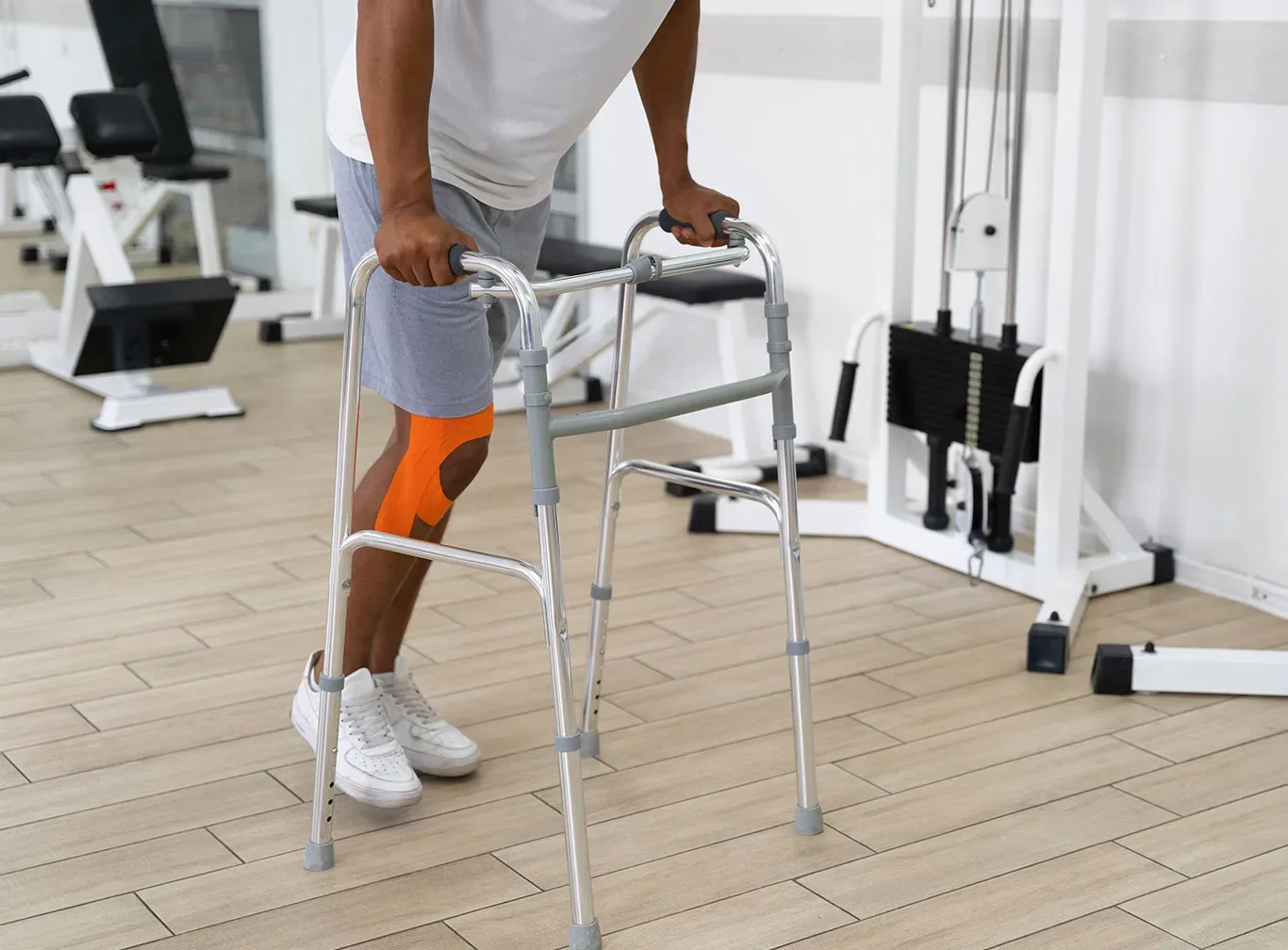
The early recovery runs on three habits. Walk short and often — a lap around the house every hour or two while awake beats one long, exhausting walk. Frequent short walks pump swelling out, help keep blood clots at bay, and rebuild confidence without inflaming the joint. Most of my patients walk the day of surgery and build from there, adding a little distance every few days as the joint allows. Use the walker or cane as long as you need it — assistive devices aren't a setback, they're how you bank safe miles while strength and balance return.
Ice and elevate in the gaps: 15–20 minutes of cold at a time with a cloth barrier, several times a day, and for knees, elevation with the ankle above the level of the heart — "toes above the nose." Swelling is the main driver of pain and stiffness in the early weeks, so controlling swelling is controlling your recovery. Add ankle pumps whenever you are lying down, do your therapy homework daily, and expect good days and bad days — the trend matters more than any single day. Knee-specific milestones are mapped out in the knee replacement recovery guide.
Two more early habits earn their keep. Keep the incision clean and dry exactly as instructed — dressing care is your first line of defense against infection. And report your pain honestly rather than toughing it out: pain that's communicated gets treated, and the plan can always be adjusted. Good pain control isn't a luxury — it's what makes the walking and therapy possible.
Physical therapy: the engine of recovery
Physical therapy typically begins within 24 hours of surgery — often the same afternoon. The first goals are deliberately basic: getting out of bed, sitting, standing, and walking with a walker. From there the program steadily builds strength, balance, flexibility, and endurance with exercises like leg lifts, knee bends, and progressive walking, following a plan tailored to you — the same rehabilitation protocols my therapy teams in Honolulu and Kunia use every day.
Your therapist will set milestones along the way — bending the knee to a target angle, walking a set distance, climbing stairs — and hitting each one is a genuine morale boost as well as a marker of progress. Two rules separate good recoveries from great ones. First, do the home exercises: the supervised sessions build the plan, but the daily homework between them builds the joint. Second, speak up about pain: some discomfort during therapy is normal, but severe or lasting pain is a signal to adjust the program, not something to push through. And never measure yourself against someone else's timeline — everyone recovers at their own pace, and the ultimate goal is the same: back to your normal activities with a better quality of life.
Technology that watches your recovery between visits
Recovery doesn't pause between appointments — and with modern tools, it doesn't go unwatched either. Zimmer Biomet's mymobility app pairs an iPhone and Apple Watch to support you from surgical preparation through recovery, feeding continuous data and your own feedback to the care team:
- Messaging by text, video, or picture — quick answers to small worries that often save an unnecessary office visit
- Patient education and guided exercises matched to your individual treatment protocol, with answers to commonly asked questions
- Gait monitoring that flags when your walking speed lags what's expected for your surgery date — catching a stalled recovery early, when it's easiest to correct
- Progress tracking: steps, flights of stairs climbed, stand hours, exercise completion, and range of motion
- Heart-rate insight: resting and walking heart rate, heart rate variability, and VO₂ max as a window on your overall fitness through recovery
For select knee patients, a sensor-equipped implant can add data from inside the knee itself. More in technology in orthopedics.
Sleep: why it's hard at first, and what helps
Poor sleep after joint replacement is nearly universal for the first few weeks — expect it, and don't panic over it. Sleep is when your body does its repair work, so it deserves the same attention as therapy. Pain interrupts sleep and lost sleep amplifies pain, so break the loop deliberately: time your evening medications so they cover bedtime, ice the joint for twenty minutes before lights out, and keep your pillows staged. After a knee replacement, avoid propping a pillow under the bent knee for hours — support the ankle instead so the knee rests straight. After an anterior hip replacement, most patients may sleep in any comfortable position, but follow your own precautions if you were given any.
A regular schedule helps more than people expect: going to bed and waking at the same time each day steadies your body clock while everything else is in flux. Short naps are fine; long afternoon naps steal night sleep, so keep daytime rest brief and keep moving between rests. Taking medications on schedule rather than chasing pain matters here too — the full home plan, including how the evening doses fit around sleep, is laid out in medication after surgery.
Patience is part of the prescription
For the first weeks you will live with real limits, and some frustration is normal. The patients who do best treat patience as a skill, not a personality trait: celebrate the small victories — the first unassisted trip to the mailbox counts — expect setback days without reading doom into them, and remember that every day of consistent work brings you one step closer to full mobility. A positive mindset isn't fluff; it's what keeps you doing the daily exercises that actually drive the recovery. And you are not alone on this road: thousands of patients have walked it before you, support is available at every step, and no question is too small to bring to my team.
Avoiding complications — and the red flags that need a call
Speed matters, but safety outranks it. Most recoveries are boringly smooth, and prevention keeps them that way: take medications as prescribed, do the exercises as instructed, keep every follow-up appointment — that's how small issues get caught while they're still small — keep the wound clean and dry, and stay active within your limits, because gentle regular movement is your best protection against blood clots.
The point of knowing the red flags is to act on the rare exceptions early, when they are easiest to treat. None of the tips on this page should ever override a warning sign — pushing through the wrong kind of pain is not toughness, it's lost time. Keep the office number handy — (808) 439-6201 — and call about any of the signs below. When in doubt, call; nobody at my office will make you feel foolish for asking. Incision care and drainage concerns are covered in wound management, and if you are still weighing surgery and want a recovery plan built around your life, start with a consultation.
- Fever over 101°F (38.3°C) or shaking chills
- Increasing redness, warmth, or drainage from the incision
- New or one-sided calf pain or swelling — possible blood clot
- Chest pain or sudden shortness of breath — call 911
- Severe pain that your prescribed medication doesn't touch
- Pain that steadily worsens instead of trending better
- Increasing stiffness, or a joint that feels unstable or gives way
- A fall onto the new joint, or sudden inability to bear weight
Putting it all together
A speedy recovery isn't one big decision — it's a stack of small ones, made consistently: the right surgeon, honest prehab, protein on every plate, a fall-proofed home, short frequent walks, therapy homework done daily, protected sleep, and a low threshold to call about warning signs. None of it requires luck; all of it rewards consistency. If you're planning a hip or knee replacement and want a recovery plan built around your life — work, family, island and all — schedule a consultation. Consultations are conducted in English, and interpreters can be arranged.
Medically reviewed by Paul Norio Morton, MD, FAAOS, FAAHKS. Last reviewed: . This article is for education only and isn’t a substitute for an exam and personalized advice — schedule a consultation to discuss your situation.