

Why nutrition changes surgical results
Healing after joint replacement is construction work, and food supplies the materials. A surgical incision, a healing bone surface, and the immune system guarding a new implant all draw on the same inventory: protein, vitamins, minerals, and water. When that inventory runs low, healing slows and complication risk rises — poor nutrition before surgery is one of the better-known risk factors for wound problems and infection.
Research bears this out: patients who are nutritionally well-nourished before and after surgery recover faster and have better long-term results, while nutritional deficiencies delay the natural healing process, raise infection risk, and prolong recovery. The uncomfortable truth is that most Americans are overfed and undernourished — plenty of calories, not enough of the nutrients healing actually runs on — which means many patients walk into surgery less prepared than they think.
The frustrating part is the timing: surgery raises your nutritional needs at exactly the moment appetite drops. That's why eating well after surgery can't be left to appetite — it has to be a plan, made in the weeks before surgery and carried through the first six weeks after. Nutrition is one of the pillars of the rapid-recovery protocol Dr. Morton's team applies to every joint replacement, and it is one of the few recovery levers entirely in your own hands.
What surgery demands of your body
Major surgery is a controlled injury, and the body responds the way it responds to any injury — by ramping up. Understanding what that ramp-up costs makes the rest of this page make sense:
- Energy needs rise. The body enters a higher metabolic state and simply requires more fuel to heal.
- Muscle shrinks fast. The trauma of surgery plus days of reduced activity cause muscle atrophy, and lost muscle extends recovery.
- The immune system weakens. Surgical stress temporarily suppresses immune defenses just when they're guarding a new implant.
- Infection risk climbs with malnutrition. Wound infection is significantly more likely in an undernourished patient.
- Inflammation lingers. Chronic inflammation impedes healing and slows the return of mobility.
- Fatigue deepens. The physiological stress of surgery compounds the tiredness of recovery.
- Weight drops unintentionally. Significant unintended weight loss is common after major surgery — and it's mostly muscle unless you feed against it.
Every recommendation that follows — the protein targets, the supplements, the hydration discipline — exists to answer one of these seven demands.
Protein: the raw material of healing
Protein is the single most important nutrient after surgery. Surgical-nutrition guidance commonly lands near 1.2 to 2 grams of protein per kilogram of body weight per day for patients healing from major surgery — for many people, roughly double their usual intake.
You don't need a calculator to get close. Build every meal around a palm-sized portion of protein — fish, chicken, eggs, tofu, lean pork, Greek yogurt, or cottage cheese — and add a protein-rich snack or a daily shake, which many patients find easier than simply eating more when appetite is low. Start about two weeks before surgery so you walk into the operating room with full reserves, and hold the pattern for at least six weeks afterward, when the rebuilding is heaviest.
One caution: if you have kidney disease, confirm your protein target with your physician first. The usual advice fits most people — not everyone.
Vitamin D, calcium, and the bone your implant lives in
An implant is only as strong as the bone that holds it, and vitamin D and calcium are that bone's supply line. Low vitamin D is surprisingly common — even in sunny Hawai‘i, where indoor work and sunscreen do their jobs — and it matters most for cementless implants, which depend on your own bone growing into the implant surface to lock it in place for the long haul.
Ask about having your vitamin D level checked before surgery; if it's low, supplementing in the weeks beforehand is simple and worthwhile. Calcium should come from food first: milk, yogurt, and cheese, plus tofu, leafy greens, and canned salmon or sardines with the bones. Reserve calcium supplements for when diet can't get you there, and make sure the team knows if you take them.
Iron, hydration, and fiber
Surgery costs blood, and iron rebuilds it. A good share of the fatigue patients feel in the first weeks is simply the body restoring its red blood cells, so give it materials: lean red meat, beans and lentils, dark leafy greens, and fortified cereals, paired with vitamin C — citrus, papaya, bell peppers — which helps iron absorb. Take iron supplements only if your team recommends them; they work when they're needed, but they are famously constipating.
Hydration deserves the same discipline. Healing tissue, medication side effects, and warm Honolulu days all raise your fluid needs, so keep water within reach and sip steadily through the day rather than catching up at night. Pale-yellow urine is the easy home test — dark urine means you're running behind. Pair those fluids with fiber — fruit, vegetables, whole grains — because the pain medications you'll take early on slow the gut; the full plan for managing that is in medication after surgery.
Blood sugar: the quiet infection lever
Elevated blood sugar impairs wound healing and raises infection risk — and that's true whether or not you carry a diabetes diagnosis. Around a new joint implant, infection is the complication we work hardest to prevent, so blood sugar gets attention before, during, and after surgery. It's a quiet lever — you can't feel it working — but it's one of the most consequential ones you control.
If you have diabetes, expect your control to be reviewed before surgery is scheduled, and use the lead-up weeks to tighten it with your primary care physician — that effort measurably lowers your risk. If you don't have diabetes, the same habits still help, because the stress of surgery pushes glucose up in everyone: cut back on sugary drinks, pair carbohydrates with protein, favor whole foods over processed ones, and keep walking. Movement is blood-sugar medicine, too, and it's one more reason the early walking program matters.
Recovery supplements Dr. Morton recommends: MEND and ENROUTE
Food comes first — but even a good diet often falls short of what surgical healing demands, especially in the weeks when appetite is suppressed. That's why Dr. Morton recommends a targeted nutritional supplement around surgery. The two programs he offers, MEND Joint Replacement and ENROUTE™, are built for surgical recovery rather than general wellness.
This is not marketing hopefulness; it's one of the better-studied corners of surgical nutrition. In multiple double-blind, placebo-controlled randomized trials of patients undergoing total joint replacement, ACL surgery, or knee arthroscopy, amino acid supplementation produced:
- 40% more muscle preservation during recovery — the supplement groups lost far less muscle to post-surgical atrophy than placebo groups
- Faster return of function — supplemented patients regained normal function significantly sooner than those on placebo
- Lower post-operative inflammation compared with placebo
Additional research on essential amino acids has shown enhanced wound healing and fewer complications in other procedures as well.
How the two programs differ
MEND Joint Replacement is a proprietary blend of essential amino acids, high in leucine — the amino acid that most strongly signals muscle to rebuild — aimed squarely at preserving muscle and restoring mobility. ENROUTE is a complete surgical nutrition program in two formulas: Prepare, a complex-carbohydrate drink with maltodextrin and electrolytes and no added sugar, and Build, a multi-nutrient formula with protein, creatine, calcium and vitamin D. Between them they preserve muscle mass, promote wound healing, support bone health and help the immune system through surgery.
| MEND Joint Replacement | ENROUTE™ | |
|---|---|---|
| What's in it | Essential amino acid (EAA) blend, high in leucine | Two formulas: Prepare (complex carbohydrate, maltodextrin, electrolytes, no added sugar) and Build (protein, creatine, calcium, vitamin D) |
| Protocol | One serving twice daily for 1 week before surgery, continued at least 2 weeks after — a 3-week protocol (two bottles) | Carbohydrate loading before surgery, rebuilding after — follow the schedule that comes with the program and bring it to your pre-operative visit |
| How to take it | Mix with water, a sports drink, juice, or a smoothie (citrus flavor) | Mix per package directions |
Patients ordering MEND can use the discount code DRMORTON for 10% off retail and free shipping. Either program works. The choice usually comes down to whether you want ENROUTE's broader carbohydrate-plus-protein coverage across the whole surgical window, or MEND's focused amino acid approach. You need one, not both — bring whichever you choose to your pre-operative visit.
The published evidence
- Essential amino acid supplementation mitigates muscle atrophy after total knee arthroplasty: a randomized, double-blind, placebo-controlled trial
- Essential amino acid supplementation in patients following total knee arthroplasty
- Cellular and morphological changes with EAA supplementation before and after total knee arthroplasty
Where to get them
Both programs are ordered directly from the maker and shipped to you. Start the timing in the table above from your surgery date, and bring whichever you choose to your pre-operative visit so it is on your medication list.
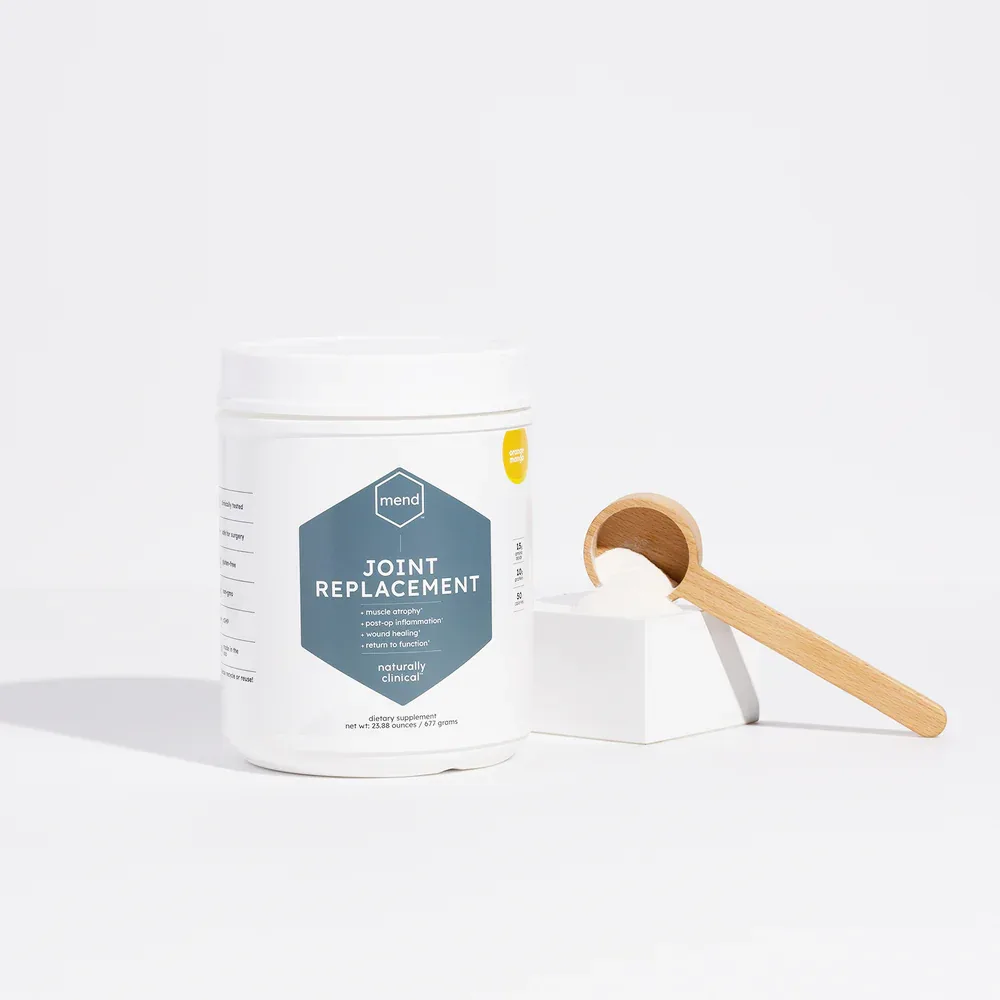
MEND Joint Replacement
The essential amino acid medical food formulated for joint replacement patients — the muscle-preservation program above, in citrus.
ENROUTE™
The surgical nutrition program Dr. Morton also offers, in two formulas: Prepare, a complex-carbohydrate drink with electrolytes and no added sugar for the run-up to surgery, and Build, carrying protein, creatine, calcium and vitamin D for afterwards. Between them they protect muscle, support wound healing and bone, and help the immune system through the operation.
Ordering through these links may earn the practice a commission at no extra cost to you. Which program suits you is decided at your visit, not by that.
Targeted supplements for swelling, bruising, and blood rebuilding
Beyond the amino acid programs, Dr. Morton recommends a short list of supplements with published evidence behind them for specific post-surgical problems. Each is available through his online supplement dispensary, and each earns its place for a reason:
Diosmin — for post-operative swelling
Diosmin has venotonic and vasoprotective properties: it improves venous circulation and reduces venous pressure, which helps minimize the leg swelling and inflammation that follow hip and knee replacement. Its anti-inflammatory effect also reduces overall discomfort and supports healing. A randomized, controlled multicenter trial published in JBJS (2024) found diosmin effective at reducing lower-extremity swelling and pain after total knee arthroplasty.
Bromelain — for bruising and inflammation
Bromelain, an enzyme extracted from pineapple, is included for its anti-inflammatory and analgesic properties. It helps reduce bruising and swelling by breaking down the proteins that trap fluid in tissues after surgery, and it has been shown to speed the resolution of bruising and promote healing in the post-operative period. A randomized, placebo-controlled trial of an oral enzyme combination with bromelain, trypsin, and rutoside, used before and after elective total hip replacement, found reduced systemic inflammation and pain (Therapeutic Advances in Musculoskeletal Disease, 2023).
Ortho Multi with 400 mg flax oil — the foundation multivitamin
A comprehensive multivitamin covers the broad base of recovery: vitamin C for collagen synthesis and skin healing; vitamin D and calcium for bone health; and B vitamins — including folate and B12 — plus iron for energy production and red blood cell formation, which helps counteract the post-operative anemia and hemoglobin drop that drive early fatigue.
Take these only as directed by Dr. Morton's team — timing matters, because some supplements that help after surgery still need to be coordinated with the ones that must stop before it.
The prehab plate — and a caution on everything else
Starting about two weeks before surgery, make every meal look the same simple way: half the plate vegetables and fruit, a quarter protein, a quarter whole grains, and water alongside. That pattern quietly covers most of what healing demands — it's the checklist below in food form. If appetite, unintended weight loss, or a restricted diet makes it hard, say so early; a plan can be built around you, starting at your consultation.
Supplements outside the plan deserve more caution than most people give them. Bring a complete list of everything you take to your pre-operative visit — including "natural" products — because several common ones, such as fish oil, vitamin E, garlic, ginkgo, and turmeric, can increase bleeding and are typically stopped before surgery on your team's instructions. Skip the megadoses; more is not better, and food covers most needs. The supplements Dr. Morton recommends above are the exception precisely because they've been studied for this purpose and are taken on a defined protocol under his team's guidance. The rest of the preparation playbook lives in speedy recovery after joint replacement.
- Palm-sized protein at every meal, plus a daily shake or protein snack
- Half the plate vegetables and fruit — color equals micronutrients
- Dairy, tofu, leafy greens, or canned fish with bones for calcium
- Ask about a vitamin D check before surgery
- Start your recovery supplement protocol on schedule — 1–2 weeks pre-op, at least 2 weeks post-op
- Water within reach all day; extra fiber to offset pain medication
- Complete supplement list to your pre-op visit — some must be stopped
Medically reviewed by Paul Norio Morton, MD, FAAOS, FAAHKS. Last reviewed: . This article is for education only and isn’t a substitute for an exam and personalized advice — schedule a consultation to discuss your situation.