
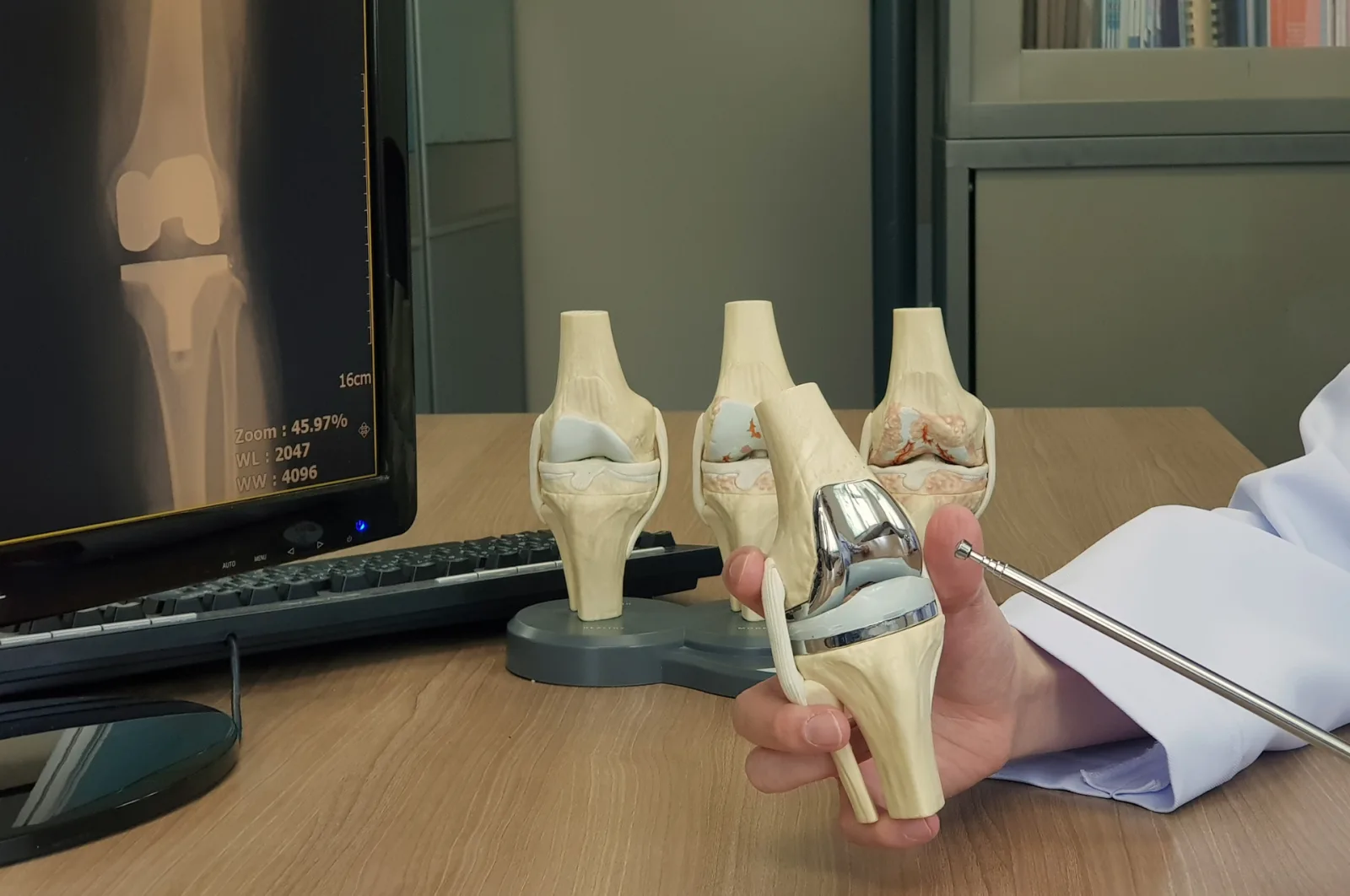
Cementless knee replacement in Honolulu — the short answer
A cementless (uncemented) knee replacement is a total knee replacement whose porous titanium components are press-fit so your own bone grows into them, instead of being bonded with acrylic cement. It suits patients with good bone quality — often younger and more active. Dr. Morton offers both fixations in Honolulu, decides on X-ray and confirms in the operating room, and pairs cementless implants with robotic planning for the exact cuts a press-fit demands. You walk the same day. Individual results vary.
- Fixation: bone grows into porous titanium over the following weeks
- Walking: full weight-bearing the day of surgery — the press-fit is stable immediately
- Best suited to: good bone quality; age alone does not decide
- The honest con: cemented fixation still has the longest track record
- The safety net: if bone is too soft in the OR, the implant is cemented instead — you consent to both
How a cementless knee stays fixed
A cementless knee is held in place by your own bone. Instead of bonding the implant with acrylic bone cement, the surgeon press-fits components whose porous titanium surfaces mimic the structure of natural bone. Over the following weeks, bone grows directly into that porous surface — a process called osseointegration — creating a biologic bond between skeleton and implant.
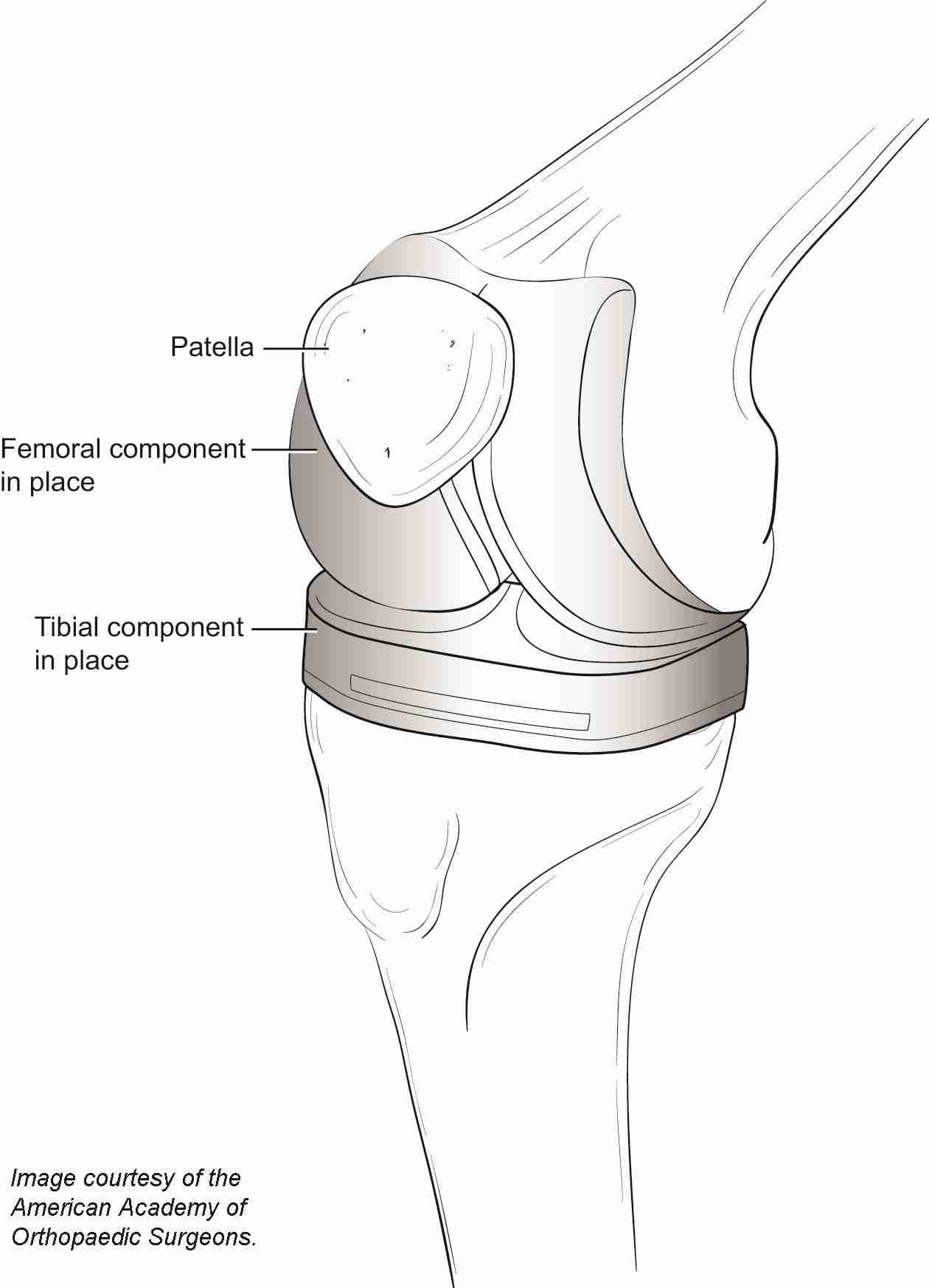
The operation itself looks like any modern total knee replacement: the worn cartilage and a thin layer of bone are removed, and the joint is resurfaced with metal and polyethylene components. What changes is the interface. A cemented knee relies on a layer of cement; a cementless knee relies on living bone. Both are accepted, well-established ways to fix a knee replacement — the question is which one fits your bone.
- Surgery
Precise press-fit
Robotic-planned cuts give intimate implant contact; the components are press-fit and stable enough for full weight-bearing immediately.
- Day 0
Walk on it
Most patients stand and walk the day of surgery; many go home within 24 hours.
- Weeks
Bone grows in
Over the following weeks bone grows into the porous titanium surface — osseointegration — converting the initial fit into a biologic bond.
- Years
Surveillance
Routine follow-up X-rays confirm the implant stays solid and catch the rare non-integration early.
The case for going cementless
The main argument is biology. Cement is strongest the day it hardens and can only degrade from there. Bone is alive — it remodels and renews itself around the implant for as long as you own the knee. For younger and more active patients who will put decades of hard use on a replacement, that living interface is appealing.
Going cementless also removes cement-specific failure modes. There is no cement mantle to crack or debond over time, and no risk of stray cement particles acting as abrasive debris inside the joint. Those advantages are one reason Dr. Morton discusses cementless fixation with patients focused on the long-term durability of their implant.
- Living biologic bond that can remodel over a lifetime
- No cement layer that can crack or loosen with age
- No cement debris to cause wear inside the joint
- Well suited to younger, active patients with strong bone
What to weigh before choosing cementless
Cemented fixation remains the gold standard, with decades of registry data behind it, and modern cementless knees have performed well in studies. Both are good options, and their own decades-long registry record is still being written — which is why the choice is made knee by knee rather than by default.
Cementless fixation also demands good bone. The initial press-fit must be rock solid so bone can grow in undisturbed; soft, osteoporotic bone may not hold the implant securely or integrate reliably, and in rare cases a component that fails to integrate causes pain and needs revision. Finally, cementless implants typically cost more than cemented ones, which can matter depending on your coverage and where surgery is performed. None of these are reasons to dismiss the technology — they are reasons to select patients carefully.
Who is a good candidate?
The best candidates are patients with good bone quality — often, though not always, younger and more active people. Dr. Morton assesses your bone on X-ray beforehand and makes the final check in the operating room: if the bone is not strong enough for a reliable press-fit, he cements the implant instead. You consent to both options, and the knee gets whichever fixation your bone actually needs.
Precision matters more without cement to fill gaps, which is why Dr. Morton pairs cementless implants with robotic-assisted planning — exact bone cuts mean intimate implant contact and dependable ingrowth. Not sure where you fall? An orthopedic consultation settles it with imaging, not guesswork.
- Good candidate: strong bone on X-ray, confirmed in the operating room
- Good candidate: younger or more active patients planning decades of hard use
- Decided in the OR: borderline bone quality — cemented if the press-fit is not rock solid
- Usually cemented instead: osteoporotic bone, or a stemmed implant such as the Persona IQ smart knee
Part of a complete rapid-recovery protocol
Fixation is one decision among several that shape how fast you recover from a total knee replacement. Dr. Morton combines cementless implants with the quad-sparing subvastus approach, a tourniquet-free technique, and opioid-sparing anesthesia. Most patients stand and walk the day of surgery — cementless components are stable for full weight-bearing immediately — and many go home within 24 hours through the same-day knee replacement program.
Dr. Morton offers cementless fixation, where bone quality allows, on every primary knee replacement he performs — at The Queen's Medical Center, Adventist Health Castle, and Hilo Community Surgery Center on the Big Island. Consultations are available in Honolulu (Ala Moana), West O‘ahu (Kunia), Hilo, or Kona: call (808) 439-6201 or book a consultation. Bring your X-rays if you have them; if not, they are taken at the same visit.
Medically reviewed by Paul N. Morton, MD, FAAOS, FAAHKS — board-certified orthopedic surgeon, fellowship-trained in adult hip & knee reconstruction and orthopedic trauma. Last reviewed: .
This page is for education only and isn’t a substitute for an exam and personalized advice — schedule a consultation to discuss your situation.