
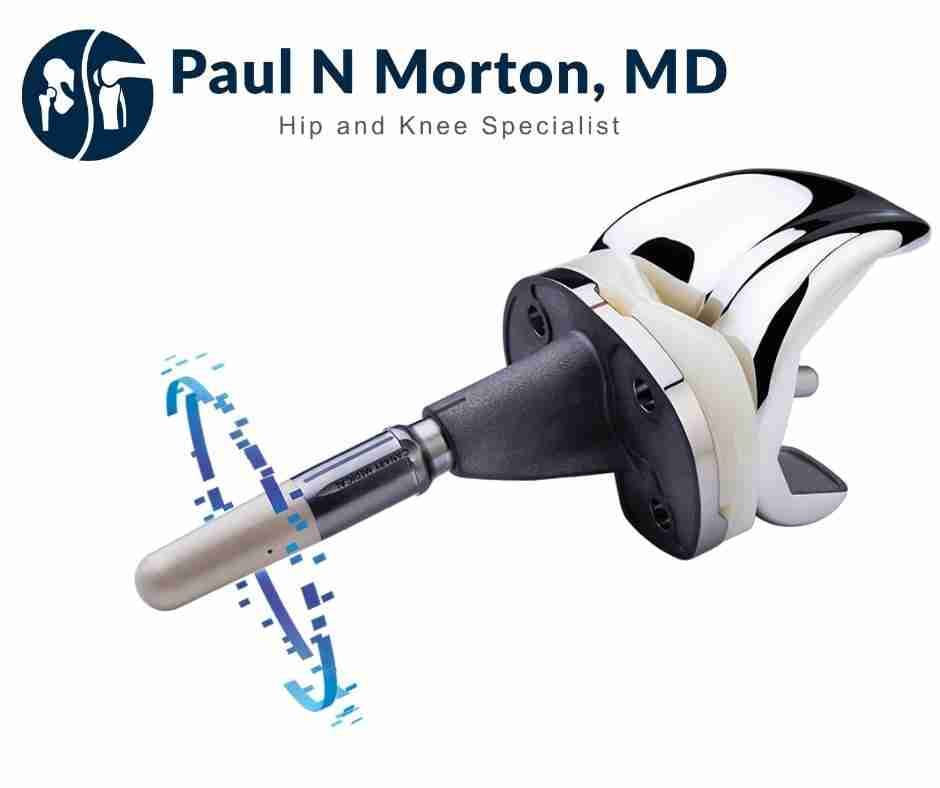
The Persona IQ smart knee in Honolulu — the short answer
Persona IQ is a Zimmer Biomet Persona total knee replacement with sensors sealed inside its tibial stem that record step count, walking speed, cadence, and range of motion after surgery and send them to a secure portal. It suits most total knee candidates, and is most useful for patients who recover far from Honolulu. Dr. Morton offers it only when he is using Zimmer Biomet implants for your knee. He placed Hawai‘i's first in 2022. The surfaces you walk on are unchanged; the benefit is objective monitoring, not a proven better result. Individual results vary.
- What it measures: steps, walking speed, cadence, and range of motion
- What it does not change: the knee surfaces, the recovery, or the need for physical therapy
- Best fit: neighbor island and fly-in patients whose recovery is monitored remotely
- Trade-offs: a longer stem in the shin bone, cemented fixation, a more involved revision if ever needed
- When it's offered: only when Dr. Morton is using Zimmer Biomet implants for your knee — ask at your consultation
What is the Persona IQ smart knee?
Persona IQ is the first smart knee implant cleared by the FDA. It pairs Zimmer Biomet's proven Persona total knee with sensor technology housed in the canturio™ tibial extension — the stem that anchors the implant inside your shin bone. From the day of surgery, those sensors record objective data about how the knee is actually working: step count, walking speed, cadence, and range of motion.
The data transmits from the implant to a small base station at home, then to a secure cloud portal your surgical team can review. Everything else about the operation is a modern robotic-assisted total knee replacement — the arthritic surfaces are resurfaced and the implant is aligned with 3D planning. The intelligence is added without changing the parts of the knee you walk on.
How the data changes your recovery
The short answer: your care team stops relying on memory and starts working from measurements. At a traditional follow-up, you estimate how far you walk and how the knee bends. With Persona IQ, Dr. Morton's team can see your actual daily numbers and compare them against the expected recovery curve.
If your walking speed plateaus or your motion stalls, that shows up in the data — often before you would have mentioned it — so therapy can be adjusted early, when small course corrections matter most. And when the numbers are climbing, you get something just as valuable: proof that you are on track.
- Objective step count, speed, cadence, and range of motion
- Progress compared against expected recovery milestones
- Plateaus flagged early so therapy can be adjusted
- Data reviewed by the team that performed your surgery
- Surgery
Robotic-assisted placement
A standard robotic total knee replacement; the sensor-bearing stem is implanted in the tibia.
- Every day
The implant records
Steps, walking speed, cadence, and range of motion are recorded from inside the knee.
- At home
Base station uploads
Data transmits to a small home base station, then to a secure, encrypted portal.
- Follow-up
Team reviews the curve
Your numbers are compared with the expected recovery curve; plateaus are flagged and therapy adjusted early.

Built for patients who recover far from Honolulu
Remote monitoring is where a smart knee earns its keep. Many of Dr. Morton's patients fly in from the neighbor islands and across the Pacific for surgery, then finish recovering at home. With Persona IQ, the implant keeps reporting after you fly out — your recovery is monitored from thousands of miles away, and for patients in Hawai‘i, telehealth visits are grounded in real data instead of guesswork.
That makes the smart knee a natural fit for the destination joint replacement program: surgery in Honolulu, structured follow-up wherever home is.
Hawai‘i's first smart knee
Dr. Morton performed Hawai‘i's first Persona IQ smart knee replacement on October 4, 2022, using robotic assistance. Known as "The Robot Doc," he is certified on four robotic platforms and has built his practice around technology that produces measurable results — precise robotic alignment during surgery, objective implant data after it. The smart knee closes the loop: for the first time, the implant itself reports back on how the operation is performing.

Trade-offs — and who should skip it
A smart implant is still an implant, and it carries considerations a standard knee does not. Dr. Morton goes through each of them before recommending one.
- A longer tibial stem. The sensor lives in a stem extension that reaches farther down the shin bone than a standard tibial component, so more tibial preparation is needed. Discomfort at the tip of a stemmed tibial component is a recognized issue with any stemmed knee design, and it is a possibility here.
- Cemented fixation. In its current form the sensor-bearing stem is used with a cemented tibial component, so patients who want cementless fixation face a choice between the two.
- A more involved revision. If the implant ever needs to be revised, removing a longer, cemented stem is a bigger job than removing a standard tibial tray.
- Monitoring, not proven better outcomes. There is not yet evidence that sensor monitoring produces better results than standard follow-up. The benefit is convenience and early flagging — objective data instead of memory, and a plateau caught sooner — which is real, but is not the same as a better knee.
Patients with limited tibial bone stock, those who prioritize cementless fixation, and those who will be seen regularly in person anyway may be better served by a standard Persona or another proven implant. Patients recovering far from Honolulu, or who simply want their recovery measured, are the ones the technology was built for.
Am I a candidate?
Persona IQ is a Zimmer Biomet implant, and Dr. Morton offers it only when he is using Zimmer Biomet implants for your knee replacement. Within that, most patients who qualify for a standard total knee replacement can be considered. The tibia must accommodate the sensor-bearing stem, and bone quality and anatomy are confirmed during planning.
If you are weighing implant options — smart versus standard, cemented versus cementless — start with an orthopedic consultation at any of Dr. Morton's four Pacific Bone & Joint clinics — Honolulu (Ala Moana), West O‘ahu (Kunia), Hilo, or Kona — or call (808) 439-6201. Most new patients are seen within one to two weeks. Bring a photo ID, your insurance card, a list of current medications, and any prior imaging or operative reports; if your X-rays were taken in Hawai‘i, the office can usually retrieve them electronically, and new standing X-rays are taken in the clinic at the same visit. Managed-care and Medicaid/Quest plans may need a referral from your primary care physician — the office checks before your visit. When an in-person visit isn't practical — a neighbor island without a nearby clinic, or a patient traveling from across the Pacific — a telehealth visit with existing X-rays can start the process. Ask at your consultation whether your knee replacement will use Zimmer Biomet implants and whether a smart knee fits your plan.
- Good fit: a total knee candidate who will finish recovering on a neighbor island or across the Pacific
- Good fit: patients who want objective recovery data reviewed by the team that operated
- Decided case by case: tibial bone stock and anatomy, confirmed during 3D planning
- Probably not: patients who prioritize cementless fixation, or a knee with limited tibial bone
Medically reviewed by Paul N. Morton, MD, FAAOS, FAAHKS — board-certified orthopedic surgeon, fellowship-trained in adult hip & knee reconstruction and orthopedic trauma. Last reviewed: .
This page is for education only and isn’t a substitute for an exam and personalized advice — schedule a consultation to discuss your situation.