
The short answer: twenty years or more is now common
About 98% of total knee replacements are still functioning at ten years, and more than 80% are still going at twenty. For most patients, that means one well-done knee replacement is the only one they will ever need.
It's worth understanding where those figures come from. They're drawn from registries and long-term studies of implants placed decades ago — designs and plastics measurably inferior to what goes into a knee today. In other words, the twenty-year numbers you can look up were earned by yesterday's technology. Today's materials are engineered to outlast them, though only time can prove it. What we can say honestly: durability is rarely the reason to delay a knee replacement anymore, and for younger patients the conversation has shifted from "will it last?" to "how do we plan for the decades it needs to cover?"
What actually wears out
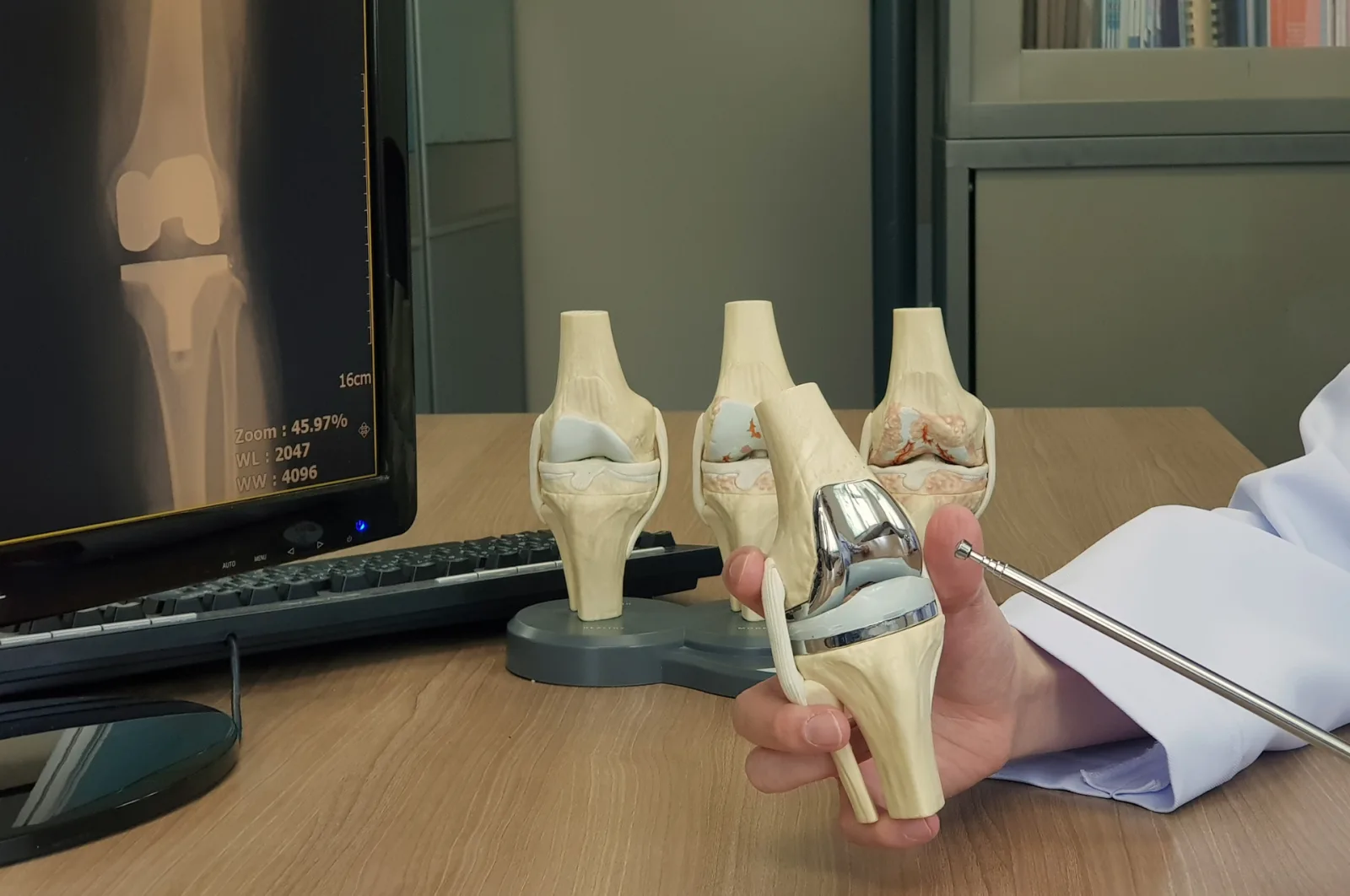
A knee replacement has three main parts: a metal component on the femur, a metal tray on the tibia, and a polyethylene (medical-grade plastic) insert between them that serves as the new cartilage. The metal almost never fails. What ages is the polyethylene insert. Microscopic wear particles are shed with use, and over many years the body's inflammatory reaction to those particles can dissolve bone around the implant — a process called osteolysis — until the bond fails. That endpoint, aseptic loosening, is the most common reason older knee replacements are eventually revised — a slow, mechanical story measured in decades, not a sudden failure.
The other threats are less about time. Infection can occur at any point after surgery — the risk is low, around 0.5%, but never zero. And instability or stiffness can end an implant's useful life even when the parts themselves are pristine. Durability, in other words, is not just a materials question; it's a surgery question and a maintenance question too.

Modern materials changed the wear curve
The single biggest advance is highly cross-linked polyethylene — plastic whose molecular chains are bonded into a far more wear-resistant network than the material used a generation ago. Some modern inserts add an antioxidant such as vitamin E to resist degradation over time. Because wear debris is what triggers bone loss and loosening, slowing the wear slows the main clock running against your implant.
Fixation has advanced in parallel. Cementless knee replacement uses porous surfaces your own bone grows into — a living, biologic bond with no cement layer to crack or debond over the decades. Dr. Morton favors cementless fixation when bone quality allows, particularly in younger, more active patients whose implants have the most years to cover. Modern component designs also reproduce the knee's natural motion more faithfully, which spreads load across the insert instead of concentrating it on one spot.
For patients with a known metal sensitivity, alternative bearing surfaces and coatings exist — worth raising at your consultation rather than discovering later. The point of all this engineering is simple: the wear that ended older implants at fifteen years is dramatically slower in the implants going in today.

Alignment: the durability factor your surgeon controls
A knee that is well aligned and balanced loads its polyethylene evenly. A knee that sits even a few degrees off concentrates force on one edge of the insert, wearing it faster and stressing the implant-bone interface. Ligament balance matters just as much: a knee left too tight or too loose on one side loads unevenly through every step of its life. These are among the strongest durability factors anyone controls — and they are decided in a single afternoon in the operating room.
This is why Dr. Morton plans every knee in 3D and executes with robotic assistance. The robot measures ligament tension in real time and helps place components precisely to a plan built from your anatomy. Precision at the time of surgery is the cheapest durability you will ever buy: it costs nothing later, wears nothing out, and pays out for decades.
What you can do to make yours last
Your habits matter as much as the hardware. Body weight multiplies across the knee with every step, so staying lean directly slows wear. Activity choices count too — walking, swimming, cycling, golf, and hiking are encouraged for life, while repetitive high-impact loading deserves an individual conversation. This is not a call to sit still; a strong, active leg protects the implant better than a deconditioned one, and most patients end up more active after surgery than before it.
Infection is the other durability threat you can influence. Because a joint replacement can be seeded by bacteria traveling from elsewhere in the body, treating skin, dental, and urinary infections promptly matters for the life of the implant — see antibiotics and dental work for how Dr. Morton approaches that question. The habits below are simple, and together they add years.
- Keep body weight in a healthy range — every pound off the frame is force off the insert
- Favor low-impact fitness for daily training; discuss high-impact sports individually
- Treat dental, skin, and urinary infections promptly — bacteria travel
- Keep blood sugar controlled if you're diabetic
- Show up for periodic follow-up X-rays even when the knee feels perfect
If your implant is wearing out
Polyethylene wear is gradual and often silent — the knee can feel fine while bone quietly thins around the implant. That's why Dr. Morton builds implant surveillance into long-term care: periodic X-rays catch wear and early loosening years before symptoms appear. Caught early, a revision can be far simpler — sometimes exchanging the worn insert while keeping well-fixed components. Caught late, bone loss makes the operation bigger and the recovery longer.
If your knee replacement is becoming painful, or it was placed fifteen or more years ago and hasn't been X-rayed since, don't wait for it to fail. A revision workup starts with simple imaging and blood tests — schedule a consultation and get a baseline you can trust.
Medically reviewed by Paul Norio Morton, MD, FAAOS, FAAHKS. Last reviewed: . This article is for education only and isn’t a substitute for an exam and personalized advice — schedule a consultation to discuss your situation.