
The short answer: skin allergy is common, implant failure from allergy is rare
Skin sensitivity to nickel is common — studies report it in roughly one in eight adults, and more often in women. A joint replacement failing because of metal allergy is another matter entirely: it is rare, and whether it truly happens at all remains genuinely debated among arthroplasty surgeons and immunologists. The large majority of patients with a nickel skin allergy receive standard implants and do perfectly well. So if you react to jewelry, you are not disqualified from a hip or knee replacement — but you do deserve a surgeon who takes the question seriously, knows what the evidence does and doesn't show, and has nickel-free options on the shelf. That is the honest starting point, and everything below builds on it.
What's actually in a hip or knee implant
Modern implants are built from a short list of materials. Cobalt-chromium alloy — the workhorse metal of most knee femoral components — contains a small amount of nickel. Titanium alloy, used in most hip stems and many sockets and tibial trays, is essentially nickel-free and highly biocompatible. Between the metal parts sits highly cross-linked polyethylene, a plastic bearing with no metal at all, and many hips use a ceramic head. These alloys are chosen because they combine long-term durability with biocompatibility. In practice this means a typical modern hip — titanium stem, ceramic head, polyethylene liner — already involves minimal nickel exposure. Knees rely more heavily on cobalt-chromium, which is why the allergy conversation comes up more often for knee replacement than for hips. It's also worth knowing that the nickel content of implant-grade cobalt-chromium is small and tightly specified — these are medical alloys engineered for the human body, not the mystery metals in costume jewelry that cause most skin reactions in the first place.
What a metal allergy actually is
When people talk about a metal allergy, they mean a Type IV (delayed) hypersensitivity — not the sudden, dramatic reaction of anaphylaxis, but a slow-building immune response that can take weeks to surface. It unfolds in two phases. First the body becomes sensitized: metal ions bind to the body's own proteins to form antigen–hapten complexes. Those complexes are then presented to T-cells, macrophages, and other immune cells in the joint's synovial tissue, which drives the reaction in the second phase — swelling, stiffness, pain, loss of motion, and sometimes a rash over the joint.
This is also why the topic is genuinely contested. Many orthopaedic surgeons are skeptical that a true implant allergy exists at all, precisely because it is delayed, hard to prove, and easy to confuse with more common problems. Dr. Morton's position is pragmatic: the reaction is uncommon and often overdiagnosed, but a patient with a convincing history of contact dermatitis to cheap metals deserves to have it taken seriously and planned around.
How common is it — and how would you know?
Skin sensitivity to these metals is more common than most people expect. In the general population the estimated prevalence is about 13% for nickel, 2% for cobalt, and 1% for chromium; sensitivity to other implant metals is rare. Women are affected more often than men.
The everyday clues are familiar ones. A rash or itch under a cheap watch band, a belt buckle, or costume jewelry is the classic sign of nickel sensitivity. Tattoos are another tell: tattoo inks contain metal salts, so someone who develops contact dermatitis after being tattooed may carry a cobalt or nickel sensitivity worth flagging. None of these guarantees a problem with an implant — the presence of a skin allergy alone does not dictate a reaction to a replacement — but they are exactly the history Dr. Morton wants to hear about before surgery, because they shape the plan.
Why a skin rash and a deep implant are two different problems
A rash under a watch band is a skin-level immune response to prolonged surface contact. An implant sits in an entirely different environment — bathed in joint fluid, away from the skin's specialized immune cells — and the two situations don't reliably predict each other. Many patients with strongly positive skin tests live with standard implants for decades without any trouble, and most research to date has not shown that a positive skin test predicts pain, loosening, or failure. That is why unexplained symptoms after a joint replacement should never be pinned on allergy first. Infection, loosening, instability, and referred pain are far more common and far more treatable, and each must be excluded with a proper workup. Metal allergy, if it is invoked at all, is a diagnosis of exclusion.
When a replaced joint hurts, rule out the common causes first
A metal reaction is slow: symptoms can surface anywhere from about four weeks to two years after surgery, so timing alone is an unreliable clue. That is exactly why allergy is a diagnosis of exclusion. Before it is ever invoked, the more common — and more treatable — reasons a replaced joint hurts have to be ruled out:
- Infection
- Mid-flexion instability
- Malalignment
- Patellar tracking problems
- Implant loosening
- Metallosis (inflammation from metal wear debris)
The workup that sorts these out may include blood tests such as cobalt and chromium levels, X-rays, a bone scan, and — in some cases — a tissue biopsy. Dr. Morton runs this systematic evaluation at his Revision Hip & Knee Replacement Clinic.
The formal criteria for an implant reaction
When the workup does point toward an implant reaction, the American Contact Dermatitis Society has published criteria for diagnosing post-implantation metal hypersensitivity in patients with unexplained pain or implant failure.
Major criteria
- An eruption (rash) overlying the metal implant
- A positive patch-test reaction to a metal used in the implant
- Complete recovery after the implant is removed
- Chronic dermatitis beginning weeks to months after implantation
Minor criteria
- Dermatitis that resists standard treatment
- A morphology consistent with dermatitis — redness, induration, papules, vesicles
- A systemic allergic dermatitis reaction
- Histology (tissue findings) consistent with allergic contact dermatitis
- A positive in-vitro test to metals, such as the lymphocyte transformation test
What imaging and tissue findings can show
On their own, X-rays are often normal in a metal-hypersensitivity reaction. Sometimes they reveal osteolysis — a loss of bone around the components — which can in turn lead to loosening and, eventually, failure of the replacement.
When an implant is removed, tissue biopsies taken during surgery typically show heavy lymphocyte infiltration of the synovium (the joint lining that produces synovial fluid), often alongside granulation tissue, fibrosis, numerous giant cells, and calcification — the picture of a chronic inflammatory response rather than infection.
Skin patch testing and the Sensiband
Skin patch testing, performed by a dermatologist or allergist, applies small doses of each metal to the skin and watches for a reaction. It is useful but not definitive: for predicting true metal hypersensitivity its sensitivity is roughly 77% and its specificity about 71% — and, crucially, a reaction at the skin does not necessarily mirror what happens at the level of bone and muscle around an implant.
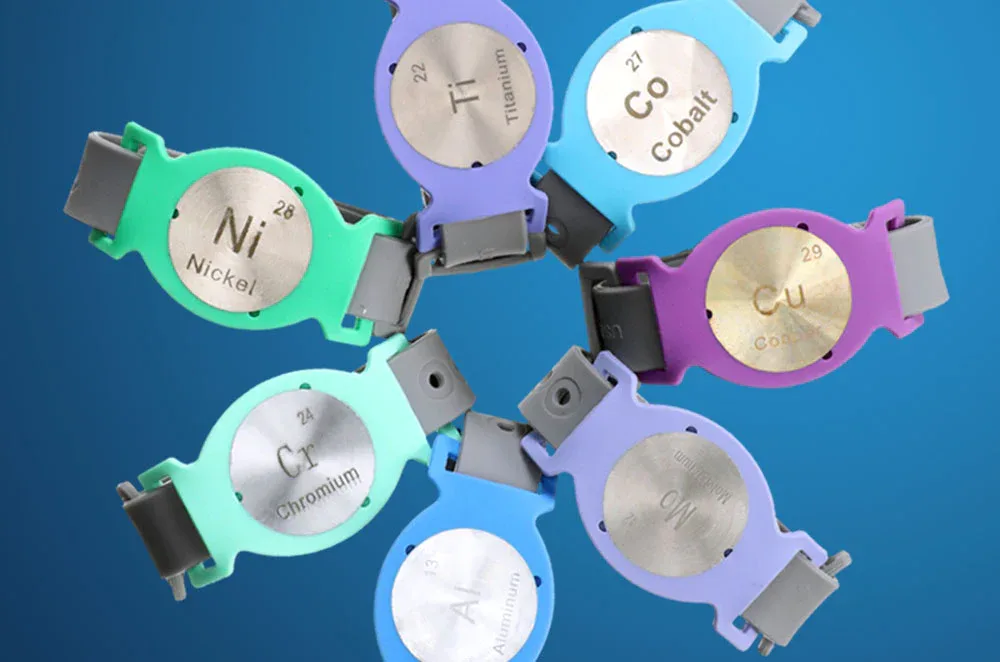
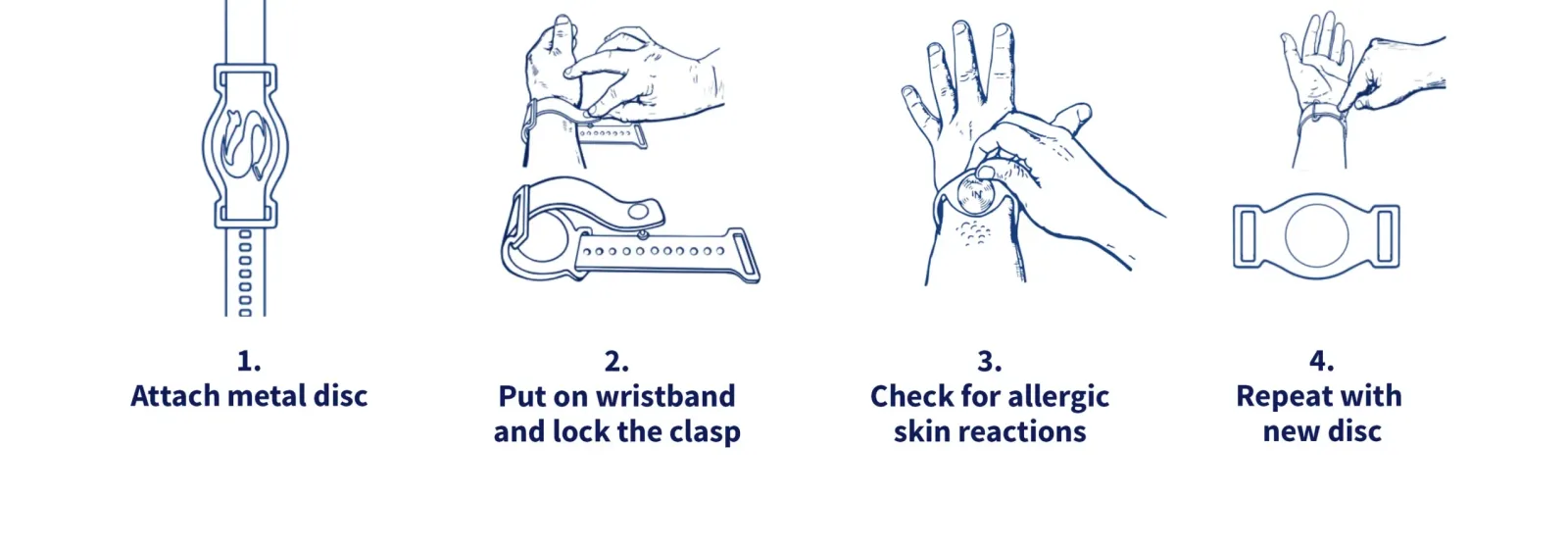
A newer option Dr. Morton's office can arrange is the Sensiband, a patented wearable test kit. The wristband holds interchangeable discs of medically pure metals — nickel, cobalt, chromium, titanium, molybdenum, aluminum, and copper — against the skin for up to a week. If contact dermatitis develops under a particular disc, it points to a sensitivity to that metal. Because it can be worn at home before surgery, it offers a simple, low-cost way to screen for the metals used in joint, dental, and other implants and to hand that information to the surgical team ahead of time.
Blood testing: the lymphocyte transformation test
The most sensitive test available is the lymphocyte transformation test (LTT), a blood test that compares how many white blood cells the immune system produces over about seven days with and without exposure to a given metal. It is more sensitive than patch testing alone.
Dr. Morton can order LTT panels through a specialized lab, Orthopedic Analysis, which offers two levels:
- Standard panel — the metals most often used in implants: nickel, chromium, cobalt, and titanium, and sometimes molybdenum, vanadium, and zirconium.
- Comprehensive panel — everything in the standard panel plus a wider range, including bone-cement monomers, iron, and specific alloy particles such as cobalt and titanium alloys. This is aimed at complex cases with prior implant failures or multiple suspected sensitivities.
Both use the Metal-LTT method and give a quantitative read on how reactive your immune cells are to each metal — information that can guide implant selection or revision planning.
Does insurance cover it?
Usually not. Medicare generally does not cover the LTT (CPT 86353) for metal hypersensitivity — it reimburses that code only for specific uses such as organ-transplant or immunotherapy monitoring. Most private payers decline it too, because the test is not FDA-approved for this indication; it is offered as a laboratory-developed test that must meet federal CLIA lab standards rather than carry FDA clearance. Logistics matter as well: the test needs viable lymphocytes and has limited availability. To arrange it, book with Dr. Morton to order the panel — or request the kit directly from the lab and have the office perform the blood draw, keeping in mind you'll cover the cost of overnight shipping from Hawai'i.
Hypoallergenic implant options — and their honest trade-offs
For a patient with a documented, significant nickel allergy — or one who simply wants the question off the table — several nickel-free strategies exist for both joints. Each reduces exposure, and each has a track record worth understanding.
- Coated implants. A surface layer — titanium nitride, zirconium nitride, or titanium-niobium — seals a standard cobalt-chromium implant away from surrounding tissue. The catch: some coated designs have shown higher revision rates (as high as 91% at five years in one series), and retrieval studies find coating delamination in roughly 20% of removed implants, which can re-expose the underlying metal and reignite the immune response.
- Oxidized-zirconium (ceramicized) components. Here an oxidized-zirconium femoral component pairs with a titanium tibial tray, sidestepping nickel. Registry data give reason for caution, though: the Australian joint registry has reported roughly double the revision risk at 12 years, U.S. registry data look similar at 7 years, and a 2023 study suggested nickel exposure may actually rise during implantation of these parts.
- Nitrogen-hardened titanium. A hardening process creates a nitrogen-enriched zone on the surface of a titanium femoral component. Implants made this way have shown a striking 96% reduction in wear versus conventional designs, which may translate into longer-lasting results. This titanium-based, nitrogen-enriched knee (marketed as Ti-Nidium) is Dr. Morton's implant of choice for patients concerned about metal allergy. Titanium is also available in cementless designs that bond directly to bone.
- All-polyethylene tibial components, which remove metal from one side of the knee entirely.
- Ceramic femoral heads in hip replacement, paired with a titanium stem and polyethylene liner, so a typical modern hip already involves minimal nickel.
One honest caveat runs through all of these: while they clearly reduce nickel exposure, the evidence that they improve outcomes for allergic patients is still limited — and some, as above, carry trade-offs of their own. Reduced exposure and peace of mind are the realistic goals, not a guarantee.

If a reaction is confirmed: treatment and revision
When the workup genuinely points to a metal reaction, treatment starts conservatively. A rash often improves with a short course of topical steroids, and an inflamed joint lining (synovitis) may settle with anti-inflammatory medication and physical therapy. If symptoms persist despite that, revision surgery to a nickel-free implant can be considered; when it works, symptoms typically ease within two to three months of the revision.
It is worth being candid about the odds. Results of revision done for suspected metal allergy are variable — several case series report good outcomes after switching to a nickel-free implant, but others do not. That uncertainty is one more reason to exhaust the common, treatable causes first and to make this decision carefully with Dr. Morton.
How Dr. Morton approaches it
The approach is straightforward. Tell us about any metal reactions during your consultation — even ones that seem trivial. A mild jewelry sensitivity usually warrants nothing more than a conversation: the evidence doesn't support swapping a proven implant for it, the available allergy tests are imperfect, and some nickel-free designs carry longevity trade-offs of their own. So a patient with no history of metal allergy does not need a special implant, and Dr. Morton will say so plainly.
A convincing history of significant reactions may warrant testing — a Sensiband, patch testing, or a lymphocyte transformation panel — and a nickel-free plan, which Dr. Morton builds routinely using titanium (his preferred nitrogen-hardened knee), ceramic, and coated options across hip and knee replacement. Peace of mind is a legitimate part of surgical planning: a patient who trusts the materials in their joint recovers with less second-guessing. And if you already have an implant and wonder whether allergy explains ongoing symptoms, the answer starts with a full workup for the common causes first. Either way, you'll get the evidence straight, not a sales pitch. Call (808) 439-6201 or schedule a consultation to talk it through.
References
- Granchi D, Cenni E, Giunti A, Baldini N. Metal hypersensitivity testing in patients undergoing joint replacement: a systematic review. J Bone Joint Surg Br. 2012;94(8):1126–34.
- Lawrie CM, Bartosiak KA, Barrack TN, Nunley RM, Wright RW, Barrack RL. Questioning the "Nickel Free" Total Knee Arthroplasty. J Arthroplasty. 2022;37(8S):S705–S709.
- Matar HE, Porter PJ, Porter ML. Metal allergy in primary and revision total knee arthroplasty: a scoping review and evidence-based practical approach. Bone Jt Open. 2021;2(10):785–795.
- Saccomanno MF, Sircana G, Masci G, et al. Allergy in total knee replacement surgery: Is it a real problem? World J Orthop. 2019;10(2):63–70.
- Akil S, Newman JM, Shah NV, Ahmed N, Deshmukh AJ, Maheshwari AV. Metal hypersensitivity in total hip and knee arthroplasty: current concepts. J Clin Orthop Trauma. 2018;9(1):3–6.
Medically reviewed by Paul Norio Morton, MD, FAAOS, FAAHKS. Last reviewed: . This article is for education only and isn’t a substitute for an exam and personalized advice — schedule a consultation to discuss your situation.