
Which hip bearing is best? The short answer
A hip bearing is the ball and liner of a total hip replacement — the two surfaces that slide against each other every step you take. For most patients today, the best bearing is a ceramic head on a highly cross-linked polyethylene liner: durable, quiet, forgiving, and free of metal-ion concerns. Dr. Paul Norio Morton individualizes the choice at Pacific Bone & Joint in Honolulu by age, anatomy, activity, and any metal sensitivity — and the bearing never changes how recovery feels, only how the hip ages. Individual results vary.
- Default today: ceramic-on-highly-cross-linked polyethylene
- Nickel sensitivity: ceramic heads, oxidized zirconium, and titanium components sidestep the question
- Higher dislocation risk: larger heads or a dual-mobility bearing, reserved for hips that need it
- Metal-on-metal from the 2000s: not automatically a problem, but it needs surveillance
- Longevity: driven more by implant position and your bone than by the bearing couple
The pairing that matters: head + liner
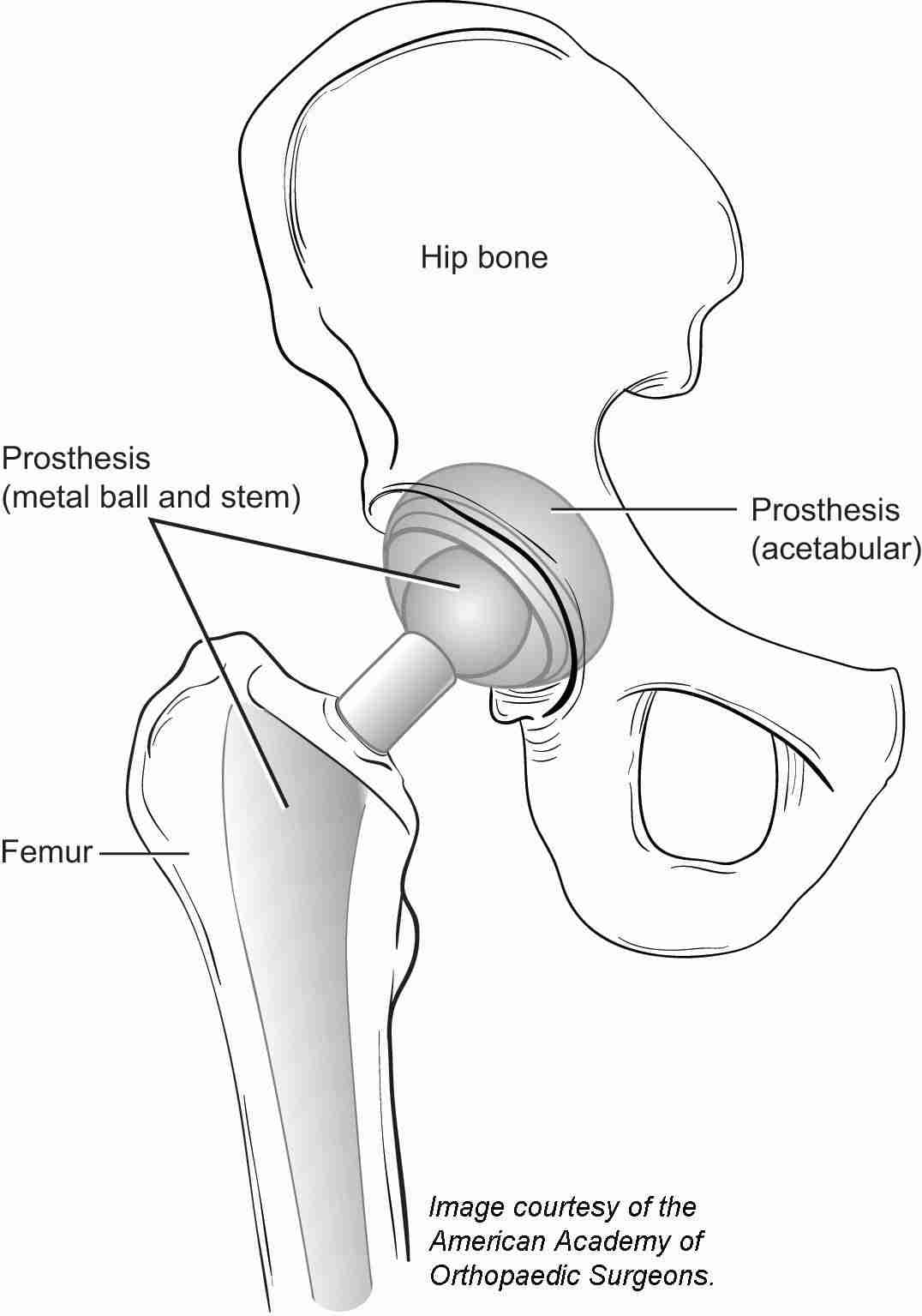
A total hip has four parts — stem, head (ball), liner, and cup — but the bearing couple is the head and liner, because that's the surface that actually wears. Every combination trades off wear rate, toughness, and cost:
- Ceramic-on-polyethylene (the modern workhorse). A smooth ceramic ball on a highly cross-linked polyethylene liner. Today's cross-linked poly is the quiet revolution of hip replacement: laboratory and registry data show wear rates dramatically lower than the plastic used in the 1990s, which is a large part of why modern hips are lasting into their third decade. This pairing is durable, forgiving, quiet, and immune to metal-ion concerns.
- Metal-on-polyethylene. A cobalt-chromium ball on the same cross-linked poly — a proven, slightly more economical option with a long track record. The trade-off is marginally higher wear than ceramic heads and a rare corrosion issue where head meets stem (see trunnionosis below).
- Ceramic-on-ceramic. The lowest wear rate of any couple — attractive on paper for the youngest patients. The trade-offs are real, though: a small risk of audible squeaking, less forgiveness of imperfect positioning, and a rare but serious risk of ceramic fracture. As cross-linked poly closed the wear gap, ceramic-on-ceramic became a niche choice.
- Oxidized zirconium ("black ceramic") on poly. A metal head with a ceramic-like surface — useful for patients with confirmed metal sensitivity who want ceramic-level wear without full ceramic's fracture risk.
What happened to metal-on-metal?
Worth knowing because you may have seen the lawsuits: metal-on-metal hips promised low wear and large, stable heads — and instead produced microscopic cobalt and chromium debris that in some patients triggered adverse local tissue reactions (ALTR): inflamed tissue, fluid collections, and damaged muscle around the hip. In 2013 the U.S. Food and Drug Administration issued a safety communication on metal-on-metal hip implants recommending closer follow-up, with metal-ion testing and imaging for patients who develop symptoms. The design has been largely abandoned for primary hip replacement, and it's a meaningful share of today's revision surgery. If you have a metal-on-metal hip from the 2000s, you don't automatically need surgery — but you do deserve surveillance: periodic X-rays, metal-ion blood levels, and imaging when indicated. Dr. Morton's complex joint clinic monitors these hips routinely.

Head size, stability, and why bigger isn't automatically better
Larger femoral heads resist dislocation — a 36mm head has to travel farther to lever out of its socket than a 28mm head. Modern practice favors the largest head your anatomy safely allows, balanced against liner thickness (a bigger head in the same cup means thinner plastic). For hips at higher dislocation risk — some revisions, certain anatomies — dual-mobility bearings add a second articulation: a poly head that itself rotates inside a polished shell, dramatically increasing the effective head size. It is an option Dr. Morton reserves for hips at higher dislocation risk rather than a routine choice; for most first-time hips, the stability comes from the muscle-sparing anterior approach and a well-positioned cup.
Trunnionosis and other fine print
Two honest footnotes patients rarely hear:
- Trunnionosis — corrosion where the head seats on the stem's taper — is a rare cause of pain years after an otherwise perfect hip, more associated with metal heads. Ceramic heads greatly reduce it — the stem's titanium taper can still corrode, but far less often — one more reason they've become the default for younger patients.
- "Metal allergy" is contested science, but for patients with strong nickel sensitivity, bearing and implant choices exist that avoid the question entirely — raise it at your consultation rather than discovering it later. More on metal allergy in joint replacement.
The takeaway: there is no single "best" bearing — there's a best bearing for your age, anatomy, bone, and activity. That decision is made with you, explicitly, at your consultation.
Which bearing fits you — and what to do next
Bearing choice is individualized, but the patterns are consistent enough to preview. Choosing a surgeon, or worried about metal sensitivity? Bring these questions to a consultation or a second opinion — call (808) 439-6201 or book online. Pacific Bone & Joint sees hip patients in Honolulu (Ala Moana), West O‘ahu (Kunia), Hilo, and Kona; bring your insurance card, any prior X-rays, and — if you already have a hip replacement — the implant stickers or operative report that identify your bearing. Managed-care and Medicaid/Quest plans may require a referral (insurance plans accepted), and neighbor-island patients can start by telehealth when an in-person visit isn't practical.
- Younger or highly active: ceramic head on highly cross-linked polyethylene, cementless fixation — see too young for hip replacement?
- Known nickel sensitivity: ceramic or oxidized zirconium head with titanium components — more on metal allergy
- Higher dislocation risk (some revisions, certain anatomies): the largest head your socket safely allows, or a dual-mobility bearing
- Existing metal-on-metal hip: periodic X-rays, cobalt/chromium blood levels, and MARS MRI if symptoms or levels rise — via the complex joint clinic
- Pain years after a good hip: ask about trunnionosis and bearing wear — start with painful hip replacement
Medically reviewed by Paul N. Morton, MD, FAAOS, FAAHKS — board-certified orthopedic surgeon, fellowship-trained in adult hip & knee reconstruction and orthopedic trauma. Last reviewed: .
This page is for education only and isn’t a substitute for an exam and personalized advice — schedule a consultation to discuss your situation.