
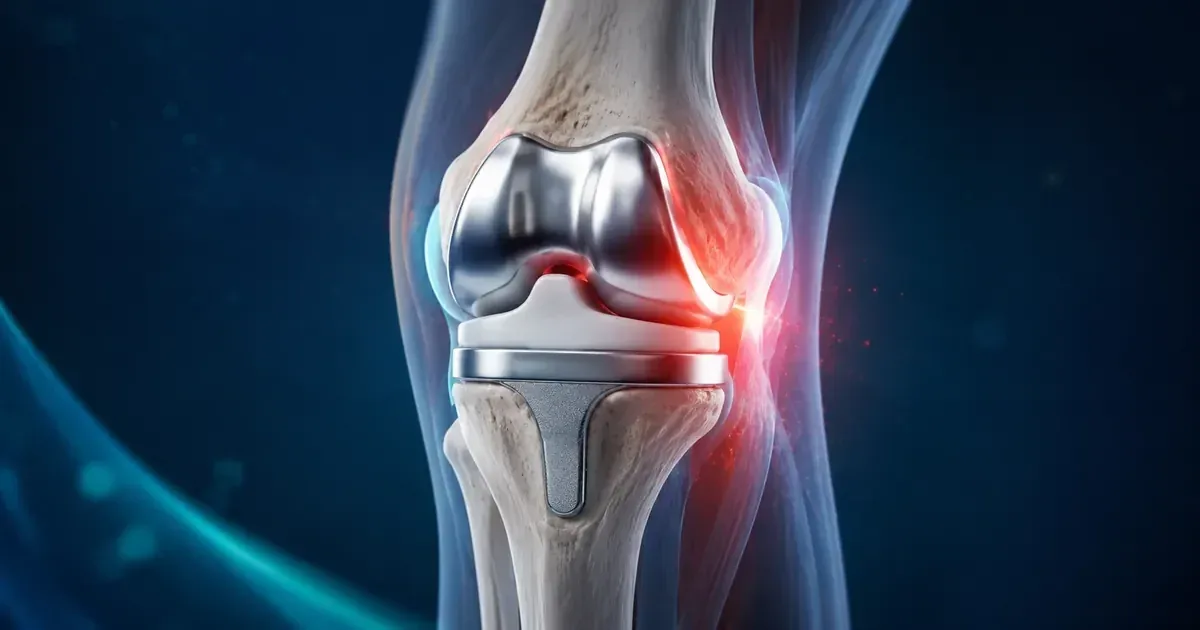
How rare is infection after knee replacement?
First, the good news. Roughly 600,000 total knee replacements are performed in the United States every year, and only a very small percentage — about 0.5% to 2% — of those patients ever develop an infection (Folusakin & Todd, 2019). Infection of a knee replacement is genuinely uncommon.
Uncommon is not never, though. Bacteria can reach the joint through small cuts in the skin or during invasive medical and dental procedures — which is why the timing of dental work around joint replacement matters. An infection may sit in the skin near the surgical incision, or deep within the joint itself, and it can appear weeks or even years after surgery. Where the infection lives and how severe it is determine the treatment.
What will I see or feel if my joint is infected?
Signs of an infected knee replacement include:
- Fever or unusual fatigue
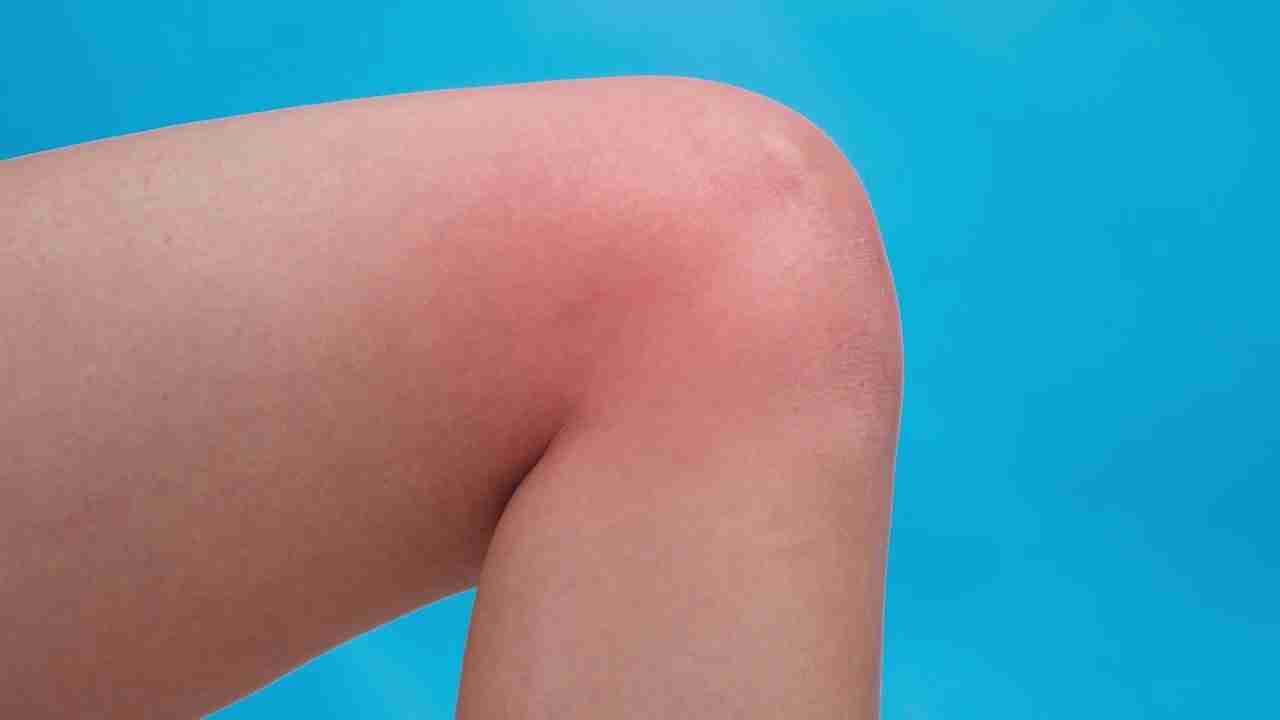
- Swelling, redness, or localized warmth over the knee
- Fluid draining from the knee or the incision
- A return of pain or stiffness after you had fully recovered from surgery
That last one deserves emphasis: a knee that was doing well and then starts hurting again is never something to shrug off. It's one of the classic presentations of a late infection — and one of the causes Dr. Morton screens for in every painful knee replacement workup.
How the diagnosis is confirmed
An X-ray or bone scan helps your surgeon look for infection around the implant. If fluid is visibly draining from the surgical site, a culture is taken — a sample of the fluid is tested in the lab to identify exactly which bacteria are present. Blood tests and needle aspiration of the fluid around the joint may also be needed to definitively diagnose a periprosthetic infection (Parvizi, et al., 2018). Identifying the organism is not academic — it dictates which antibiotics will work and which surgical strategy makes sense.
Non-surgical treatment: when antibiotics alone can work
If an infection is caught early enough and is not severe — confined to the skin surface only — treatment can be non-invasive. Oral or IV antibiotics are often very successful for early, superficial infections, with no surgery required.
Suppressive antibiotic therapy — long-term antibiotics that hold an infection in check rather than cure it — is reserved for patients with chronic infections who are not good candidates for surgery. Its overall treatment success rate is about 67% (Wouthuyzen-Bakker, et al., 2017).
The honest caveat: once bacteria establish themselves on the implant itself, antibiotics alone rarely cure the problem. Most patients with a deep joint infection will need at least one revision procedure to cure it.
DAIR: debridement, antibiotics, and implant retention
If it has only been a few weeks since your knee replacement, you may be a candidate for D.A.I.R. — the one surgical option that keeps your original implant. The surgeon opens the knee, thoroughly washes it out, and removes infected tissue (debridement), followed by 6 weeks of IV antibiotics. Expect periodic blood tests, needle aspirations, or cultures along the way to confirm the antibiotics are working.
The trade-off is its success rate: only about 50% of patients achieve eradication of the infection with DAIR (Vasso & Panni, 2014). That's why it's offered only in the narrow early window, before bacteria have fully colonized the implant surface.
Single-stage revision: one surgery, new implant
A single-stage revision handles everything in one operation: debridement, removal of the infected prosthesis, and implantation of a new prosthesis — all the same day.
Benefits:
- Fewer surgeries and fewer anesthesia events
- Less expensive overall
- Lower risk of the complications that come with multiple operations
- Potential for a shorter hospital stay and less total rehabilitation time
- Lower reported reinfection rates — 4.3% versus 13.5% for two-stage revision in comparative data
Outcomes: 80–90% of appropriately selected patients achieve eradication of their infection (Kildow, et al., 2020).
Two-stage revision: the standard for long-standing infections
Two-stage revision is used when an infection may have been present for months or years — long-standing infections are simply harder to eradicate. It remains the more common choice in the United States, where it is generally believed to work better for chronic infections.
Stage 1 — remove and treat. The surgeon debrides the joint, removes the infected knee implant, and places an antibiotic-loaded spacer in the joint. The spacer does three jobs at once: it keeps the joint stable, preserves some mobility, and continuously bathes the infected joint in antibiotics (Mazzucchelli, et al., 2015). Stage 1 also includes 6 weeks or more of IV antibiotics, with periodic blood tests to confirm the infection is responding.
Stage 2 — rebuild. Once testing confirms the infection has cleared, the spacer is removed, the joint is debrided again, and a new prosthesis is implanted.
Benefits:
- Two separate chances to debride infected tissue
- Two chances to assess how the infection responds to antibiotics during the interval between surgeries
Risks and trade-offs (Negus, et al., 2017):
- The accumulated risk of two major operations
- Potential spacer failure, leading to further surgery
- Higher overall cost
- Two separate recovery and rehabilitation periods
- About 10% of patients become medically unfit for the second-stage surgery (Gomez, et al., 2015)
- Reinfection is still possible even after both stages — comparative series report infection control around 93% (Haddad, et al., 2014)
What's new in infection treatment: better spacers
The antibiotic spacer used between stages has come a long way, and the choice of spacer shapes how you live during those weeks or months. There are two families:
Static spacers
- Used for severe bone loss, a static spacer prevents motion at the knee and acts like a temporary fusion. Many surgeons build this by placing cement alone within the knee.
- Dr. Morton adds an internal rod to the construct. That extra stability keeps the spacer from dislodging during your recovery — a known failure mode of cement-only static spacers.
Mobile (articulating) spacers
- Traditional mobile spacers are made of antibiotic cement bonded to the ends of the femur (thigh bone) and tibia (shin bone).
- Newer techniques use mobile implants with metal and polyethylene (plastic) components surrounded by antibiotic-impregnated cement — essentially a temporary knee that also delivers antibiotics. These allow a far more functional knee during the spacer phase.
- Some patients find these newer spacers so functional that they never need the second-stage surgery at all.
The bottom line
Infection after knee replacement is uncommon — but when it happens, it is a serious complication that rewards speed. Contact your surgeon immediately if you notice fever, fatigue, swelling, redness, warmth over the knee, fluid draining from the knee, or a return of pain or stiffness after you had fully recovered. With appropriate treatment, an infection can be cured, with a realistic expectation of full recovery and a return to your normal activities and mobility.
Dr. Morton is a fellowship-trained hip and knee surgeon whose complex and revision joint clinic manages infected knee replacements for patients across Hawai'i, with offices in Honolulu, West O'ahu, Hilo, and Kona. If your knee doesn't feel right — whether your original surgery was here or anywhere else — call (808) 439-6201 for an evaluation, and good wound care after surgery remains your best first defense.
Medically reviewed by Paul N. Morton, MD, FAAOS, FAAHKS — board-certified orthopedic surgeon, fellowship-trained in adult hip & knee reconstruction and orthopedic trauma.
This page is for education only and isn’t a substitute for an exam and personalized advice — schedule a consultation to discuss your situation.