
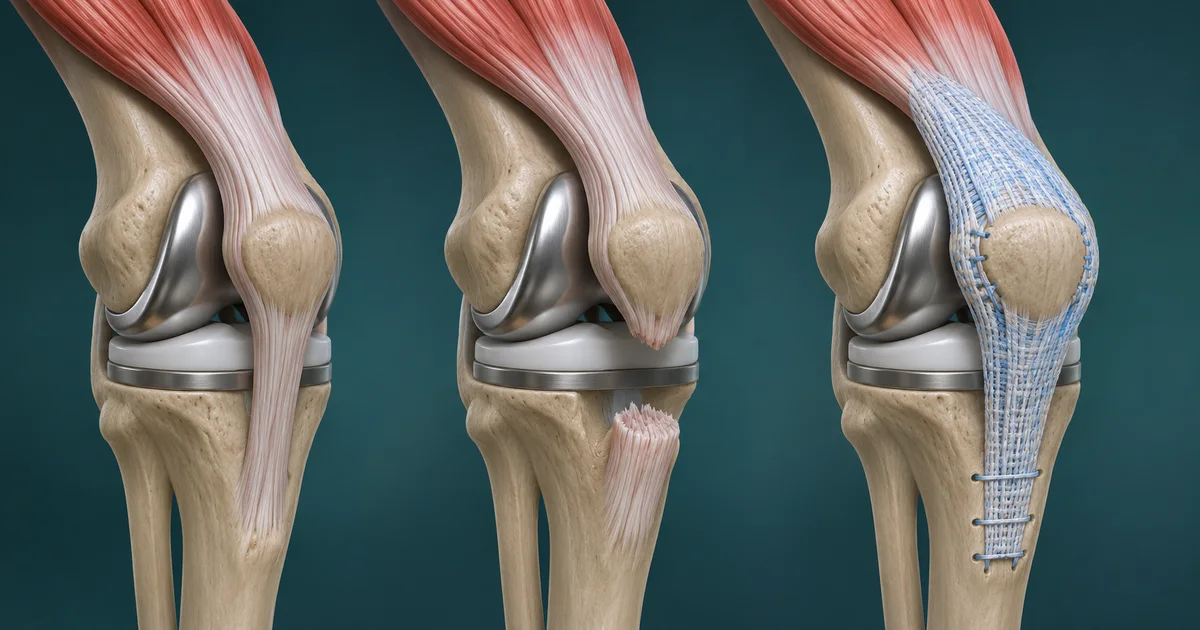
What is the knee extensor mechanism?
The extensor mechanism is a linked chain: the quadriceps muscle attaches to the quadriceps tendon, the tendon connects to the patella, and the patellar tendon connects the patella to the tibia. When the quadriceps contracts, this chain pulls the knee straight. It also controls the knee while rising from a chair, climbing stairs, and preventing a fall.
After total knee replacement, failure can occur at the quadriceps tendon above the patella, through the patella as a fracture, or at the patellar tendon below the patella. These are different injuries and do not all require the same operation.
What symptoms should prompt an urgent evaluation?
A sudden pop, fall, forced bend, new inability to perform a straight-leg raise, or a knee that repeatedly gives way should be assessed promptly. Some people can still move the leg because scar tissue or a partial tendon connection remains, but they may develop an extensor lag: the knee can be straightened by someone else, yet the patient cannot hold it fully straight.
New wound drainage, fever, increasing redness, rapidly worsening swelling, or severe pain adds concern for infection or fracture. Until the knee is evaluated, use a brace or immobilizer if one has been provided, avoid forced flexion, use a walking aid, and reduce fall risk.
How is the diagnosis made?
The workup begins with the event, prior operations, wound history, examination, and standing or trauma X-rays. The surgeon checks where the extensor chain is interrupted, whether the patella has moved, how much active extension remains, and whether the knee replacement is loose, malpositioned, unstable, or associated with bone loss.
Ultrasound or metal-artifact-reduction MRI may help define a tendon defect and tissue quality. CT can clarify a difficult fracture or component position. Infection must be considered, especially after multiple operations or wound problems; blood tests and joint aspiration may be needed before reconstruction. The revision joint clinic uses this diagnosis-first approach because reconstructing a tendon without addressing infection, loosening, or instability can leave the underlying cause untreated.
Does every disruption need surgery?
No. A partial tear with a functioning straight-leg raise, a stable patellar fracture with an intact extensor mechanism, or a patient whose medical risk outweighs the likely benefit may be managed with a brace, activity modification, walking aids, and close follow-up. The tradeoff can be persistent weakness, extensor lag, difficulty with stairs, or continued brace dependence.
Complete disruption with loss of active extension usually creates a major functional problem. The decision still depends on timing, tissue quality, infection status, implant stability, skin and soft-tissue condition, fall risk, medical health, and what level of walking function is realistic.
When can the tendon be repaired, and when is reconstruction needed?
An acute quadriceps tendon injury with usable tissue may sometimes be repaired, often with augmentation because tissue around a knee replacement may be compromised. Direct repair of a patellar tendon rupture has historically had a high failure and complication rate; reconstruction is commonly considered when the tendon is chronic, retracted, previously repaired, or too weak to hold sutures.
A systematic review found substantial complication rates across these injuries and supported reconstruction for patellar tendon disruption, while allowing selected acute quadriceps ruptures to be repaired. This is not a simple choice based only on the calendar. The surgeon must judge whether the remaining tissue can safely support healing.
What are mesh and allograft reconstruction?
When native tissue cannot be repaired reliably, the extensor chain can be rebuilt with a synthetic polypropylene mesh, a donor extensor-mechanism allograft, or another individualized construct. Mesh is woven into or fixed to the tibia and incorporated into the remaining tendon and quadriceps tissues. An allograft replaces a larger portion of the chain with donor tibial bone, patellar tendon, patella, and quadriceps tendon.
Neither option is universally superior. A meta-analysis found no clear difference in overall success, revision, infection, or functional scores between allograft and synthetic reconstruction. Choice depends on the defect, bone and skin condition, infection history, prior operations, implant plan, surgeon experience, graft availability, and the rehabilitation strategy.
When does the knee replacement itself need revision?
Some patients need only the extensor mechanism reconstructed. Others need simultaneous revision knee replacement because components are loose, malpositioned, unstable, infected, or incompatible with the reconstruction. Severe bone loss may require cones, stems, augments, or a more constrained implant. Soft-tissue coverage may require plastic-surgery support.
The operative plan should include contingencies. Imaging may not reveal the full extent of tissue damage, component motion, scar, or bone loss. If infection is confirmed, the reconstruction may need to be staged rather than placed into an infected field.
Why is recovery so protective and slow?
A reconstruction can stretch or fail if the knee bends before the graft or mesh has incorporated. Rehabilitation is therefore far more protective than routine knee-replacement therapy. Dr. Morton’s published extensor mechanism reconstruction protocol uses a long-leg cast with no knee motion for 12 weeks, followed by a hinged brace and staged flexion limits when the reconstruction is ready.
The exact order controls weight bearing, cast changes, brace settings, and strengthening. Patients should not accelerate motion because the knee feels stiff. A fall, forced bend, cast or brace failure, new wound problem, or increasing extensor lag requires prompt contact with the surgical team.
What outcomes and risks should patients understand?
Reconstruction can improve active extension and walking function, but it remains salvage surgery with meaningful risk. A large single-center mesh series reported improvement in extensor lag and encouraging implant retention, while a separate mesh cohort documented failures and infections despite prolonged immobilization.
More recent comparative evidence is sobering. In a 2023 study, five-year survival free of repeat revision or severe persistent extensor lag was 54%, with no significant difference between allograft and mesh. Infection, recurrent lag, re-rupture, wound problems, stiffness, falls, repeat reconstruction, fusion, or amputation can occur. These numbers describe complex referral populations, not an individual prediction, but they support careful counseling and realistic goals.
Questions to ask at a revision-knee consultation
- Where is the extensor mechanism disrupted: quadriceps tendon, patella, or patellar tendon?
- Is the defect partial or complete, and how much active extension remains?
- Is the injury acute enough for repair, or is reconstruction more reliable?
- Has infection been evaluated when indicated?
- Are the knee-replacement components fixed, positioned, and stable?
- Would mesh, allograft, another graft, or bracing best fit my situation?
- Will component revision or soft-tissue coverage be needed?
- How long will the knee be immobilized, and what are the weight-bearing limits?
- What functional improvement is realistic, and how much extensor lag may remain?
- What findings would change the plan during surgery?
The bottom line
Loss of active knee extension after replacement is a diagnosis, not a single operation. Stable partial injuries may be braced; selected acute quadriceps injuries may be repaired; chronic, deficient, or failed tissues often require mesh or allograft reconstruction. Infection, component problems, bone loss, and soft-tissue coverage can turn the case into a broader revision. If a replaced knee suddenly buckles or can no longer straighten, schedule an urgent revision-focused evaluation and protect the knee from another fall.
Sources and further reading
- Allograft or synthetic mesh reconstruction: five-year risks (2023)
- Marlex mesh reconstruction series of 77 knees (2018)
- Mesh reconstruction and postoperative immobilization (2020)
- Systematic review of extensor tendon disruption after TKA (2019)
- Meta-analysis: allograft versus synthetic reconstruction (2019)
Medically reviewed by Paul Norio Morton, MD, FAAOS, FAAHKS. Last reviewed: . This article is for education only and isn’t a substitute for an exam and personalized advice — schedule a consultation to discuss your situation.