
The short answer: the reason for revision shapes the recovery
A revision can be a limited exchange of one implant part or a major reconstruction involving removal of several components, bone graft, stems, augments, cones, sleeves, or a staged infection treatment. Those operations cannot share one reliable recovery calendar.
The first question is not simply, “How long does revision recovery take?” It is, “What failed, what must be rebuilt, and what needs protection while it heals?” Your diagnosis, reconstruction, health, mobility before surgery, and home support all affect the answer.
Why revision surgery is different from a first replacement
Primary replacement usually begins with native bone and anatomy. Revision begins around an existing implant, scar tissue, and anatomy changed by the earlier operation. The surgeon may need to identify and remove well-fixed parts without causing unnecessary bone loss, clear damaged tissue, and reconstruct areas that no longer support a standard implant.
AAOS patient guidance describes revision hip and knee replacement as longer, more complex procedures that require extensive planning and specialized implants and tools. Greater complexity does not mean recovery will go poorly; it means the plan must be individualized and comparisons with a friend’s first replacement may be misleading.
A correct diagnosis is the foundation of recovery planning
Revision should target a defined, correctable problem such as loosening, instability, infection, fracture, wear, malposition, recurrent dislocation, or severe stiffness. Pain alone is not a diagnosis. Pain can also come from the spine, tendons, nerves, weakness, or another joint.
The workup may include serial X-rays, blood tests, aspiration, CT, metal-artifact-reduction MRI, and review of the original operative report. The JRH Revision Hip & Knee Replacement Clinic uses this diagnosis-first approach because recovery expectations depend on what the operation is actually intended to correct.
A smaller revision and a full reconstruction are not the same operation
Some revisions replace a modular liner, head, or one loose component while other parts remain secure. Others require removal of the entire hip or knee replacement, management of bone loss, and implants that anchor farther into the femur or tibia.
A limited revision may allow a pathway closer to primary replacement, but the label “small revision” does not guarantee a quick recovery. Soft-tissue repair, infection concern, fracture risk, and the stability of the retained components still matter. Ask which parts will be changed and which structures need time to heal.
Infection can turn recovery into a staged process
When infection is the reason for revision, treatment may involve debridement with component retention, a one-stage exchange, or a two-stage pathway with implant removal, an antibiotic spacer, antimicrobial treatment, and later reimplantation. Each stage has its own wound, mobility, medication, and rehabilitation plan.
Do not compare a staged infection recovery with an aseptic revision for loosening. Infection treatment may require coordination among orthopedic surgery, infectious-disease clinicians, pharmacy, home-health services, and physical therapy. The infected knee replacement guide explains why timing and organism-specific treatment change the plan.
Bone loss or fracture may change weight bearing
Revision implants often use stems, augments, cones, sleeves, graft, or custom components to obtain support when bone has been damaged. A fracture around an implant, an osteotomy used for safe component removal, or a repair of weakened bone may require temporary limits on how much weight can be placed through the leg.
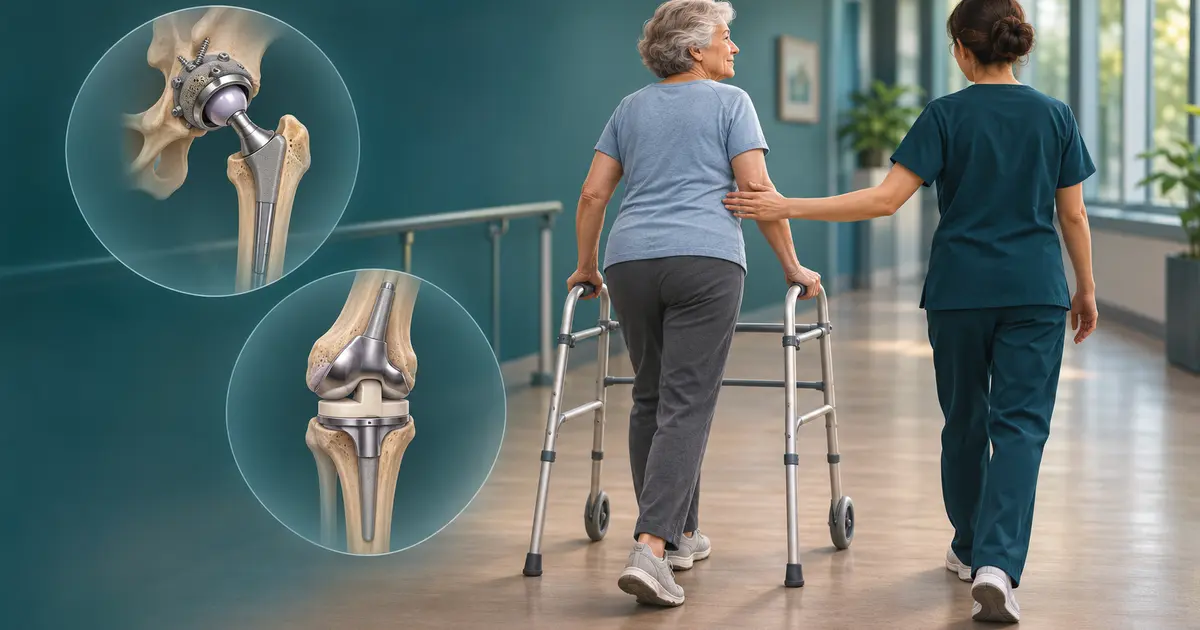
Other patients can bear weight as tolerated soon after surgery. Follow the written instructions for your reconstruction rather than copying a generic protocol. Using a walker longer is not a sign of failure when the purpose is to protect bone or soft tissue while it heals.
The first days focus on safety, mobility, and the wound
Early goals usually include pain and nausea control, blood-clot prevention, safe transfers, walking with the prescribed device, and a plan for stairs and bathroom access. The team also watches the incision, blood count, circulation, nerve function, and medical conditions that can slow discharge.
Some revisions follow a rapid hospital pathway; others require more monitoring or inpatient rehabilitation. Discharge depends on medical stability and safe function, not a promised number of nights. Arrange transportation, medications, equipment, and help at home before surgery whenever possible.
The first six weeks are about protecting the reconstruction
During the early phase, swelling, fatigue, and the need for an assistive device are common. Therapy emphasizes safe walking, motion allowed by the surgeon, muscle activation, and everyday function. The exact exercise and range-of-motion plan changes when there has been a fracture, tendon or muscle repair, bone graft, spacer, or wound concern.
More exercise is not always better. Pushing past restrictions can jeopardize healing, while too little movement can contribute to weakness, stiffness, and blood clots. The best program is progressive and tied to the operation actually performed.
Improvement can continue for many months
Research on revision knee replacement identifies different recovery trajectories: some people improve early, others improve later or continue improving between early and one-year assessments, and some do not obtain the benefit they hoped for. Studies of revision hip replacement also show meaningful average improvements in pain and function, although gains are generally smaller and less predictable than after primary hip replacement.
These studies describe groups, not an individual forecast. A slow early phase does not automatically mean the revision has failed, and a good first few weeks do not eliminate the need for ongoing precautions and follow-up.
Hip and knee revisions have different rehabilitation priorities
After revision hip replacement, the plan may emphasize dislocation precautions, abductor healing, leg-length adaptation, and protection of the femur or pelvis. After revision knee replacement, priorities may include swelling control, extension, flexion, quadriceps activation, and stability while protecting repaired ligaments, tendons, or bone.
A patient with a simple component exchange may progress differently from someone with a hinge knee, pelvic reconstruction, proximal femoral replacement, or extensor-mechanism repair. The words “revision hip” or “revision knee” are only the starting point for a rehabilitation prescription.
Return to driving, work, and activity must be individualized
Driving requires more than reaching a certain week: you need adequate reaction time and control, must be off impairing medication, and must follow local legal and insurance requirements. Right-sided surgery, weight-bearing restrictions, and use of a brace can delay safe driving.
Return to work depends on transportation, stamina, walking demands, lifting, and whether modified duty is available. A systematic review found that many patients return to work and report improved activity after revision knee replacement, but the evidence was limited and could not support one universal timeline. Higher-impact sports and heavy labor require a specific conversation about implant, bone, and fall risk.
Preparation can make a complex recovery safer
Bring the prior operative report, implant information, older imaging, infection records, and a current medication list. Optimize anemia, diabetes, nutrition, nicotine use, sleep apnea, and bone health when appropriate. Do not stop blood thinners, osteoporosis medicine, or other prescribed medication without instructions from the treating clinicians.
- Confirm the diagnosis and which components may need revision
- Ask whether infection has been adequately evaluated
- Clarify expected weight-bearing and motion restrictions
- Arrange a walker, bathroom safety equipment, and home assistance
- Plan transportation and possible neighbor-island lodging or follow-up
- Know who to call for wound, medication, or therapy questions
- Schedule postoperative visits before leaving the hospital or surgery center
Questions to ask before revision surgery
Clear answers help set realistic expectations and expose uncertainty that still needs workup:
- What is the confirmed cause of failure?
- Is this likely to be a partial component revision or a full reconstruction?
- How much bone loss or soft-tissue damage do the images show?
- Could infection change the operation or require stages?
- Will I be allowed to bear weight immediately?
- Will a brace, spacer, graft, osteotomy, or tendon repair change therapy?
- What mobility milestone must I meet before discharge?
- What help and equipment should I arrange at home?
- When will driving and work be reconsidered?
- Which findings would make recovery longer than currently expected?
Call promptly for warning signs
Contact the surgical team promptly for increasing drainage, an opening incision, spreading redness, fever with worsening joint symptoms, calf swelling or pain, new weakness or numbness, a fall, sudden deformity, or inability to bear weight that is new. Call 911 for chest pain, severe shortness of breath, fainting, or stroke symptoms.
Do not wait for a routine appointment when symptoms are rapidly worsening. Early assessment can distinguish expected postoperative changes from infection, clot, fracture, dislocation, or another complication.
The bottom line
Revision recovery is a reconstruction-specific process, not a longer version of every primary replacement protocol. The reason for failure, parts revised, bone and soft-tissue condition, infection status, and medical health determine the safest pace.
Bring prior records and imaging to an orthopedic consultation or request a revision second opinion. Dr. Paul Morton’s adult-reconstruction and trauma training supports complex hip and knee evaluation across Hawai‘i. Individual recommendations, timelines, and outcomes vary.
Sources and further reading
- AAOS OrthoInfo: Revision Total Knee Replacement
- AAOS OrthoInfo: Revision Total Hip Replacement
- Recovery patterns during the first year after revision knee arthroplasty
- One-year patient-reported outcomes after primary and revision hip arthroplasty
- Patient-reported outcomes after revision compared with primary hip replacement
- Systematic review: activity, return to sport, and work after revision knee arthroplasty
Medically reviewed by Paul Norio Morton, MD, FAAOS, FAAHKS. Last reviewed: . This article is for education only and isn’t a substitute for an exam and personalized advice — schedule a consultation to discuss your situation.