

ACL recovery — the short answer
Recovery after ACL reconstruction runs in phases, each earned rather than scheduled: protect and straighten the knee for two weeks, rebuild motion and strength by six weeks, start straight-line running around months three to four, train sport-specific movement from month six, and return to cutting sport at nine to twelve months after passing strength and hop testing. A meniscus repair stretches the early phase. Individual timelines vary.
- Weeks 0–2
Protect and calm
Swelling control, full extension, quad activation, weight-bearing with crutches and weaning as the quad returns.
- Weeks 2–6
Rebuild the basics
Bend past 120°, normal gait, closed-chain strength, the stationary bike as workhorse.
- Months 3–4
Earn the right to run
Straight-line running once quad strength, a quiet knee, and single-leg control check the boxes.
- Months 6–9
Sport-specific training
Plyometrics, landing mechanics, agility, progressive cutting at speed.
- Months 9–12
Testing-based return
Strength within roughly 90% of the other leg, symmetric hop tests, clean mechanics, a quiet knee — and the head ready too.
Weeks 0–2: protect and calm the knee
The first two weeks have two jobs: protect the healing graft and calm the joint down. Swelling control — elevation, ice or cold therapy, compression — is the priority, because a swollen knee shuts down the quadriceps and stalls everything that follows.
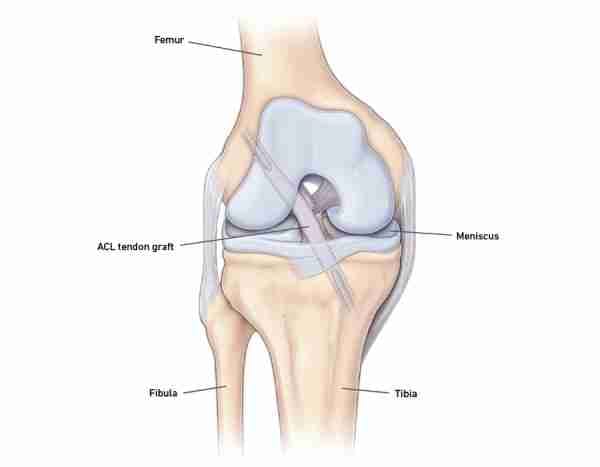
Three goals dominate this phase. First, get the knee fully straight; full extension early prevents the stiffness that is hardest to fix later. Second, wake up the quad with straight-leg raises and gentle activation work. Third, walk — most patients bear weight as tolerated with crutches right away and wean off them as the quad returns, often within the first couple of weeks. Bending comes along gradually, and the incisions need routine care while they heal. If your meniscus was repaired at the same operation, expect this phase to run longer — a brace and protected weight-bearing for a period your surgeon sets, and limits on deep bending — because sutured meniscus tissue has to heal before it's loaded. It's an unglamorous phase, and it sets up the entire year.
Weeks 2–6: rebuild the basics
By six weeks, the knee should be starting to look and act like a knee again. Physical therapy shifts from protection to rebuilding: restoring bend, normalizing your walking pattern, and loading the leg with closed-chain strength work like leg presses, mini-squats, and step-ups that strengthen without straining the graft. The stationary bike becomes a workhorse in this phase — it restores motion, rebuilds the quad, and keeps your cardiovascular base without pounding the joint.
Swelling is your feedback system. A knee that puffs up after a session is telling you the dose was too high; adjust, don't push through. Typical six-week milestones give you and your therapist an honest scorecard.
- Full extension equal to the other knee
- Bend approaching 120 degrees or more
- Walking without crutches or a limp
- Strong straight-leg raise with no lag
- Swelling largely resolved between sessions
Months 3–4: earning the right to run
Running is earned, not scheduled. Around the three-to-four-month mark, most patients begin a return-to-running progression — but only after checking boxes: quad strength approaching that of the other leg, a quiet knee that doesn't swell after exercise, and clean mechanics on single-leg tasks. Starting to run on a weak quad trades short-term satisfaction for long-term trouble.
Early running is straight-line only — flat ground or a treadmill, walk-jog intervals, no cutting or pivoting. The graft is biologically remodeling during these months and is not yet at full strength, which is why this phase stays disciplined even when the knee feels great. Strength training continues in parallel, because the single best predictor of a good outcome at one year is a quadriceps that pulls its weight. The structured progressions Dr. Morton's patients follow are part of his physical therapy and rehabilitation protocols.
- Ready to start running if: quad strength is approaching the other leg, the knee stays quiet after exercise, and single-leg tasks look clean
- Too soon if: the knee swells after sessions, you can't do a strong single-leg squat without the knee caving in, or a repaired meniscus is still inside its protected window
Months 6–9: sport-specific training
This is the phase most people skip — and the phase that protects the graft. Between roughly six and nine months, rehab turns into training: plyometrics, landing mechanics, agility ladders, progressive cutting and pivoting, and drills that mimic your sport at increasing speed and unpredictability.
The goal is to close the gap between "cleared to jog" and "ready for an opponent." Game situations are chaotic — a defender bumps you mid-landing, the ball arrives a beat late — and the knee has to handle load it didn't plan for. Practicing decision-making at speed, not just movement patterns, is what builds that reserve. Athletes in cutting sports like soccer and basketball need more time here than straight-line athletes such as paddlers, swimmers, and cyclists, who often return to full activity earlier in the year. What you're returning to shapes the plan — more on that in ACL injuries in sports.
Months 9–12: testing-based return to sport
Return to sport should be a test you pass, not a date you reach. Most surgeons now use objective criteria: quadriceps and hamstring strength within roughly 90 percent of the uninjured leg, symmetric performance on a battery of single-leg hop tests, clean movement quality on video or clinical assessment, and a knee that stays quiet through full training.
The reasoning is blunt: re-tear risk is highest in young athletes who return early to cutting sports — a meta-analysis of 19 studies (Wiggins et al., Am J Sports Med 2016) found nearly 1 in 4 athletes under 25 who returned to high-risk sport sustained a second ACL injury in either knee — and studies report fewer re-injuries in athletes who wait longer and pass strength testing before returning. The graft can fail, and so can the other knee's ACL — both are on the table when an athlete goes back underprepared. Nine months is a floor for most pivoting athletes, not a promise; some knees need twelve. Formal return-to-sport testing is available through your physical therapy team and reviewed at your follow-up visits, so the decision rests on numbers rather than optimism. If your team clears you at nine months with objective data behind it, that's a strong position. If you're being cleared by the calendar alone, ask more questions.
The mental game: psychological readiness is real
Fear of re-injury is one of the most common reasons athletes never get back to their sport — even with a perfectly good knee. Hesitation shows up as playing tentatively, protecting the leg on landings, and avoiding the exact movements the rehab prepared you for. That guarding itself changes mechanics and can increase risk.
Confidence is trained like strength: gradual exposure to the movements that scare you, in controlled settings, until the knee proves itself. Validated questionnaires can help measure psychological readiness alongside the physical tests, and it's worth being honest with your surgeon and therapist about where your head is. A knee that passes every test attached to an athlete who doesn't trust it is not ready — and that's a solvable problem, not a character flaw. If your recovery has stalled — physically or mentally — a consultation to reassess the plan is worth far more than pushing through. Unsure your rehab is on track, or had surgery elsewhere? A second opinion with your operative report, or a visit with the practice's PB&J Physical Therapy team in Honolulu or Kunia working from Dr. Morton's rehabilitation protocols, can reset the plan — call (808) 439-6201 or book online. Neighbor island patients can check in by telehealth when a clinic visit isn't practical. The long-term stakes, including arthritis risk after an ACL tear, reward getting this year right.
Medically reviewed by Paul Norio Morton, MD, FAAOS, FAAHKS. Last reviewed: . This article is for education only and isn’t a substitute for an exam and personalized advice — schedule a consultation to discuss your situation.