
The short answer: a loose feeling is a symptom, not a diagnosis
Instability after total knee replacement means the reconstructed knee does not remain predictably balanced during part of its motion or under load. Patients may describe buckling, shifting, wobbling, distrust, a need to lock the knee straight, or a sense that the leg cannot support them. Some notice repeated swelling, difficulty rising from a chair, or trouble going down stairs.
Those descriptions are important, but they do not prove that the metal components are loose from the bone. A knee can be mechanically unstable even when the implants are well fixed. Conversely, implant loosening, infection, weakness, nerve problems, or pain referred from the hip or back can imitate instability. A revision decision should never rest on the word “loose” alone.
Common signs that deserve a focused instability evaluation
Instability often appears during specific tasks rather than during quiet sitting. Write down what the knee is doing, when it happens, and whether swelling follows. That history helps distinguish one pattern from another.
- The knee gives way or buckles, especially on uneven ground
- Going down stairs feels less controlled than going up
- The knee shifts when rising from a chair or stepping off a curb
- You repeatedly brace or lock the leg straight before putting weight on it
- There is recurrent swelling after ordinary activity without a new injury
- The knee feels stable when straight but loose in a bent position
- A new clunk, shift, or side-to-side wobble is paired with pain or loss of trust
- Symptoms are getting worse rather than gradually improving during normal recovery
Normal recovery sensations are not always instability
A new knee replacement often feels unfamiliar. Early swelling, muscle inhibition, fatigue, numbness near the incision, and reduced confidence can make the leg feel weak. Painless clicking can also occur as the implant surfaces and soft tissues move. These sensations may improve as swelling falls and strength returns.
What is less reassuring is repeated true buckling, a visible or palpable shift, a progressive change after a period of good function, or recurrent effusions that return with activity. Timing matters. A knee that never felt balanced suggests a different set of causes from a knee that became unstable years later.
Four patterns surgeons look for
Instability is not one condition. The examination asks where in the arc of motion the balance is lost and in which direction the knee moves.
| Pattern | Typical clues | What may contribute |
|---|---|---|
| Flexion instability | Giving way or distrust with the knee bent; difficulty downstairs or rising; recurrent swelling | A flexion space that is too loose, posterior-cruciate-ligament insufficiency in some designs, component size or position, or progressive soft-tissue laxity |
| Extension instability | Instability near a straight knee, sometimes with hyperextension or a need to lock the leg | Soft-tissue imbalance, bone loss, component position, or neuromuscular weakness |
| Mid-flexion instability | The knee may feel firm when fully straight and at 90 degrees yet unstable between those positions | Joint-line change, component geometry or position, and collateral-ligament balance |
| Multidirectional instability | Wobble in several positions or directions | Broad ligament insufficiency, major bone loss, severe malalignment, trauma, or a complex prior reconstruction |
The labels guide the workup, but real knees do not always fit neatly into one box. The key is to reproduce the patient’s symptom and connect it to a correctable mechanism.
Why the knee may become unstable
Some causes begin at the original operation: the spaces may not have been balanced equally, a component may be oversized, undersized, or positioned in a way that changes ligament tension, or the selected implant constraint may not match the available ligament support. Other causes develop later. Ligaments can stretch, bone can be lost around an implant, a component can loosen, the plastic insert can wear, or trauma can damage previously stable soft tissues.
Infection deserves special attention because it can present as pain, swelling, stiffness, or instability without dramatic fever or drainage. A new unstable feeling may also be driven by quadriceps weakness, nerve disease, or another joint. The cause—not just the sensation—determines whether therapy, bracing, medical treatment, or revision is appropriate.
The workup starts with a precise history and examination
A useful history includes the date and type of the original replacement, whether the knee ever felt good, when the unstable feeling began, any fall or injury, the exact tasks that trigger it, and whether swelling, warmth, night pain, or systemic symptoms occur. Operative reports and implant stickers can help identify the components already in place.
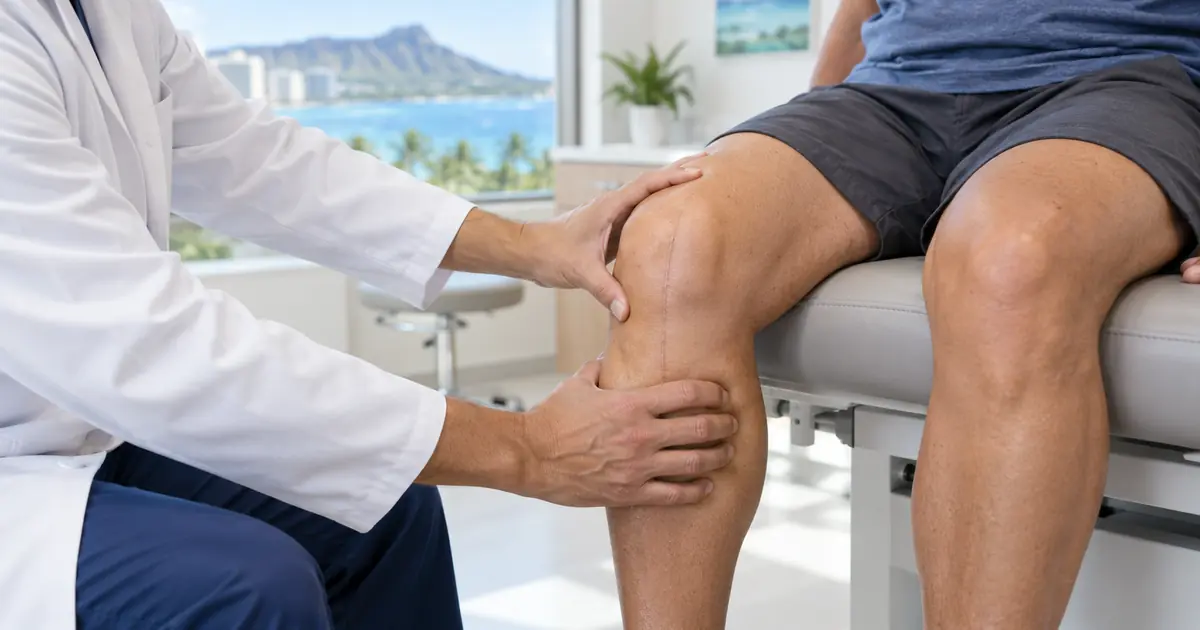
During the examination, the surgeon observes gait, alignment, quadriceps control, range of motion, the kneecap, and the hip and spine. Stability is tested in extension, mid-flexion, and deeper flexion with controlled varus-valgus and front-to-back stress. Comparing the symptom with the position that reproduces laxity is more informative than a single generic “drawer” test.
Imaging and laboratory tests answer different questions
Standing X-rays show alignment, component position, joint-line level, bone loss, fractures, and signs of wear or loosening. Comparing new films with older images can reveal gradual migration or progressive radiolucent lines. Full-length alignment films, specialized views, stress radiographs, or CT may be useful when rotation, subtle instability, or bone loss is uncertain.
Blood tests such as ESR and CRP may be used when infection is possible. If concern remains, the knee may need aspiration for cell count, differential, culture, and other synovial tests. No imaging study can safely substitute for the infection workup when the history or examination raises concern.
What research says about diagnosing instability
An evidence-based review of instability after knee replacement emphasizes combining the patient’s history, physical examination, and investigations to identify the instability pattern. A published diagnostic algorithm for flexion instability likewise shows why infection, loosening, malposition, and ligament problems must be separated before treatment.
The field still lacks one universal objective test. A 2026 scoping review found that perceived instability and manual laxity do not always line up cleanly, which reinforces a practical rule: revision should not be offered for a vague symptom without a reproducible pattern and a plausible mechanical correction.
Can therapy or a brace help?
When weakness, control, or deconditioning contributes, targeted physical therapy may improve confidence and function. Strengthening the quadriceps, hip abductors, and balance system can be useful. A brace may reduce symptoms temporarily for selected patients or help clarify whether added support changes the problem.
These measures cannot correct a malpositioned component, major ligament deficiency, severe wear, infection, or advanced bone loss. In a large series of flexion instability, nonoperative management improved symptoms in about one third of patients; many with persistent patient-reported instability or recurrent effusions proceeded to revision. That is not a promise for an individual knee, but it supports trying conservative care when the diagnosis and severity make it reasonable.
When revision may help—and when it may not
Revision can help when the workup identifies a correctable cause that matches the symptoms: an unbalanced flexion or extension space, component malposition, ligament insufficiency, polyethylene wear, loosening, or another defined failure. The operation may involve exchanging one or more components, rebuilding bone, restoring joint-line position, and using an implant with the level of constraint needed for the remaining ligaments.
Revision is not simply “put in a thicker plastic.” An isolated liner exchange has narrow indications because increasing thickness can tighten one part of the motion while leaving another problem unsolved. Likewise, revising a painful knee with no diagnosis has poor odds of delivering the expected result. A revision knee replacement plan should explain what is wrong, how the operation corrects it, what alternatives exist, and what outcome is realistic.
Red flags that should not wait for a routine visit
Contact your surgical team promptly for rapidly increasing pain or swelling, new redness or warmth, drainage, fever, chills, or night sweats. The American Association of Hip and Knee Surgeons advises that persistent pain with swelling, warmth, drainage, or redness—with or without systemic symptoms—can signal infection. Sudden inability to bear weight, a new deformity, a locked knee, or instability after a fall needs urgent assessment for fracture, dislocation, or tendon injury.
Call emergency services for chest pain, trouble breathing, fainting, or other life-threatening symptoms. Online information cannot determine whether a specific replaced knee is infected or mechanically unsafe.
How to prepare for a second-opinion visit
Bring the original operative report if available, the implant card or stickers, prior and current X-rays on disc or through the imaging portal, laboratory and aspiration results, and a list of previous procedures. A short symptom diary is valuable: note the position, activity, swelling, and recovery after each episode.
- Did the knee ever feel stable and function well after the first replacement?
- Does it give way near straight, while partly bent, or in deep flexion?
- Is going downstairs, rising, or walking on uneven ground the main problem?
- Does swelling appear after activity, and how long does it last?
- Was there a fall, infection, wound problem, or sudden change?
- What treatment has already been tried, and what changed the symptoms?
- What activity or function matters most to regain?
The bottom line
If your knee replacement feels loose, the important next step is not choosing a revision implant—it is proving why the knee feels unstable. The components may be well fixed but poorly balanced, or the problem may be loosening, infection, wear, weakness, the kneecap, or a source outside the knee. A careful workup separates these possibilities and prevents a second operation aimed at the wrong target.
Dr. Paul Morton evaluates painful and unstable knee replacements through the Revision Hip & Knee Replacement Clinic. For a diagnosis-first second opinion, schedule a consultation or call (808) 439-6201. Bring prior imaging and operative records if you have them.
Sources and further reading
- Al-Jabri et al.: Management of instability after primary total knee arthroplasty—an evidence-based review
- Moser et al.: Treatment of flexion instability after primary total knee arthroplasty
- Diagnostic algorithm in patients with flexion instability after cruciate-retaining total knee arthroplasty
- van Laarhoven et al.: Measures used to evaluate instability after total knee arthroplasty—scoping review
- AAHKS patient guidance: Infection and your knee replacement
Medically reviewed by Paul Norio Morton, MD, FAAOS, FAAHKS. Last reviewed: . This article is for education only and isn’t a substitute for an exam and personalized advice — schedule a consultation to discuss your situation.