
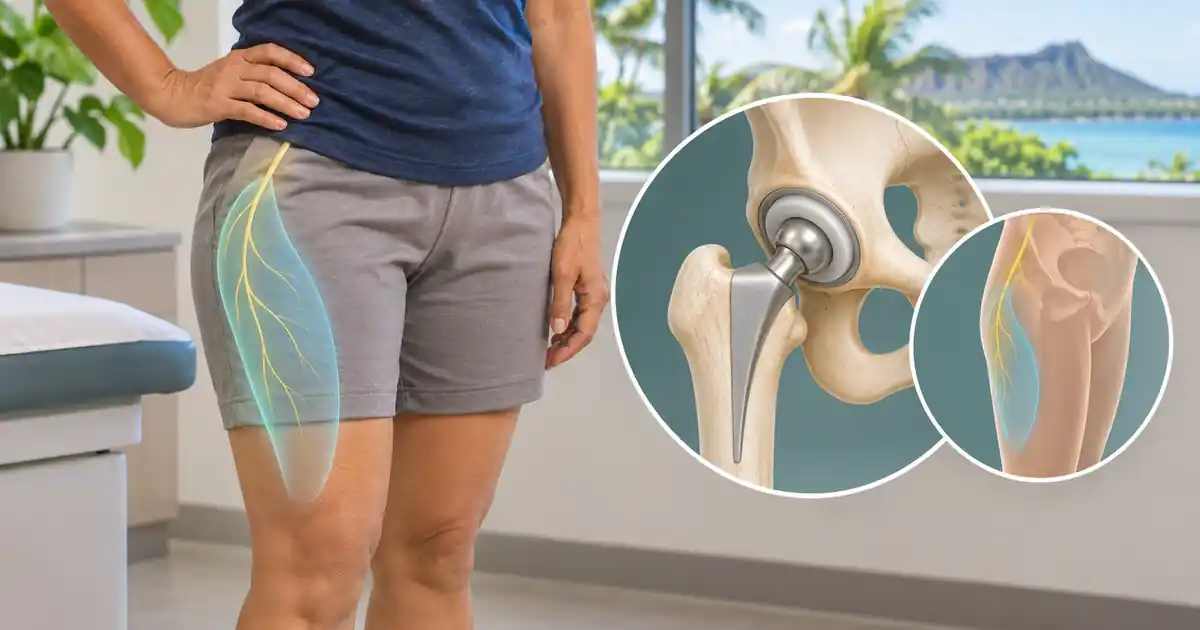
Why does the outer thigh feel numb after an anterior hip replacement?
A patch of changed sensation on the front or outer side of the thigh can occur after direct anterior hip replacement. A small sensory nerve called the lateral femoral cutaneous nerve (LFCN) travels near the surgical approach. Stretch, pressure, or local irritation can leave skin feeling numb, tingly, unusually sensitive, or occasionally burning. The nerve carries sensation, not the muscle power that straightens the knee, so an isolated sensory patch is different from a leg that suddenly becomes weak.
Having a numb patch does not, by itself, mean the hip implant is loose or that the operation failed. A new symptom still deserves discussion with your surgical team, especially when it is worsening, unusually painful, or accompanied by other changes.
What does typical sensory change look like?
Patients often describe a small region that feels like local anesthetic has not completely worn off, reduced feeling under clothing, pins and needles, or sensitivity when fabric touches the skin. The location varies because the LFCN branches are anatomically variable. A superficial patch near the incision may also reflect small skin nerves disturbed during surgery.
Describe the location, size, onset, and trend to your clinician. Photographing or drawing the boundary of the area can help compare one visit with the next. Numbness extending into the foot, progressive weakness, or substantial new back pain is not the classic isolated outer-thigh pattern and warrants a broader examination.
How long can it last?
Some sensation returns as swelling and local irritation settle over weeks to months. Others notice gradual changes over a year or longer, and a small patch can persist. Research reports very different rates because studies use different definitions, ask about symptoms at different times, and include different patient groups. That makes a single universal percentage misleading.
A 2021 literature review highlighted large variation in how LFCN symptoms after anterior hip replacement are measured. In a small cohort followed up to two years, many reported paresthesias improved or resolved, though not all did. Another longer-term follow-up found that sensory symptoms could persist for years without substantially reducing measured hip function. These observations describe groups, not a timetable or guarantee for one person.
What should you do at home?
Continue the walking and rehabilitation plan your surgeon provided. Avoid repeatedly rubbing, heating, or icing a region where sensation is reduced: diminished feeling can make a skin injury harder to recognize. Choose comfortable clothing and note whether the affected area is shrinking, stable, or becoming more troublesome. Do not begin nerve medications, supplements, or aggressive massage based solely on an online description.
If the patch is bothersome, let the team know. They can examine the hip and neurologic function, check the incision, consider whether symptoms fit LFCN irritation or another cause, and discuss appropriate symptom management. The first-year hip recovery guide can help put other expected milestones in context.
When should you contact your surgeon?
Call the surgical team promptly for a new or enlarging area of numbness, severe burning pain, new weakness, increasing groin or hip pain, a fall, wound redness or drainage, or fever. An examination may be needed to distinguish a superficial sensory nerve problem from a wound complication, a back-related nerve problem, or the less common injury to a nerve that controls muscle strength.
Seek emergency care for sudden major leg weakness, inability to walk, a cold or pale foot, new loss of bladder or bowel control, chest pain, or serious shortness of breath. Do not wait for a routine follow-up when there are major new neurologic or vascular symptoms.
Does this mean anterior hip replacement was the wrong approach?
No. A sensory complication should be evaluated on its own merits, but it does not automatically overturn the original choice of surgical approach. Anterior, posterior, and lateral approaches have different tradeoffs. The best approach depends on anatomy, prior surgery, implant needs, surgeon experience, and the patient's goals. You can review the broader procedure and alternatives in our hip replacement overview.
It is reasonable to ask at a postoperative visit: Which nerve territory does this resemble? Is muscle strength normal? Does the pattern look stable? What changes should trigger earlier review? And when would further testing be useful?
The bottom line
A localized patch of outer-thigh numbness after anterior hip replacement may reflect irritation of the LFCN or nearby skin nerves. It often affects sensation more than day-to-day mobility, but recovery is variable and some symptoms persist. Keep track of the trend, report troubling or changing symptoms, and seek urgent care for weakness or other red flags. For case-specific guidance, schedule an orthopedic evaluation rather than relying on a generic recovery clock.
Sources and further reading
- Systematic literature review: LFCN lesions after direct anterior primary THA (2021)
- LFCN sensory impairment after direct anterior THA (2010)
- Long-term natural history of LFCN neuropraxia after anterior hip arthroplasty (2019)
- Femoral nerve palsy after total hip arthroplasty: incidence and recovery (2018)
Medically reviewed by Paul Norio Morton, MD, FAAOS, FAAHKS. Last reviewed: . This article is for education only and isn’t a substitute for an exam and personalized advice — schedule a consultation to discuss your situation.