

What is pickleball?
Pickleball is a fun, social sport enjoyed by people of all ages. It is played with paddles and a perforated plastic ball on outdoor courts, indoor courts, and even grass. Simple rules and a forgiving pace of play make it an excellent option for anyone who wants to stay active with friends — which is exactly why it comes up so often in conversations about life after joint replacement.
The game was invented in 1965 on Bainbridge Island, Washington, by Joel Pritchard, Bill Bell, and Barney McCallum — three fathers looking for a new summer activity for their families. They blended badminton, tennis, and table tennis on a modified badminton court and wrote the rules and equipment specifications themselves. Pickleball first caught on in the Pacific Northwest, but it has since spread to all 50 states — including courts across Hawai'i — and to countries around the world.
One of the best things about pickleball is how accessible it is. Whether you are a seasoned athlete or a complete beginner, you can find a way to enjoy the game and improve your skills, and organized leagues and tournaments give competitive players something to aim for. There is genuinely something for everyone.
The rules of pickleball at a glance
The rules are relatively simple and easy to learn — part of why the sport welcomes newcomers so readily:
- The court. Pickleball is played on a badminton-sized court, 20 feet wide by 44 feet long — roughly a quarter of a tennis court's area. The net sits at 36 inches at the sidelines and 34 inches in the middle. The court is striped like a tennis court, with right and left service courts and a 7-foot non-volley zone in front of the net, known as "the kitchen."
- The ball and paddles. The ball is perforated plastic, similar to a whiffle ball, and it is struck with paddles that resemble oversized ping-pong paddles.
- The serve. Serves travel diagonally across the court, starting from the right service court. The serve must be underhand and must clear the net, and the server stays within the service court until the ball is struck.
- The return. The receiving team must let the ball bounce before returning it. Volleys — balls hit in the air — must be struck from outside the kitchen.
- Scoring. Points are scored when the other side fails to return the ball.
- Winning. Play singles or doubles. The first team to 11 points wins, provided it leads by two; at 10–10, play continues until one side opens a two-point lead.
More detailed rules govern tournament play — the USA Pickleball Association's official rulebook has the complete set.
Why pickleball suits patients with a new hip or knee
Compared with tennis, pickleball asks less of a replaced joint: the court is smaller, the underhand serve is gentler, and rallies involve shorter bursts of movement. That low-impact profile is why so many of Dr. Morton's patients are able to return to it — and why the sport keeps growing among the very age group most likely to have had a hip or knee replacement.
Low-impact does not mean no-impact, though. Quick lateral steps, sudden stops at the kitchen line, and long doubles sessions all load the joint. The goal is not to avoid pickleball — it is to return to it deliberately.
The road back: what the first year looks like
The first year after a knee or hip replacement can be challenging. It is a season of recovery and rehabilitation — and a season of getting back to the activities you love. If pickleball is one of them, approach your return with caution and a gradual progression.
During the first few months after surgery, your focus belongs on physical therapy — rebuilding strength and range of motion. Your therapist will guide you on when it is safe to start folding pickleball back into your exercise routine. Follow those recommendations; the most common mistake is pushing too hard, too soon.
As recovery progresses, structure your return: begin with drills and exercises that rebuild technique and endurance, then move to casual games with friends, and eventually to organized league play if that is your goal. Most patients can return to pickleball within 3 to 6 months after surgery, but it can take up to a full year to regain enough strength and balance to feel truly comfortable on the court.
Every person's recovery is different, so it is okay to take it slow and listen to your body. Do not be afraid to take breaks or dial back the intensity if you feel tired or sore. Above all, remember that the first year is a time of progress and accomplishment — be patient with yourself and celebrate the milestones along the way. With determination and the right approach, you can get back to the game you love. For a fuller picture of what recovery involves, see Dr. Morton's guides to knee replacement recovery and the first year after hip replacement.
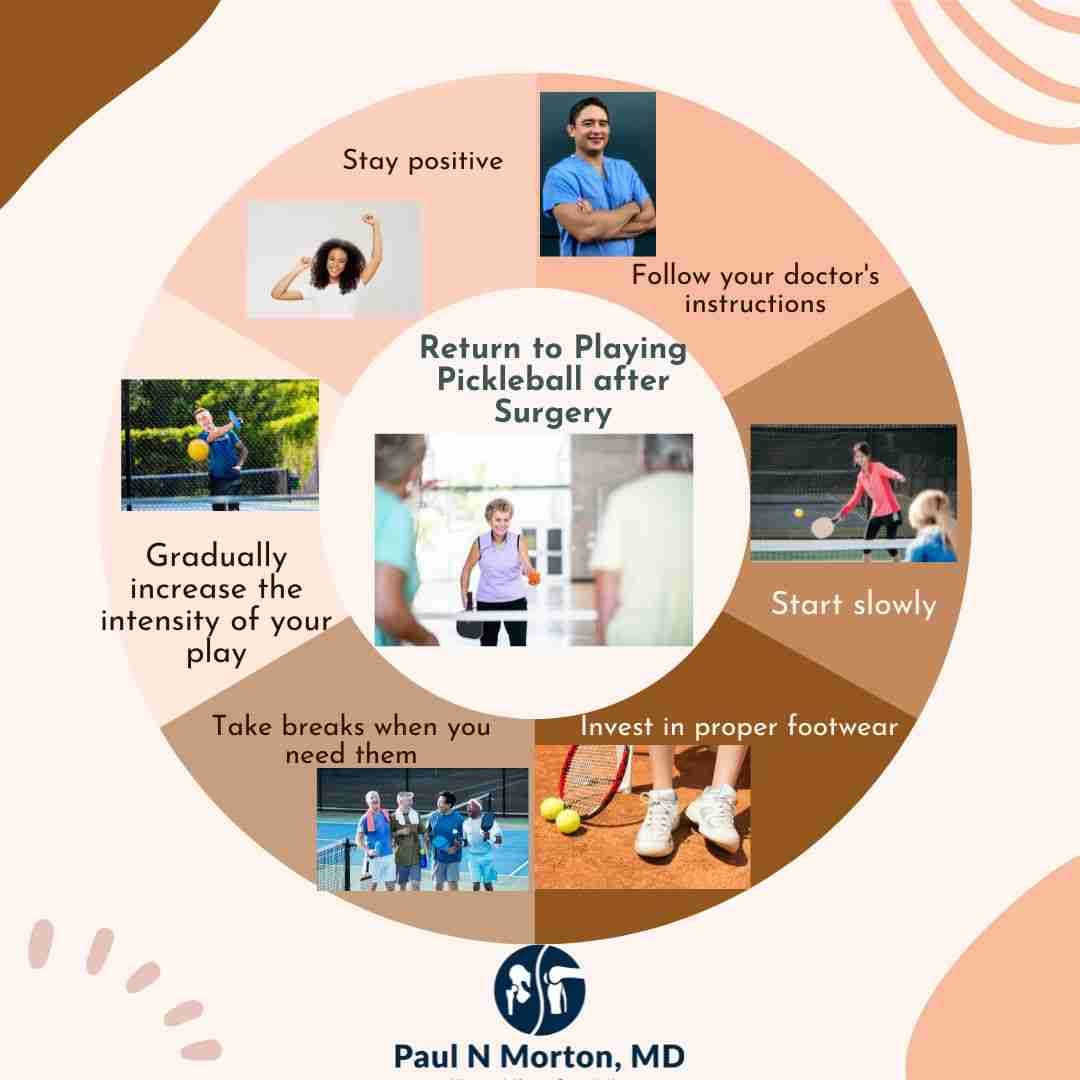
Six tips for a safe return to the court
- Follow your surgeon's and therapist's instructions. Your recovery plan — including physical therapy to strengthen muscles and restore range of motion — exists for a reason. Your therapist can tell you when it is genuinely safe to return to activities like pickleball.
- Start slowly. Do not jump straight back to your pre-surgery level of play. Begin with lighter drills and gradually increase intensity and duration as strength and endurance return.
- Invest in proper footwear and support. Pickleball puts real strain on the joints, so protect yourself. Choose court shoes with good cushioning and stability, and consider a knee brace or wrap for added support.
- Take breaks when you need them. It is better to rest and come back stronger than to push through fatigue and risk a setback or injury.
- Increase intensity gradually. As your strength and endurance build, work up to more challenging drills, longer games, and eventually organized league play.
- Stay positive. Returning to sport after surgery is challenging. Focus on your progress, celebrate your achievements, and be patient with yourself.
How Dr. Morton helps patients get back in the game
Dr. Morton is a fellowship-trained hip and knee replacement surgeon, and return-to-activity goals — pickleball included — are part of the surgical plan from the very first consultation. He is certified on all four major surgical robots (ROSA, Mako, CORI, and VELYS), and precise, robotically assisted implant placement paired with rapid-recovery protocols is aimed at exactly this outcome: an active life after surgery.
Physical therapy is available at the Kunia and Honolulu clinics, and Dr. Morton sees patients in Honolulu, West O'ahu, Hilo, and Kona. If you are wondering whether your hip or knee is ready for the kitchen line — or whether joint pain is keeping you off the court in the first place — call (808) 439-6201.
Medically reviewed by Paul Norio Morton, MD, FAAOS, FAAHKS. Last reviewed: . This article is for education only and isn’t a substitute for an exam and personalized advice — schedule a consultation to discuss your situation.