
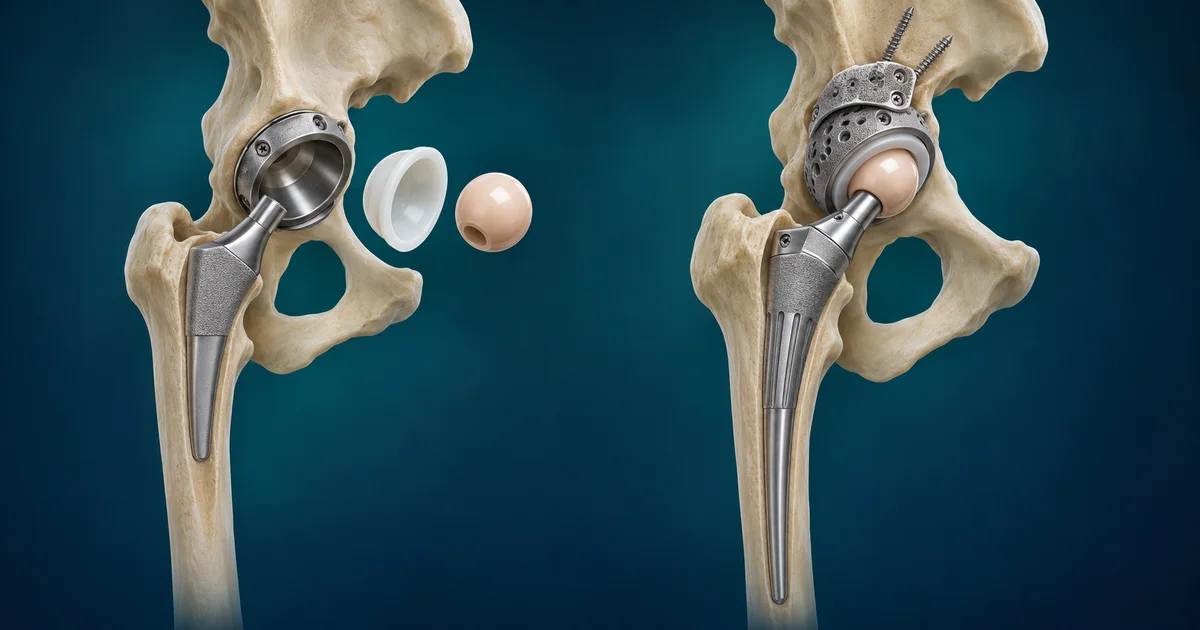
What does “just replacing the ball and liner” mean?
Most modern total hip replacements are modular. A metal cup is fixed in the pelvis, a liner locks or is cemented inside that cup, a stem is fixed in the femur, and a femoral head—the artificial ball—attaches to the stem. During an isolated head and liner exchange, the surgeon replaces the modular ball and liner while retaining the metal cup and femoral stem.
This is still revision hip surgery. The joint must be exposed, the bearing removed, the taper and locking mechanism inspected, fixation and position assessed, and infection considered. Retaining components can preserve bone and reduce the work of removing well-fixed implants, but a limited exchange is not automatically safer or more durable for every painful, worn, unstable, or recalled hip replacement.
When might a head and liner exchange be considered?
A limited exchange may be considered when the cup and stem are well fixed, acceptably positioned, structurally intact, and compatible with a safe modern bearing. The failure mechanism must also be one that exchanging modular parts can reasonably address. Examples may include selected cases of polyethylene wear, contained osteolysis around a stable cup, certain bearing-surface problems, or corrosion at the head-neck junction when the stem taper remains usable. In selected acute infection operations, modular parts may be exchanged as part of debridement; that is a separate infection strategy with different timing and candidacy rules.
Published results show why selection matters. A single-center comparative study found similar two-year rerevision-free survivorship after head-and-liner exchange and full acetabular revision in selected aseptic cases. That does not mean the operations are interchangeable. The retained cup must be stable, positioned appropriately, and suitable for the required liner and head.
When is cup or stem revision more likely to be necessary?
The acetabular cup is more likely to need revision when it is loose, malpositioned, damaged, incompatible with an appropriate liner, or surrounded by bone loss that threatens fixation. Cup revision may also be needed when the existing position contributes to impingement or instability, when the locking mechanism has failed, or when the implant has a poor track record that makes retention unwise.
The femoral stem may need revision when it is loose, fractured, severely corroded, malpositioned, incompatible with a safe new head, or associated with a fracture or major bone loss. Chronic infection often requires a broader strategy because bacteria can persist on retained implant surfaces. Some cases need only the cup revised, some only the stem, and others require both components plus bone graft, augments, specialized revision implants, or a staged reconstruction. The broader revision hip replacement guide explains that range.
Why component position and hip stability matter
Opening the hip and exchanging modular parts changes the scarred soft-tissue envelope and can increase instability risk. A larger head, offset liner, dual-mobility construct, or constrained liner may help in selected situations, but no bearing can reliably compensate for every malpositioned component, severe abductor deficiency, impingement pattern, or spine-pelvis problem.
In a retrospective cohort, a prior history of instability was strongly associated with dislocation after isolated head-and-liner exchange. Another modern series reported that dislocation remained an important complication and found cup position relevant to risk. A hip revised specifically for recurrent dislocation therefore needs a cause-based plan rather than an assumption that changing the ball or liner will solve the problem. See the separate guide to hip replacement dislocation.
What about polyethylene wear and osteolysis?
Older polyethylene can wear and generate particles that trigger bone loss around an otherwise painless implant. This process, called osteolysis, may be visible on surveillance X-rays before the cup or stem becomes loose. If the cup is truly well fixed and well positioned and the bone defects are manageable, replacing the worn liner and femoral head—sometimes with bone grafting—may preserve the shell.
But retention is not a benign default. Long-term studies report later rerevision, instability, and loosening in some patients. A long-term cohort found acceptable results when a well-fixed cup was retained, while also documenting dislocation and later rerevision. Another study of head-and-liner exchange linked extensive osteolysis with greater concern for later cup loosening. This is why implant surveillance and comparison with prior images matter.
What workup helps decide between limited and full revision?
The decision starts with the symptom pattern, examination, current and prior X-rays, and the original operative report and implant stickers. Surgeons assess whether the cup and stem have moved, whether radiolucent lines or bone loss suggest loosening, whether the hip impinges, and whether the abductors and other stabilizing tissues function. CT can help define component orientation and three-dimensional bone loss. Metal-artifact-reduction MRI and metal-ion testing may be useful when soft-tissue injury or corrosion is suspected.
Infection must be considered before an aseptic revision plan is finalized. Depending on the presentation, evaluation may include inflammatory blood tests and hip aspiration for cell count and cultures. Sudden severe pain after trauma also requires assessment for fracture. The painful hip replacement guide explains why a symptom is not a diagnosis and why replacing parts without identifying the failure mechanism can leave the real problem untreated.
Can the plan change during surgery?
Yes. Imaging can suggest that a component is fixed, but the definitive assessment may occur after exposure and direct testing. The surgeon may discover a damaged locking mechanism, an unavailable or incompatible liner, unexpected corrosion, a compromised stem taper, larger bone defects, soft-tissue damage, or component motion. Those findings can make cup or stem revision safer than retaining the implant.
Before surgery, ask what findings would trigger a larger reconstruction and whether the consent, instruments, compatible bearings, revision cups, stems, augments, graft, and stability options will be available. Planning for both a limited exchange and component revision is not uncertainty for its own sake; it is a safeguard when the final answer depends on direct implant and tissue assessment.
Is recovery always easier after a limited exchange?
Retaining well-fixed components may shorten the operation, preserve bone, and avoid the risks of extracting a cup or stem. Some patients therefore have a recovery closer to a primary hip replacement. However, recovery still depends on the indication, surgical approach, tissue damage, infection status, precautions, preoperative strength, and complications. A smaller implant change does not guarantee less pain, faster recovery, or a lower chance of another operation.
Component revision may require protected weight bearing while bone heals, especially when major bone loss, fracture, graft, or complex fixation is involved. Its advantage is the ability to correct problems that a modular exchange cannot fix. For a broader framework, see recovery after revision joint replacement.
Questions to ask at a revision hip consultation
- What is the leading diagnosis, and what alternatives still need to be excluded?
- Are the cup and stem well fixed and positioned appropriately for my anatomy and movement?
- Has infection been evaluated when indicated?
- Is the existing locking mechanism intact, and is a compatible modern liner available?
- Is the stem taper safe for a new femoral head?
- How much osteolysis or other bone loss is present?
- What is my instability risk, and are the abductor muscles and other stabilizers functional?
- What findings would change the operation from head-and-liner exchange to cup, stem, or full component revision?
- What reconstruction options will be available if the bone loss is worse than expected?
A strong revision plan explains both the preferred operation and its contingencies. The goal is not to retain components at any cost; it is to preserve safe, useful implants while correcting every important cause of failure.
The bottom line
Exchanging only the femoral head and acetabular liner can be reasonable when the retained cup and stem are well fixed, appropriately positioned, compatible with a safe bearing, and not undermined by infection, severe corrosion, instability mechanics, or threatening bone loss. Loose, damaged, malpositioned, incompatible, or infected components often require a broader revision. If a hip replacement is painful, worn, unstable, or changing on surveillance imaging, schedule a revision-focused orthopedic evaluation rather than assuming the smallest operation is the best operation.
Sources and further reading
- Head-and-liner exchange versus full acetabular component revision (2022)
- Prior instability and dislocation after isolated head-and-liner exchange (2022)
- Long-term outcomes after retention of the acetabular component (2023)
- Long-term success and failure after polyethylene liner and head exchange (2019)
- Review: isolated head and liner exchange in revision hip arthroplasty (2017)
Medically reviewed by Paul Norio Morton, MD, FAAOS, FAAHKS. Last reviewed: . This article is for education only and isn’t a substitute for an exam and personalized advice — schedule a consultation to discuss your situation.