
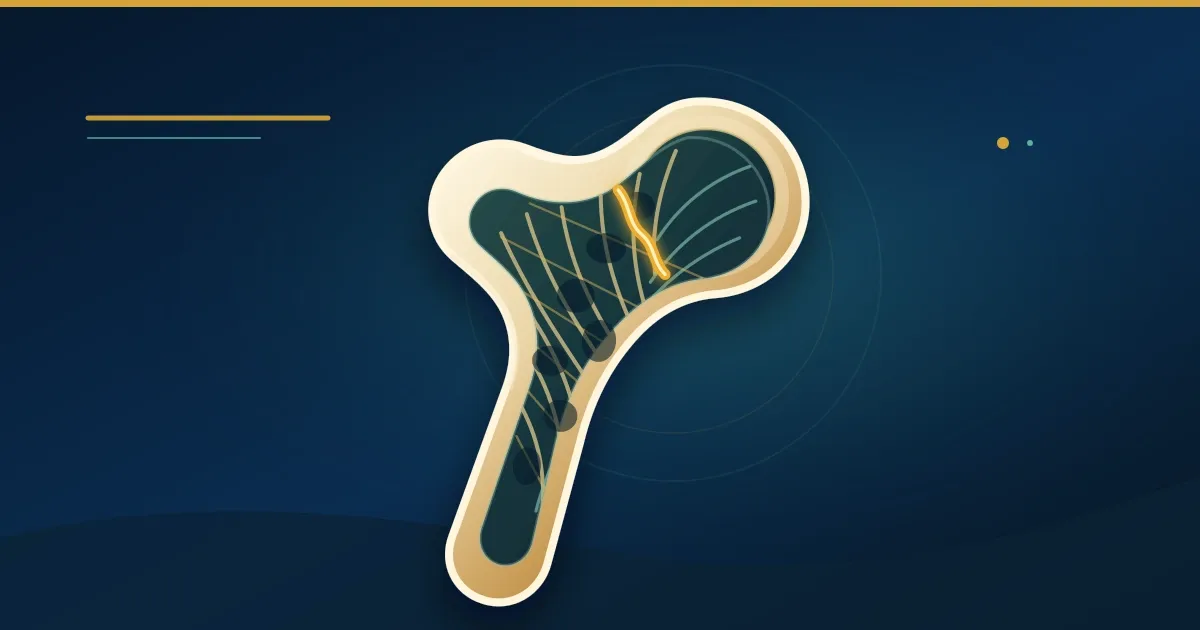
A common injury with serious consequences
Hip fractures are common but debilitating injuries — in the young and the elderly alike. In the United States, more than 300,000 people age 65 and older are hospitalized for a hip fracture every year, and hip fractures and the falls that cause them are a major risk factor for increased mortality in older patients.
Several factors predispose people to these fractures:
- Osteoporosis — weakened bone that can break from a simple fall, or even without one
- Frequent falls — from balance problems, medications, or hazards at home
- Frailty — reduced muscle strength and slower reflexes
- Malnutrition — bone and muscle can't stay strong without adequate protein, calcium, and vitamin D
Just as the causes vary, so do the treatments. The right option depends on the location and extent of the injury, your other medical conditions, and your goals — and an orthopedic surgeon's job is to guide you through that decision to your best possible outcome.
Hip anatomy: why the fracture's location decides so much
The hip is a ball-and-socket joint built for powerful movement — walking, running, jumping. The "socket" is a cup-shaped portion of the pelvic bone called the acetabulum. The "ball" is the upper end of the thigh bone, the femoral head. Just beneath the head is the narrow femoral neck, and below that are two bony prominences called the trochanters. The femoral head fits into the acetabulum and rotates freely, giving the hip its full range of motion — and a fracture can occur at any of these locations.
Two anatomic facts complicate hip fractures:
- Blood supply. Some areas of the hip are much better vascularized than others. Without an adequate blood supply, a broken bone cannot heal — which is why fractures near the femoral head are treated so differently from fractures lower down.
- Muscle pull. Powerful muscles attach to the upper femur, and they can pull on the fragments of a fractured hip, displacing the break and making it unstable.
The main types of hip fracture
Surgeons categorize hip fractures by location, because location largely decides the treatment. Most hip fractures fall into one of three zones of the upper femur:
| Fracture type | Where it is | Usual treatment |
|---|---|---|
| Intracapsular (femoral head and neck) | Inside the joint capsule, where the blood supply is vulnerable | Screws if non-displaced or in younger patients; partial or total hip replacement if displaced |
| Intertrochanteric | Through the broad bone between the two trochanters | Cephalomedullary nail or sliding hip screw |
| Subtrochanteric | Below the trochanters, in the upper shaft | Intramedullary nail, sometimes combined with screws or a plate |
An intracapsular fracture breaks the femoral head or neck within the joint capsule — the envelope that contains the joint's lubricating fluid — where the break can cut off circulation to the femoral head. An intertrochanteric fracture occurs lower, through well-vascularized bone that usually heals reliably once stabilized. Fractures can also occur in the acetabulum or the shaft below, but these patterns account for the great majority of broken hips.
That difference in blood supply matters. An intertrochanteric fracture usually heals well once fixed. A displaced femoral neck fracture often cannot be trusted to heal, because the femoral head may lose its circulation — the same problem seen in avascular necrosis. Understanding which fracture you have is the first step in understanding your options.
How hip fractures happen
Over 95% of hip fractures in older adults in the U.S. are caused by falls, and certain fracture patterns tend to follow certain mechanisms. In older adults, a femoral neck fracture typically follows a direct fall onto the side of the hip, a twisting injury, or the sudden completion of a gradual insufficiency fracture — bone weakened by osteoporosis that finally gives way. Intertrochanteric fractures in older adults follow the same kinds of falls.
In younger patients, both fracture types usually require high-energy trauma, such as a motor vehicle collision. That distinction matters for care: a young person with a broken hip may have other associated injuries the surgical team needs to identify and address, which is one reason hip fractures in the young are evaluated as trauma, not just as an isolated broken bone.
Fixation or replacement: how the decision is made
The short version: intertrochanteric fractures are usually fixed, and displaced femoral neck fractures are usually replaced.
Fixation means stabilizing your own bone so it can heal — with screws, a sliding hip screw, or a rod placed down the center of the femur (a cephalomedullary nail). It's the standard for intertrochanteric fractures and for femoral neck fractures that are non-displaced or occur in younger patients, where saving the natural hip is the priority. Compared with replacement, fixation with screws involves less blood loss and a lower wound-infection risk — but it also carries a meaningfully higher chance of needing another operation if the bone fails to heal.
Replacement is chosen when the fracture is displaced or unstable, when it occurred through osteoporotic or insufficient bone, or whenever the femoral head's blood supply is unreliable. The evidence for this is strong: older patients treated with hip replacement after a displaced femoral neck fracture report better function scores, greater satisfaction, and less pain than those treated with internal fixation. In one study, only 11% of patients treated with replacement needed repeat surgery, compared with 40% of those treated with fixation.
Replacement comes in two forms. A partial replacement (hemiarthroplasty) replaces only the ball and suits patients with lower activity demands. Active, independent patients with a displaced femoral neck fracture often do better with a total hip replacement, which resurfaces the socket too and delivers more reliable long-term comfort — including younger, fit patients who need a reconstruction that supports a higher level of activity for a longer time. The traditional trade-off is that replacement after a fracture carries a higher dislocation risk than elective replacement, a real concern in frail patients for whom another fall can be devastating. That is one reason technique matters: when replacement is the right call, Dr. Morton can often use the same muscle-sparing anterior approach he uses for elective hips, which is associated with lower dislocation risk.
The fixation toolkit: nails, screws, and plates
When fixation is the right treatment, the implant is matched to the fracture:
- Intramedullary (cephalomedullary) nail — a long rod placed into the marrow canal of the femur to stabilize the fracture from the inside. For intertrochanteric and subtrochanteric fractures, studies suggest nails offer fewer revisions, slightly less pain, and greater mobility than sliding hip screws — though some data show a higher risk of malalignment, which is where surgical experience counts.
- Sliding hip screw — a screw-and-side-plate construct that compresses the fracture as the patient bears weight, increasing stability at the fracture site and promoting healing. For many intertrochanteric patterns, neither method is clearly superior; the choice depends on the specific fracture geometry.
- Screws alone — typically used for non-displaced femoral neck fractures, and in young patients as an attempt to preserve the natural hip and avoid replacement.
- Plates — thin metal implants secured with screws along the bone surface, used for some subtrochanteric and complex patterns. Subtrochanteric fractures sometimes require a nail and screws together.
Ultimately the surgeon selects the construct that best fits the fracture's location and stability — which is why training across the full toolkit, rather than a single favorite implant, protects patients.
Why hip fractures are urgent
Hip fracture surgery is one of the few orthopedic operations where sooner is clearly better. Most centers aim to operate within a day or two of injury, because lying immobile with a broken hip raises the risk of pneumonia, blood clots, pressure injuries, and loss of independence. Early surgery means earlier pain relief, earlier walking, and a better shot at returning to your own home rather than a facility.
Urgency doesn't mean rushing the decision. The fracture pattern is studied on X-rays — and occasionally CT or MRI for subtle breaks — medical issues are optimized quickly, and the operation chosen is the one that lets you put weight on the leg as soon as possible. Older patients benefit from team-based care — hospital physicians tune up heart, lung, and medication issues while the surgical team plans the fracture repair, so surgery happens both quickly and safely. Getting the first operation right matters enormously: a failed fixation or a dislocating partial replacement means revision surgery that is harder on every front.
When surgery isn't the answer
A small group of patients with hip fractures are better served without an operation. Non-operative management is reserved for those who would be harmed more by surgery than helped by it:
- Patients who were not walking before the injury
- Patients with severe dementia who have minimal pain from the fracture
- Medically unstable patients with multiple serious conditions who cannot safely undergo anesthesia
- Patients nearing the end of a terminal illness, where comfort is the priority
Even then, the decision is made deliberately, with the patient and family, weighing pain control, mobility, and goals of care.
Trained for both sides of the decision
Few surgeons are fellowship-trained in both fracture surgery and hip replacement. Dr. Morton completed an AO Trauma fellowship at Charité in Berlin — one of Europe's leading trauma centers — alongside his adult reconstruction (hip and knee) fellowship at the University of Chicago. He takes trauma call at The Queen's Medical Center and hospitals across O‘ahu, treating hip fractures with the full toolkit: modern nailing techniques, hemiarthroplasty, and total hip replacement.
That training means the recommendation you get isn't limited by what the surgeon is comfortable doing. If your fracture needs fixation, it's fixed well. If it needs a replacement, you get one performed by a surgeon who replaces hips every week.
Recovery — and preventing the next fracture
Recovery starts almost immediately. Most patients are helped out of bed the day after surgery, bearing weight as tolerated with a walker, and progress through structured physical therapy over the following weeks. Pain is managed with an opioid-sparing multimodal approach, and good protein intake and nutrition measurably support healing in older adults — remember that malnutrition is one of the factors that predisposes to fracture in the first place.
Just as important: a hip that breaks from a simple fall is a warning sign. Dr. Morton's protocol includes a bone-health evaluation — bone density testing, vitamin D and calcium review, and coordination with your physician on osteoporosis treatment — plus practical fall-prevention steps at home. Simple changes — clearing trip hazards, adding grab bars and night lighting, reviewing medications that cause dizziness — meaningfully cut the risk of another fall. Treating the fracture without treating the bone leaves the other hip at risk. If you or a family member is recovering from a hip fracture, or you want a plan to protect fragile bones, schedule a consultation.

Medically reviewed by Paul N. Morton, MD, FAAOS, FAAHKS — board-certified orthopedic surgeon, fellowship-trained in adult hip & knee reconstruction and orthopedic trauma.
This page is for education only and isn’t a substitute for an exam and personalized advice — schedule a consultation to discuss your situation.