
What is knee arthroscopy?
Knee arthroscopy — the "knee scope" — is one of the most common minimally invasive procedures in orthopedic surgery, and the name says exactly what it is. Arthro comes from the Greek arthron, meaning joint; -scopy comes from a Greek root meaning to look or watch. In knee arthroscopy, the surgeon literally looks inside the joint.
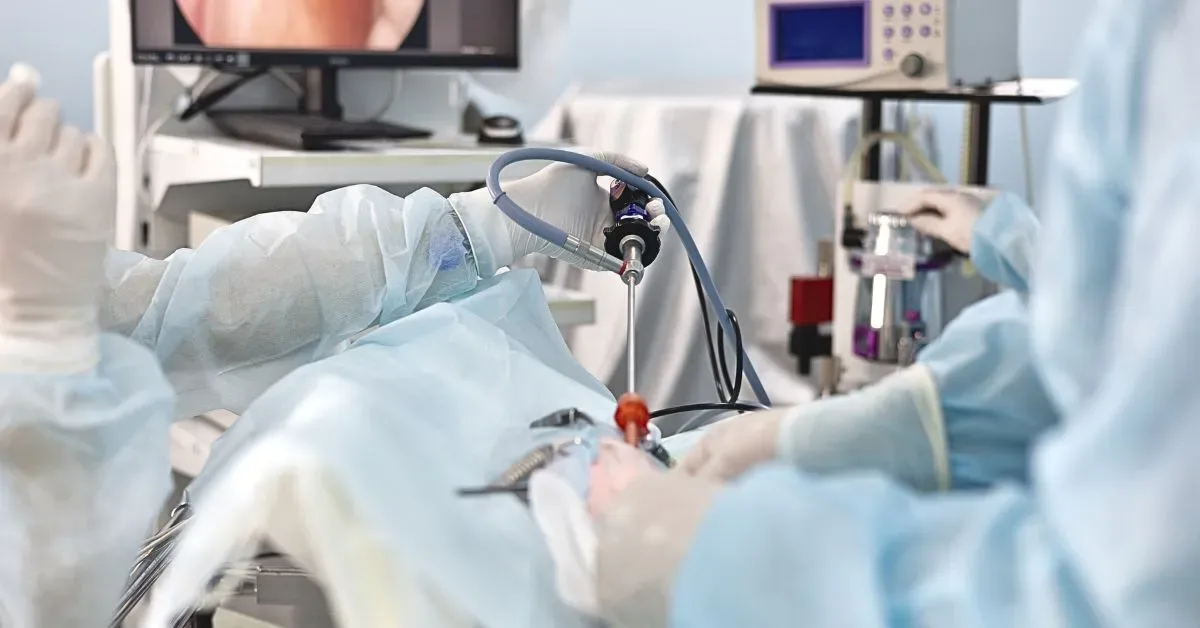
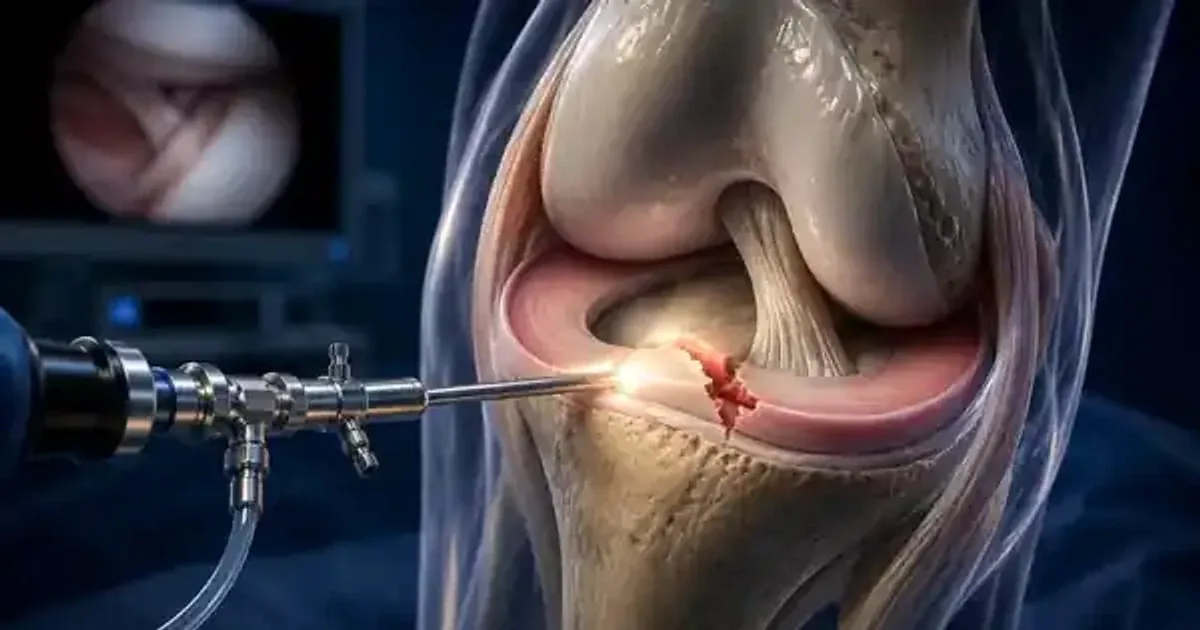
Through an incision about a centimeter or less — the size of a buttonhole — a long, thin, tube-shaped camera with a lens at its tip enters the knee. Sterile fluid gently expands the joint so every compartment can be examined in high definition on a screen — the menisci, the cartilage surfaces, the ligaments — before anything is treated. When there is work to do, a second equally small portal admits the working instruments: trimming and shaving tools that remove torn tissue, or suture instruments that repair damaged structures such as the meniscus. There is no open incision, no muscle is cut, and there is no hospital stay — you go home the same day.
Photos from inside your knee become part of your record, so you can see exactly what was found and what was done. Dr. Morton uses arthroscopy for specific, fixable problems inside the knee. It is a superb tool for the right diagnosis and the wrong tool for others — and you deserve to know which is which before anyone schedules you for surgery. That honesty is the starting point for every arthroscopy conversation in this practice.
What a knee scope treats well
Arthroscopy shines when there is a discrete mechanical problem: a torn meniscus that catches or locks the knee, a loose fragment of cartilage or bone floating in the joint, or a focal cartilage injury in an otherwise healthy knee. It is also the platform for ligament surgery — ACL reconstruction is performed arthroscopically.
Inside the joint, the scope works in two modes. Some tissue is removed because it will never heal: a hopelessly frayed meniscus fragment, inflamed joint lining (synovitis), unstable cartilage flaps, loose bodies. Other tissue is repaired because it can: a torn meniscus is sutured, a ligament is reconstructed, a poorly tracking kneecap is addressed, an infected joint is washed out. Knowing which mode your knee needs is the heart of the surgical plan.
For meniscus tears, Dr. Morton repairs rather than removes whenever the tear pattern and blood supply allow, because a preserved meniscus protects your cartilage for decades. Learn more about meniscus repair surgery in Honolulu.
For focal cartilage injuries, options range from smoothing unstable flaps to procedures that stimulate or restore cartilage within a defined defect — a very different situation from the diffuse wear of arthritis, and one where a scope genuinely earns its place.
Occasionally, arthroscopy answers a question imaging cannot. X-rays and CT scans do not capture the fine detail of cartilage damage, and when the story your knee tells on examination disagrees with the pictures, looking directly inside settles it. Even then, an MRI comes first — surgery should confirm a diagnosis you already trust, not go hunting for one.
- Meniscus tears — repaired when possible, trimmed when necessary
- Loose bodies: floating fragments of cartilage or bone
- Focal cartilage injuries in otherwise healthy knees
- Ligament reconstruction, including ACL surgery
- Inflamed joint lining (synovitis) that has failed conservative care
- Kneecap tracking problems, in carefully selected knees
- Joint infections that need washing out
- Selected cases where exam and imaging disagree
What a scope won't fix: arthritis
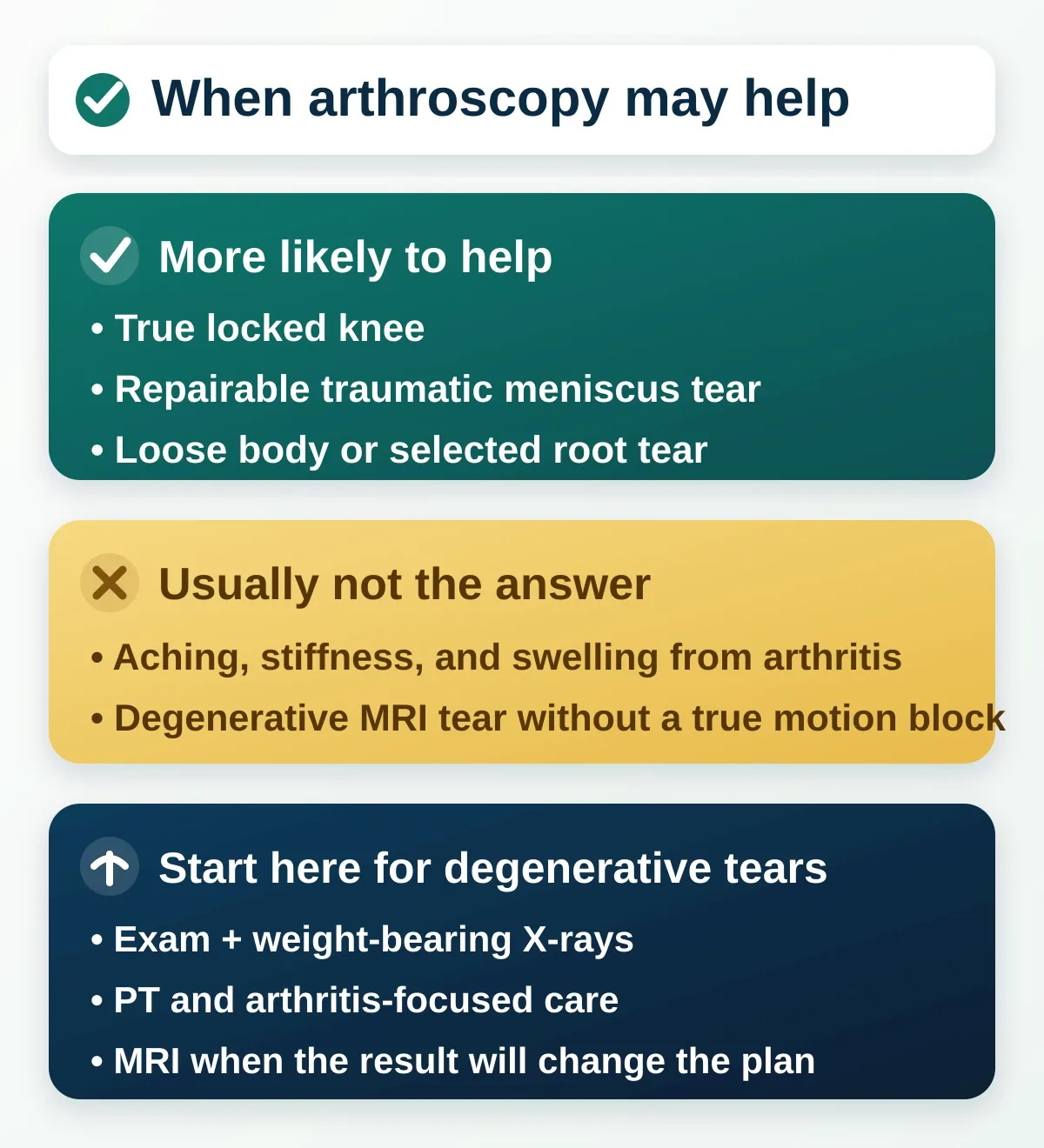
Here is the honest part. Multiple high-quality randomized trials have shown that arthroscopic "clean-up" surgery does not provide lasting relief when the underlying problem is arthritis. Worn cartilage does not regrow because debris was rinsed out — for most arthritic knees, a scope adds surgical risk without durable benefit, and Dr. Morton will tell you that directly, even when it means not operating. That candor can save you months of recovering from a surgery that was never going to work.
There are exceptions — a knee truly locked by a displaced tear may still warrant arthroscopy — but they are exceptions. Arthritis has better options, from strengthening and injections among the alternatives to knee replacement to a partial or total knee replacement when the joint is genuinely worn out. If your knee damage is too severe for a scope, that is the conversation you deserve to have — not another clean-up.
Preparing for knee arthroscopy
Good outcomes begin before the operating room. After your consultation, Dr. Morton may order additional tests, and he will often ask your primary care physician to assess your overall health and tune up any chronic conditions before surgery. Those small investments are a large part of why complication rates stay low.
Blood sugar is a good example. Patients with diabetes carry a higher risk of infection after any operation, so confirming good control before surgery — sometimes with a simple lab test — meaningfully protects your result.
Because arthroscopy is outpatient surgery, the rest of the preparation is refreshingly simple. You will receive specific instructions on when to stop eating and drinking, which medications to take or hold, and what to expect on the day itself.
- Health check with your primary care physician — chronic conditions optimized before surgery
- Diabetes control confirmed — good blood sugar significantly lowers infection risk
- Clear fasting instructions: when to stop eating and drinking
- Medication review: what to take and what to hold
- A ride home arranged — you will not drive on surgery day
Surgery day and recovery
Knee arthroscopy is same-day surgery under general or regional anesthesia, often taking under an hour. Expect one to two hours in the recovery room afterward; then a loved one drives you home. Local anesthetic placed during surgery often lasts several hours — sometimes overnight — and anti-inflammatory medication handles most of what remains. Every case is paired with opioid-sparing multimodal pain control, so narcotics play a minimal role, if any. Ice and elevation keep swelling down for the first few days.
You walk the day of surgery. Some patients use crutches briefly for comfort or until cleared for full weight bearing, and meniscus repairs need a period of protected weight bearing while the tissue heals — biology cannot be rushed.
| Milestone | Typical timing after a simple scope |
|---|---|
| Recovery room | 1–2 hours, then home with a driver |
| Walking | Day of surgery |
| Desk work | Often within days |
| Driving | Usually 1–3 weeks, once off pain medication and cleared |
| Low-impact exercise | Within weeks |
| Complete recovery | Often 6–8 weeks; repairs and reconstructions take longer |
Recovery depends on what was done inside. After a simple trim or loose-body removal, the timeline above is typical; a meniscus repair or ligament reconstruction runs longer, on a structured rehabilitation schedule you will know before surgery. Physical therapy is available through the practice's Honolulu and Kunia locations, so strength and motion rebuild on a plan matched to your procedure.
You will go home with simple dressings, a plan for icing and elevation, and clear instructions on when to start moving. Most patients are surprised by how quickly the small portals heal — the work happens inside the joint, so the outside has very little to recover from.
Risks — and why they stay low
Knee arthroscopy carries the risks of any surgery — infection, blood clots, stiffness, and bleeding into the joint — but the complication rates are very low. Small incisions, short operative times, and walking the same day all work in your favor.
Preparation is the other half of the equation. Optimizing chronic conditions such as diabetes before surgery is not paperwork for its own sake — it is how those low rates are maintained, patient by patient. You will also go home knowing exactly what warning signs to watch for, with a direct line to the office at (808) 439-6201 if anything seems off.
Straightforward pricing, with or without insurance
Arthroscopy is one of the most cost-effective procedures in orthopedics when performed at an outpatient surgery center, where facility fees run dramatically lower than at hospitals. Dr. Morton accepts most major insurance plans in Hawai‘i, and for patients paying out of pocket he offers a transparent, bundled self-pay knee arthroscopy package.
Not sure whether your knee needs a scope, an injection, or simply a plan? Start with an orthopedic consultation — bring your imaging if you have it, and you will leave with a clear diagnosis and your real options, surgical or not.
Medically reviewed by Paul N. Morton, MD, FAAOS, FAAHKS — board-certified orthopedic surgeon, fellowship-trained in adult hip & knee reconstruction and orthopedic trauma.
This page is for education only and isn’t a substitute for an exam and personalized advice — schedule a consultation to discuss your situation.